
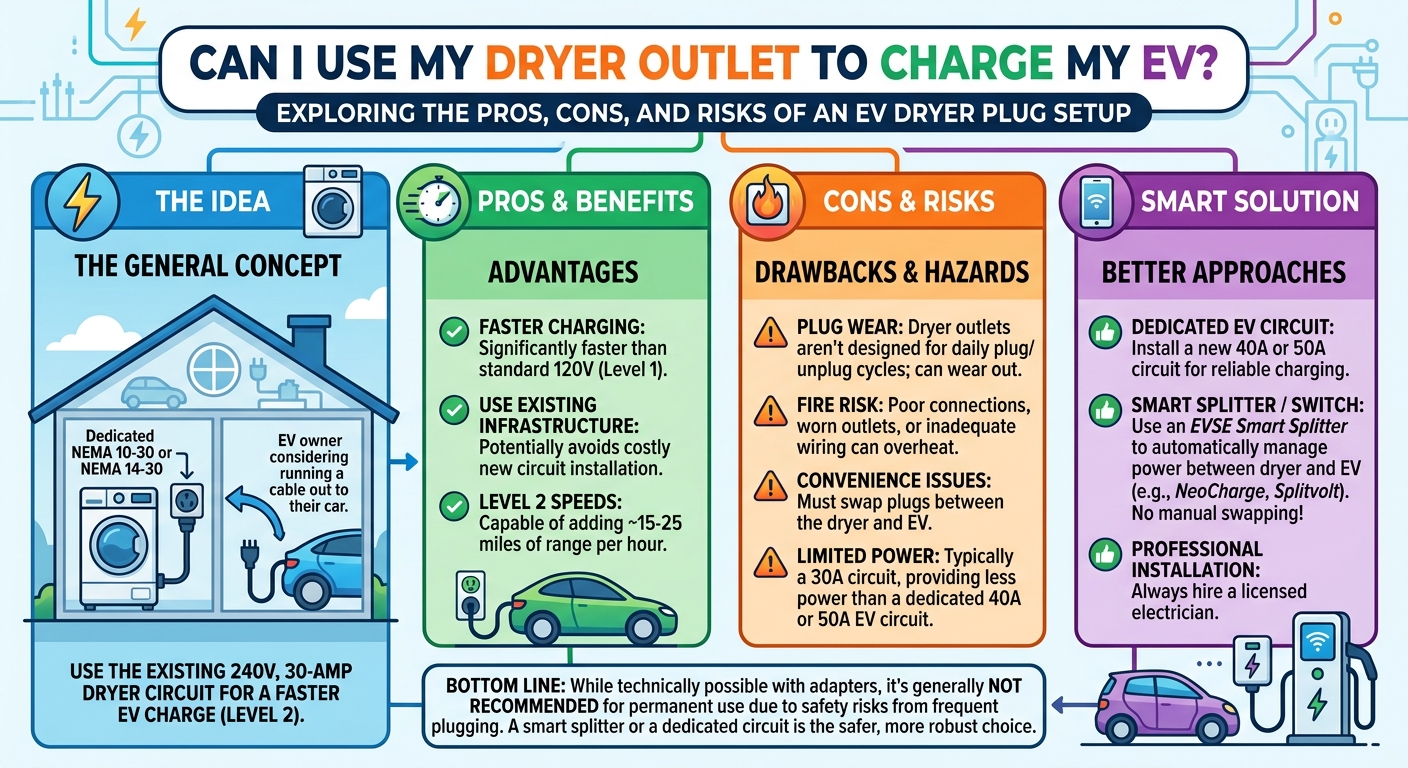
With the rapid rise of electric vehicle (EV) adoption, new EV owners often look for cost-effective ways to set up Level 2 home charging without paying thousands of dollars for full electrical panel upgrades. One of the most common solutions is utilizing an existing 240-volt clothes dryer outlet.
The short answer is yes, you can use your dryer outlet to charge an EV, and it serves as a highly effective Level 2 charging setup that adds roughly 15 to 22 miles of range per hour.
However, because residential dryer circuits were originally designed for intermittent appliance use rather than the heavy, continuous electrical loads demanded by an electric vehicle, you must adhere to strict safety protocols, electrical codes, and proper hardware selection to prevent thermal hazards, breaker trips, or code violations.
For more technical breakdowns and home charging setup recommendations, visit EV Charger Advisor.
Understanding Dryer Circuit Specs: NEMA 14-30 vs. NEMA 10-30
Before plugging in an EV charger, you must identify the exact type of 240V outlet installed in your home. Most dryer circuits are installed on a 30-Amp circuit breaker and feature one of two standard socket configurations:
1. NEMA 14-30 (Modern 4-Prong Outlet)
-
Standard: Installed in most residential homes built after 1996 in compliance with National Electrical Code (NEC) updates.
-
Wiring: Contains four conductors—two hot wires, one neutral wire, and a dedicated protective earth ground wire.
-
Safety Profile: Highly recommended for EV charging because the dedicated ground wire provides safe grounding path protection during long charging cycles.
2. NEMA 10-30 (Legacy 3-Prong Outlet)
-
Standard: Standard outlet type in homes constructed prior to 1996.
-
Wiring: Features three conductors—two hot wires and a shared neutral/ground wire.
-
Safety Profile: Requires extra caution because it lacks a separate grounding line. If you use a NEMA 10-30 outlet, you must ensure your EV charging cable is explicitly rated for 10-30 use or consult a certified electrician to verify grounding safety.
To learn more about how plug formats compare, check out our guide on EV charging types.
The 80% Continuous Load Rule: Why 24 Amps Is Your Max Limit
The most critical safety regulation governing EV charging on a dryer circuit is the National Electrical Code (NEC) 80% Rule.
Because electric vehicle charging draws steady, uninterrupted current for hours at a time, electrical codes classify EV charging as a continuous load. Electrical circuits carrying continuous loads must operate at no more than 80% of the breaker’s total rated capacity.
If you plug a $32\text{-Amp}$ or $40\text{-Amp}$ Level 2 EV charger into a $30\text{-Amp}$ dryer outlet, the circuit breaker will trip repeatedly, or worse, the wiring inside the wall can overheat, creating a fire hazard. You must use a charger capped at 24 Amps or manually dial down your vehicle’s charging limit to 24A.
Step-by-Step Mathematical Example: Calculating Dryer Outlet Charging Times
To see how charging on a 240V / 24A dryer circuit translates to real-world battery recovery, let us calculate the charging time for a vehicle with an 80 kWh battery pack (charging from 20% to 80% state of charge).
Given Parameters:
-
Total Energy Needed: $80 \text{ kWh} \times (0.80 – 0.20) = 48 \text{ kWh}$
-
Dryer Circuit Power Output (240V at 24A): $\frac{240\text{V} \times 24\text{A}}{1000} = 5.76 \text{ kW}$
-
Standard Level 1 Wall Outlet (120V at 12A): $1.44 \text{ kW}$
Calculation 1: Standard 120V Level 1 Charging
Calculation 2: 240V / 24A Dryer Outlet Charging
Result Breakdown: Using a 24A dryer outlet reduces full overnight charging from over 33 hours down to 8.3 hours, making it fully capable of replenishing daily commutes while you sleep.
Critical Safety Best Practices & Hardware Accessories
1. Avoid Frequent Plugging and Unplugging
Residential dryer receptacles are engineered for occasional plug insertions over a 10-to-15-year period. Swapping a plug daily between your dryer and EV charger wears down internal metal tension clips. Loose contacts create electrical resistance, generating extreme heat that can melt the outlet.
2. Install a Smart Splitter (Automatic Switch)
If your EV and clothes dryer share the same 30A outlet, do not use basic passive “Y-splitter” adapters, as both appliances could turn on at the same time and trip the breaker. Instead, install a UL-listed Smart Dryer Splitter. A smart splitter keeps both devices plugged in, automatically pausing EV charging whenever the dryer runs and resuming charging when the cycle finishes.
3. Ensure Commercial-Grade Outlet Construction
If your dryer outlet is old or feels loose when plugging in a cord, hire a licensed electrician to swap the wall socket with an industrial-grade NEMA 14-30 receptacle.
To explore dynamic energy management solutions for your home, explore our guide on smart chargers.
Comparison Table: Dryer Outlet vs. Other Home Charging Options
| Feature | Standard Wall Outlet (120V) | Dryer Outlet (240V / 24A) | Dedicated Hardwired Charger |
| Circuit Breaker | 15A / 20A (120V) | 30A (240V) | 50A / 60A (240V) |
| Max Safe Charging Current | 12A / 16A | 24 Amps | 40A / 48 Amps |
| Power Output (kW) | $1.4 \text{ kW} – 1.9 \text{ kW}$ | $5.7 \text{ kW}$ | $9.6 \text{ kW} – 11.5 \text{ kW}$ |
| Added Range per Hour | $3 – 5 \text{ miles}$ | $15 – 22 \text{ miles}$ | $30 – 45 \text{ miles}$ |
| Installation Cost | $0 | $0 – $400 (for Splitter) | $800 – $2,500+ |
Summary & Key Takeaways
-
Effective Level 2 Solution: A 240V dryer outlet delivers $5.76\text{ kW}$ of power, fully charging most EVs overnight in 8 to 9 hours.
-
24A Maximum Current Limit: Always cap EV charging at 24 Amps on a 30A circuit to comply with the 80% NEC continuous load rule.
-
Use Smart Splitters: Protect your home from electrical overloads by using automated smart splitters instead of manually swapping plugs.
-
Identify Outlet Type: Prefer modern 4-prong NEMA 14-30 outlets over older 3-prong NEMA 10-30 sockets for optimal grounding protection.













Leave a Reply