
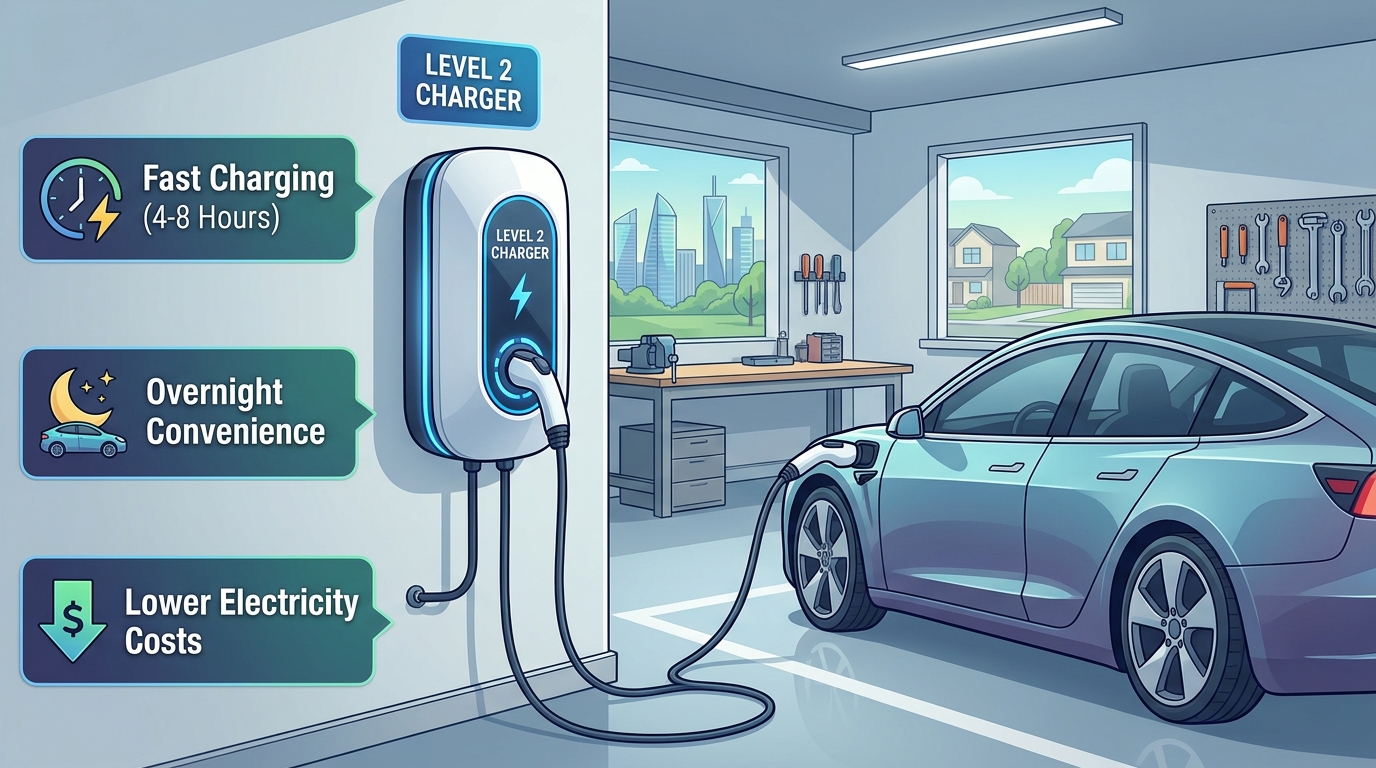
Upgrading to an electric vehicle (EV) reduces fuel dependency and lowers recurring transportation expenses. However, relying exclusively on standard 120-volt Level 1 trickle charging—which yields only 2 to 5 miles of range per hour—can result in long charge times for daily commuters. Installing a dedicated 240-volt Level 2 home charging station delivers 20 to 44 miles of range per hour, restoring a full battery overnight. Despite the clear speed advantage, homeowners evaluating hardware expenses and electrician labor often ask: Is installing a Level 2 EV charger worth it?
Installing a Level 2 EV charger at home is worth it for most daily EV drivers. Though whether it makes sense for you depends on your daily driving habits, home electrical capacity, and budget, the combination of convenience, speed, and electricity cost savings delivers a strong long-term return on investment (ROI).
Under National Electrical Code (NEC Article 625) standards, evaluating electrical panel capacity, continuous load rules, and smart utility scheduling ensures your investment provides maximum safety, convenience, and financial efficiency.
For complete hardware reviews, installer guides, and panel load calculators, visit EV Charger Advisor.
1. The Core Benefits: Why Level 2 Charging Is Worth the Investment
Upgrading to Level 2 home charging delivers major operational and financial benefits compared to standard outlet trickle charging or public charging networks:
A. Massive Time Savings & Daily Recovery
-
Level 1 (120V Outlet): Adds 2 to 5 miles per hour. Recharging a depleted 60 kWh battery takes 40 to 50+ hours, making it impractical for drivers covering moderate or long daily distances.
-
Level 2 (240V Wallbox): Adds 20 to 44 miles per hour. Recharging the same 60 kWh battery takes 4 to 8 hours, allowing you to wake up to a 100% full battery every morning.
B. Lower Fueling Costs vs. Public Commercial Stations
-
Public Fast Chargers: Charging at commercial public stations typically costs 2x to 4x more per kWh than residential electricity rates due to operator markups and demand tariffs.
-
Home Time-of-Use (TOU) Rates: Smart Level 2 wallboxes allow you to schedule automated charging during off-peak overnight hours when utility rates are lowest. Over 20,000 miles of driving per year, home Level 2 charging can save drivers $800 to $1,500+ annually compared to public stations or gasoline.
C. Property Value & EV Readiness
-
Home Resale Appeal: Installing a dedicated 240V Level 2 charging station increases residential property value and creates a strong selling point for future home buyers owning electric vehicles.
To learn more about how charger power levels and wire sizes compare, check out our guide on EV charging types.
2. Cost Breakdown & ROI Calculation
Evaluating whether a Level 2 charger makes financial sense requires comparing upfront setup costs against ongoing savings:
LEVEL 2 CHARGER COST VS. SAVINGS MATRIX:
[Upfront Investment]                                [Annual Financial Returns]
 • Hardware Wallbox: $350 – $750                     • Public Charging Savings: $600 – $1,200 / Year
 • Electrician Labor & Wire: $450 – $1,200           • TOU Off-Peak Savings: $200 – $400 / Year
 • Total Investment: $800 – $2,000                   • Gas Fuel Savings: $1,000 – $1,800 / Year
                                                                │
                                                                ▼
                                                    [Typical Payback Period: 1.5 to 3 Years]
A. Total Installed Cost Range
-
Hardware Unit (EVSE): $350 – $750 for a quality 32A to 48A smart wallbox.
-
Installation & Circuit Wiring: $450 – $1,200 for a standard garage installation requiring dedicated 240V circuit breakers (40A or 60A) and heavy copper wire (#8 or #6 AWG) under NEC Article 625.
-
Typical Total Investment: $800 to $2,000 for a basic to moderate setup.
B. Payback Period
-
For drivers traveling 30+ miles daily (10,000+ miles per year), electricity savings from off-peak home charging completely offset the upfront $1,000–$1,500 installation cost in 18 to 36 months.
To explore Wi-Fi-enabled smart wallboxes engineered with integrated load management features, read our guide on smart chargers.
3. Decision Matrix: Is Level 2 Right for You?
Not every driver requires a Level 2 wallbox immediately. Use this simple guide to decide:
A. Level 2 IS Worth It If You:
-
Drive more than 30 to 40 miles per day.
-
Own a pure Battery Electric Vehicle (BEV) with a large 60 kWh–100 kWh battery pack.
-
Live in a multi-EV household where two cars share charging access.
-
Want to take advantage of low off-peak overnight electricity tariffs.
B. Level 1 MAY BE Sufficient If You:
-
Drive less than 15 to 20 miles per day and can leave the car plugged in for 12+ hours overnight.
-
Own a Plug-In Hybrid Electric Vehicle (PHEV) with a small battery pack (under 15 kWh).
-
Live in a rental property or plan to move in the near future.
Comparison Table: Level 1 vs. Level 2 Charging Trade-Offs
| Evaluation Parameter | Level 1 (120V Outlet) | Level 2 (240V Dedicated Wallbox) |
| Charging Speed | 2 – 5 Miles Range / Hour | 20 – 44 Miles Range / Hour |
| Full Charge Time (60 kWh) | 40 – 50+ Hours | 4 – 8 Hours |
| Upfront Cost | $0 (Included with vehicle) | $800 – $2,000 (Hardware + Labor) |
| Electrical Circuit Needed | Standard 15A/20A 120V Outlet | Dedicated 40A–60A 240V Circuit |
| Smart Scheduling (TOU) | Rare | Standard (App-Controlled Off-Peak) |
| Overall Value / ROI | Low speed, high wait time | High ROI for daily commuters |
Summary & Key Takeaways
-
High ROI for Daily Commuters: For drivers covering 30+ miles per day, a Level 2 charger pays for itself in 1.5 to 3 years through off-peak electricity savings.
-
Unmatched Daily Convenience: Fully recharges battery packs overnight in 4 to 8 hours, eliminating range anxiety.
-
Smart Scheduling Cuts Bills: Wi-Fi smart wallboxes allow you to automate charging during off-peak hours to secure the lowest rates.
-
Adhere to NEC Code Rules: Continuous loads require circuit breakers and copper wire conductors (#6 or #8 AWG) sized to 125% of maximum continuous current.













Leave a Reply