
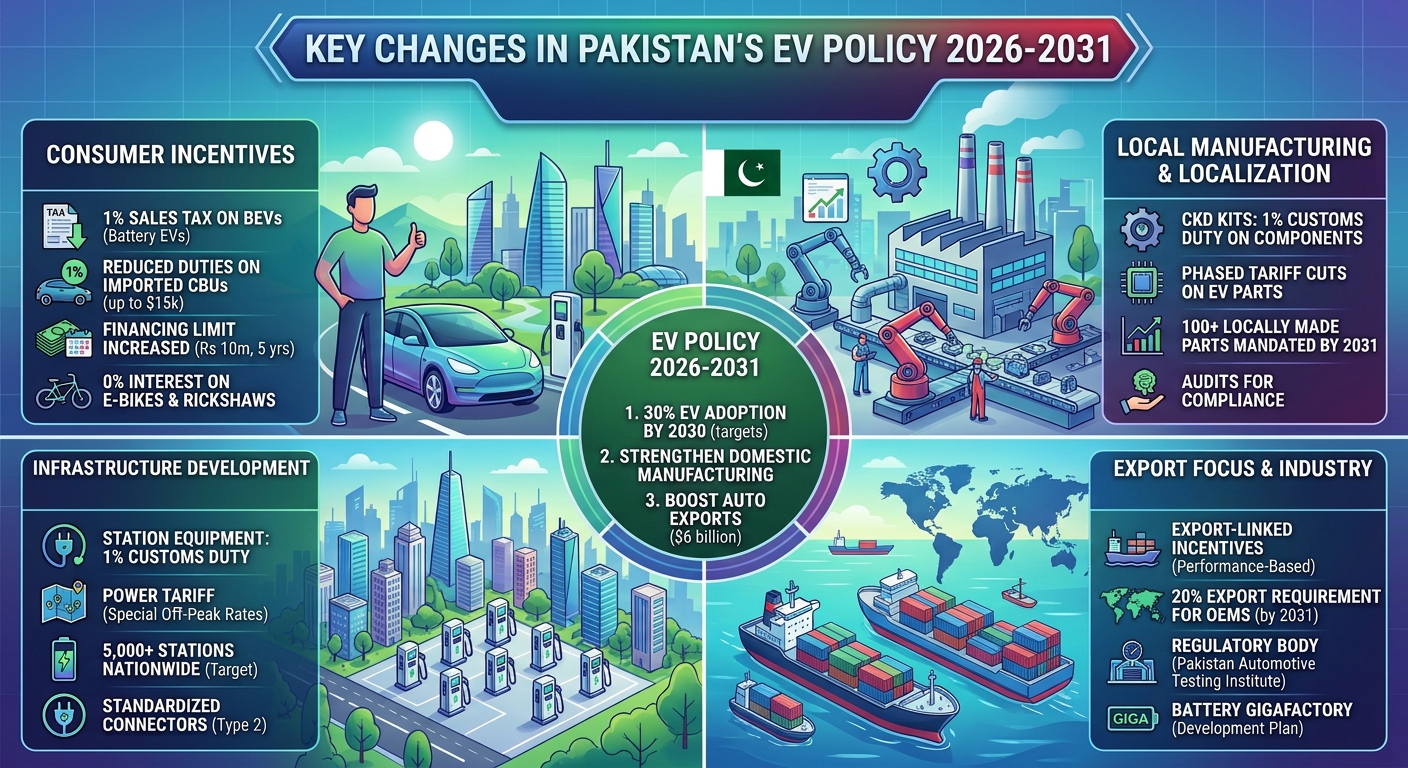
Pakistan’s electric vehicle (EV) policy updates are part of the broader Pakistan Auto Policy 2026–31, which replaces the previous framework that expired in June 2026. Drafted by the Engineering Development Board (EDB) and approved by high-level government committees, this five-year roadmap transitions the country toward higher electrification, localized manufacturing, and cleaner mobility targets.
The key changes focus on revised tax structures across EV powertrains, enhanced consumer financing terms, lower import tariffs for affordable compact EVs, and localized component manufacturing standards under National Electrical Code (NEC) and UNECE safety parameters.
Under NEC Article 625 standards and local energy guidelines, understanding these policy shifts enables consumers, fleet operators, and contractors to make informed hardware investments.
For complete hardware reviews, installer guides, and panel load calculators, visit EV Charger Advisor.
1. Differentiated Sales Tax & Duty Framework
The 2026–31 policy establishes a tiered sales tax model designed to incentivize pure battery electric vehicles while regulating hybrid technologies:
A. Battery Electric Vehicles (BEVs) — 1% Sales Tax
-
Tax Treatment: Pure battery electric vehicles retain a concessionary 1% sales tax rate (rejecting proposed increases to 18%).
-
High-Value Luxury Surcharge: EVs valued above $75,000 (CBU import value) face an additional 10% Federal Excise Duty (FED).
B. Range-Extended EVs (REEVs) & Plug-In Hybrids (PHEVs)
-
Range-Extended EVs (REEVs): Moving away from full EV tax parity, REEVs (vehicles using a small petrol engine solely to recharge the battery) are taxed at 6% sales tax.
-
Plug-In Hybrids (PHEVs): Sales tax on PHEVs drops significantly from previous 18%–25% tiers down to 9% sales tax, making plug-in hybrid crossovers far more accessible.
C. Affordable Compact EV Concessions
-
Import Tariff Cut: To bring budget EVs within reach of urban commuters, CBU electric cars priced below $15,000 carry a reduced 5% customs duty.
To learn more about how charger power levels and wire sizes compare, check out our guide on EV charging types.
2. Enhanced EV Financing & Infrastructure Expansion
To accelerate adoption among middle-class buyers and commercial operators, the policy introduces substantial credit and charging infrastructure support:
2026–31 EV POLICY INCENTIVE STRUCTURE:
[Auto Policy 2026–31 Framework]
              │
      ┌───────┴───────────────────────────────┬───────────────────────────────┐
      ▼                                       ▼                               ▼
[Financing Limits Extended]       [Infrastructure Investments]        [Consumer Protections]
 • Loan Limit: Raised to PKR 1 Crore • Grid & Charging Network Expansion • Mandatory Booking Price Locks
 • Loan Tenure: Extended to 5 Years   • Battery-as-a-Service Support     • UNECE Safety Compliance
-
State Bank Financing Limit Increase: The maximum Auto Financing loan cap for electric vehicles is raised from PKR 30 Lakh to PKR 1 Crore (PKR 10 Million), with maximum loan tenures extended from 3 years to 5 years.
-
Charging Infrastructure Incentives: Provides duty concessions on imported fast-charging hardware (DC fast chargers) and encourages battery-swapping networks to support two-wheeler and three-wheeler commercial fleets.
-
Consumer Booking Safeguards: Booking payments are capped at 20% of the vehicle’s ex-factory price with price-lock mechanisms enforced at booking to protect buyers from arbitrary price hikes during delivery waits.
To explore Wi-Fi-enabled smart wallboxes engineered with integrated load management features, read our guide on smart chargers.
3. Local Value Addition & Localization Targets
To build a sustainable domestic EV supply chain, the policy mandates progressive localization targets for manufacturers operating in Pakistan:
-
2-Wheeler & 3-Wheeler Localization: Reaches 85% domestic value addition by 2030, focusing heavily on local battery pack assembly, electric motors, and controller manufacturing.
-
CKD Kit Duties: Concessionary 1% customs duty applied on imported EV-specific parts and raw materials for local assembly plants to lower domestic production costs.
-
National Safety Alignment: Adopts 45 additional UNECE vehicle safety regulations and establishes the Pakistan Automotive Testing Institute to inspect both local assembled and imported vehicles.
Comparison Table: Sales Tax & Policy Breakdown by Powertrain
| Vehicle Powertrain Type | Previous Tax Structure | Policy 2026–31 Sales Tax Rate | Key Financial Impact |
| Battery Electric Vehicle (BEV) | 1% Sales Tax | 1% Sales Tax | Sustains low prices for pure EVs |
| Range-Extended EV (REEV) | ~1% Sales Tax | 6% Sales Tax | Slight tax increase for engine-generator models |
| Plug-In Hybrid (PHEV) | 18% – 25% Sales Tax | 9% Sales Tax | Major price reduction on PHEV crossovers |
| EVs Valued Above $75,000 | Standard Duties | 1% Tax + 10% FED | Luxury luxury surcharge applied |
| EV Financing Limit | Max PKR 30 Lakh | Up to PKR 1 Crore (5 Yrs) | Enables financing for full-sized EVs |
Summary & Key Takeaways
-
BEVs Retain 1% Sales Tax: Pure battery electric vehicles keep the lowest tax tier, while PHEVs drop to 9% and REEVs adjust to 6%.
-
Financing Raised to PKR 1 Crore: Loan limits for EVs increase substantially, allowing buyers to finance higher-spec electric vehicles over 5 years.
-
Sub-$15,000 EV Concessions: Entry-level urban EVs benefit from reduced 5% customs duties to drive mass adoption.
-
Localization & Safety Mandates: Strict domestic value addition targets (85% for two/three wheelers) ensure local industrial growth alongside international UNECE safety compliance.













Leave a Reply