
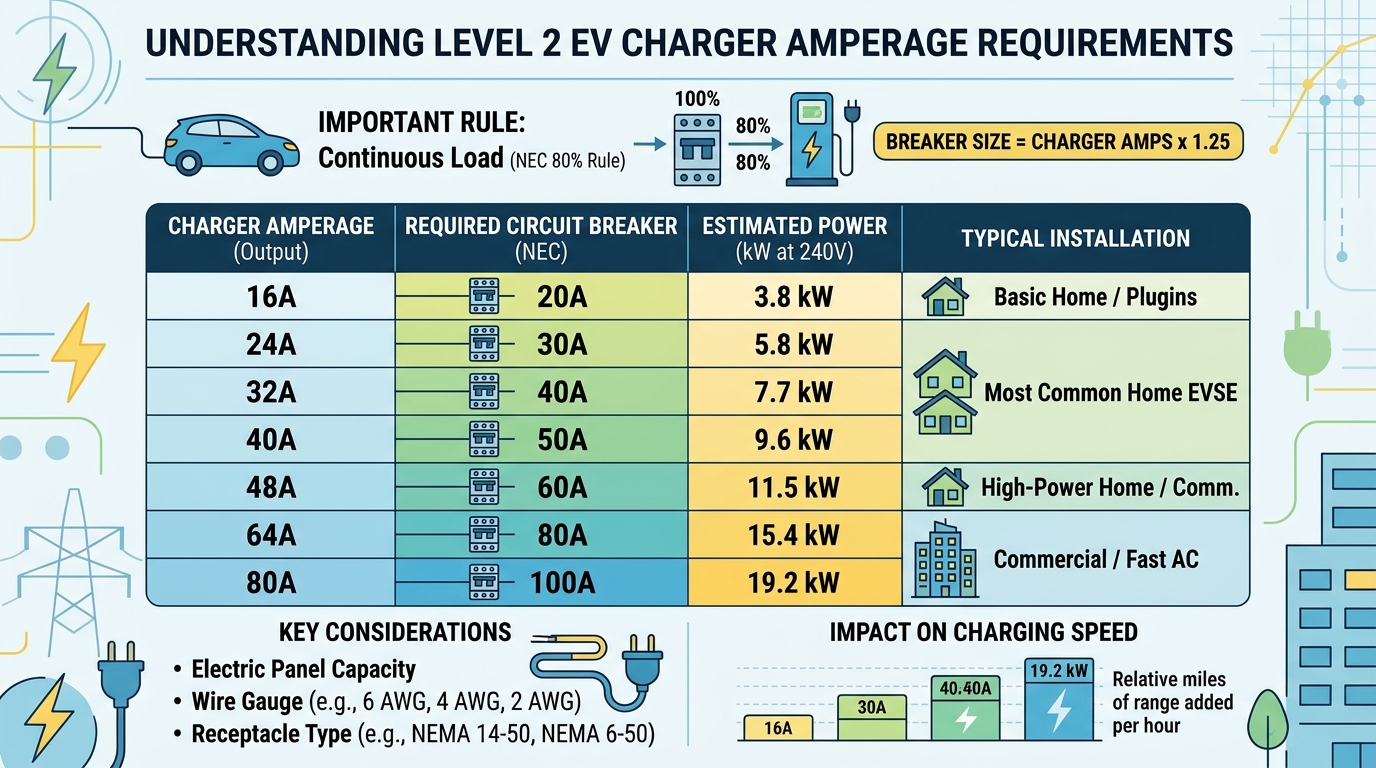
Upgrading residential electrical infrastructure for electric vehicle (EV) charging provides predictable, high-speed home refueling. Installing a Level 2 charging wallbox delivers 20 to 44 miles of driving range per hour over a dedicated 240-volt single-phase branch circuit. Because an EV charger draws maximum rated power non-stop for hours, determining the correct amperage is critical for balancing charging speed, wire conductor sizes, and circuit breaker ratings. Homeowners frequently ask: How many amps do I need for a Level 2 EV charger?
Most home Level 2 EV chargers require 32 to 48 Amps of continuous current, operating on a dedicated 240-volt circuit.
Under National Electrical Code (NEC Article 625) standards, applying the 125% continuous duty overcurrent rule dictates that a 32A to 48A charger must be backed by a 40-Amp to 60-Amp double-pole circuit breaker paired with properly rated copper conductors.
For complete hardware reviews, installer guides, and panel load calculators, visit EV Charger Advisor.
1. The NEC 125% Continuous Duty Sizing Rule
Understanding why an EV charger requires a higher circuit breaker rating than its operational amperage comes down to electrical heating mechanics:
NEC 125% CONTINUOUS LOAD SIZING FORMULA:
[Continuous Charging Amperage]  ×  1.25  =  [Required Circuit Breaker Sizing]

EXAMPLES:
• 32 Amps Continuous  ×  1.25  =  40-Amp Circuit Breaker
• 40 Amps Continuous  ×  1.25  =  50-Amp Circuit Breaker
• 48 Amps Continuous  ×  1.25  =  60-Amp Circuit Breaker
-
Continuous Load Classification (NEC 625.42): The NEC defines an EV charger as a continuous load because it operates at maximum current draw for three hours or longer.
-
Thermal Margin Protection: Running maximum current through breakers and conductors generates sustained heat. Oversizing the breaker and wiring by 25% ensures electrical components operate within safe thermal limits without nuisance trips or insulation melting.
To learn more about how charger power levels and wire sizes compare, check out our guide on EV charging types.
2. Common Level 2 Amperage Configurations & Wire Sizing
Selecting the appropriate amperage tier depends on vehicle capabilities, installation preferences, and main service panel headroom:
A. 32-Amp Level 2 Setup (7.68 kW Output)
-
Circuit Breaker Required: 40-Amp Double-Pole Breaker
-
Conductor Gauge: #8 AWG Copper Wire
-
Replenishment Speed: Adds 20 to 28 miles of range per hour
-
Best Suited For: Plug-in hybrids, smaller EVs, or homes with 100A main service panels. Available in plug-in or hardwired formats.
B. 40-Amp Level 2 Setup (9.60 kW Output)
-
Circuit Breaker Required: 50-Amp Double-Pole Breaker
-
Conductor Gauge: #6 AWG Copper Wire
-
Replenishment Speed: Adds 30 to 38 miles of range per hour
-
Connection Format: Standard limit for plug-in installations utilizing industrial NEMA 14-50 receptacles. Under NEC 625.54, plug-in receptacles require an upstream 240V GFCI breaker.
C. 48-Amp Level 2 Setup (11.52 kW Output – Recommended)
-
Circuit Breaker Required: 60-Amp Double-Pole Breaker
-
Conductor Gauge: #6 AWG Copper Wire (rated for $75^\circ\text{C}$ terminals)
-
Replenishment Speed: Adds 36 to 44 miles of range per hour
-
Connection Format: Hardwired Direct Connection. Pursuant to NEC 625.44, continuous currents exceeding 40 Amps cannot use wall outlets and must be permanently hardwired.
To explore Wi-Fi-enabled smart wallboxes engineered with integrated load management features, read our guide on smart chargers.
3. Main Panel Headroom & Dynamic Load Management
Adding a continuous 40A or 60A breaker requires calculating existing household electrical demand:
-
NEC Article 220 Panel Calculations: A licensed electrician evaluates total household loads (HVAC, water heaters, kitchen appliances) before connecting a dedicated EV circuit. Homes with standard 200A main panels typically accommodate a 60A circuit easily.
-
Older 100A Panels & EVEMS Solutions: On 100A main service panels, adding a 48A continuous load may cause service overload. Installing an Electric Vehicle Energy Management System (EVEMS) under NEC 625.42 enables dynamic current throttling, automatically adjusting charger power during peak house usage to bypass an expensive $2,500–$4,000 main service panel replacement.
Comparison Table: Level 2 Amperage & Circuit Specifications
| Continuous Amperage | Circuit Breaker Size | Power Output (240V) | Conductor Wire Gauge | Connection Method | Range Added / Hour |
| 16 Amps | 20A Breaker | 3.84 kW | #12 AWG Copper | Plug-in / Hardwired | 10 – 14 Miles |
| 24 Amps | 30A Breaker | 5.76 kW | #10 AWG Copper | Plug-in / Hardwired | 15 – 18 Miles |
| 32 Amps | 40A Breaker | 7.68 kW | #8 AWG Copper | Plug-in / Hardwired | 20 – 28 Miles |
| 40 Amps | 50A Breaker | 9.60 kW | #6 AWG Copper | NEMA 14-50 / Hardwired | 30 – 38 Miles |
| 48 Amps | 60A Breaker | 11.52 kW | #6 AWG Copper | Hardwired Only | 36 – 44 Miles |
Summary & Key Takeaways
-
32A to 48A Standard: Most home Level 2 chargers run on 32 to 48 Amps of continuous current over a 240V circuit.
-
Apply the 125% Breaker Rule: EV chargers are continuous loads requiring circuit breakers sized to 125% of charger amperage (e.g., 48A continuous requires a 60A breaker).
-
Hardwiring Unlocks Max Output: Continuous draws above 40A (such as 48A output) require direct hardwiring and #6 AWG copper wire.
-
Use EVEMS on 100A Panels: Deploying dynamic load management prevents main panel overloads without necessitating full service upgrades.













Leave a Reply