
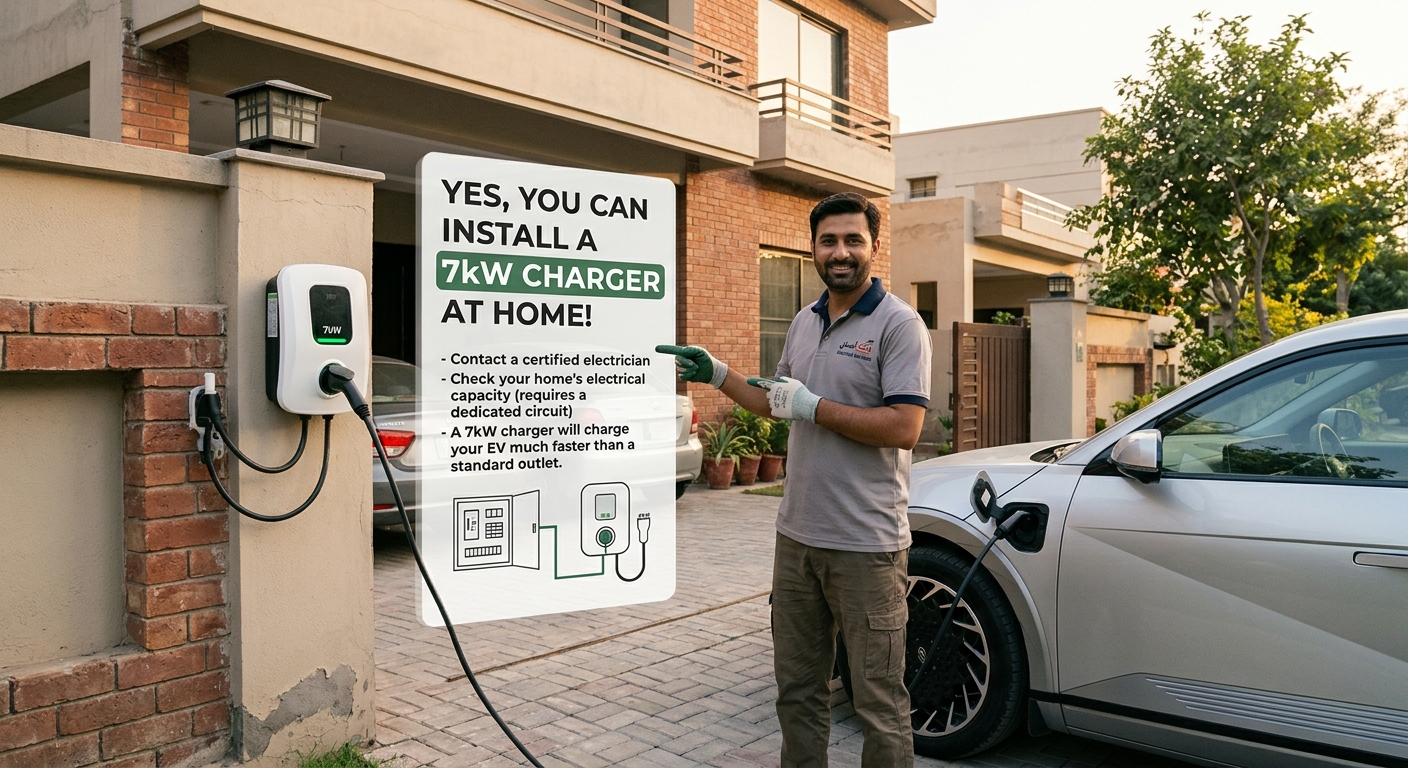
Upgrading to an electric vehicle (EV) brings smooth performance, quiet operation, and predictable home refueling. Installing a Level 2 home charging station supplies 20 to 30 miles of driving range per hour over a standard 230V/240V single-phase circuit, making overnight battery recovery convenient and cost-effective. However, as new EV owners evaluate their garage or outdoor parking options, they encounter a critical practical question: Can I install a 7kW charger at home?
Yes, you can install a 7kW charger at home. A 7kW wallbox is the most widely installed Level 2 charger for single-family residences. It operates on a standard 230V/240V single-phase electrical supply, drawing a continuous 32 Amps of current, and is backed by a dedicated 40-Amp double-pole circuit breaker.
Under National Electrical Code (NEC Article 625) standards, verifying main panel load capacity, selecting proper conductor wire sizes, and opting for industrial-grade components ensures safe, code-compliant, and reliable daily operation.
For complete hardware reviews, installer guides, and panel load calculators, visit EV Charger Advisor.
1. Key Electrical Requirements for a 7kW Home Charger
Installing a 7kW Level 2 charging station requires meeting specific electrical infrastructure standards:
A. Single-Phase 230V/240V Dedicated Circuit
-
Voltage & Amperage Draw: A 7kW wallbox operates at $240\text{V}$ and draws a continuous current of 32 Amps ($240\text{V} \times 32\text{A} = 7,680\text{W}$ or $7.68\text{ kW}$).
-
NEC 125% Overcurrent Rule (NEC 625.41): Because EV charging is classified as a continuous load, circuit breakers and conductor wiring must be rated to 125% of the charger’s maximum output ($32\text{A} \times 1.25 = 40\text{A}$).
-
Dedicated Breaker Requirement: Requires a dedicated 40-Amp double-pole circuit breaker.
B. Conductor Wire Gauge Sizing
-
#8 AWG Copper Conductors: A 40A circuit running standard residential distances requires minimum #8 AWG copper conductors rated for $75^\circ\text{C}$ to maintain thermal safety and efficiency.
To learn more about how charger power levels and wire sizes compare, check out our guide on EV charging types.
2. Panel Load Capacity & EVEMS Mitigation
Evaluating main distribution panel headroom is critical prior to installing a 7kW wallbox:
PANEL CAPACITY CHECK & DECISION PATH:
[Main Electrical Panel] ──► [Perform NEC Article 220 Load Calculation]
                                     │
         ┌───────────────────────────┴───────────────────────────┐
         ▼                                                       ▼
[Sufficient Capacity]                                [Panel Constrained]
         │                                                       │
         ▼                                                       ▼
[Direct Dedicated Circuit]                           [Install EVEMS / Load Management]
 (Standard 40A Breaker)                              (Bypasses full panel upgrade)
-
Service Panel Load Calculation (NEC Article 220): A licensed electrician calculates existing household loads (air conditioning, water heaters, kitchen ranges). Most 200A main service panels easily accommodate a 40A breaker.
-
Older 100A Service Panels: On capacity-constrained 100A panels, adding a 32A continuous load may approach capacity limits.
-
EVEMS Smart Load Management: Installing an Electric Vehicle Energy Management System (EVEMS) under NEC 625.42 monitors real-time total household electricity draw. The system automatically throttles charger power during peak appliance usage, bypassing an expensive $2,000–$4,000 main service panel upgrade.
To explore Wi-Fi-enabled smart wallboxes engineered with integrated load management features, read our guide on smart chargers.
3. Plug-In (NEMA 14-50) vs. Hardwired Installation
A 7kW (32A continuous draw) wallbox can be installed using two primary physical connection methods:
A. Plug-In Installation (NEMA 14-50 / 6-50 Receptacle)
-
Flexibility: Allows simple wallbox unmounting for portability or service replacement.
-
Code Standard (NEC 625.54): Requires an upstream 2-pole GFCI circuit breaker in the main panel.
-
Industrial Receptacle Mandatory: Requires commercial industrial-grade receptacles (such as Hubbell or Bryant) to handle daily high continuous thermal expansion.
B. Direct Hardwired Connection
-
Higher Reliability: Direct terminal connections eliminate socket contact wear and point-of-failure thermal degradation.
-
Cost Efficiency: Bypasses the need for expensive 240V GFCI circuit breakers, as listed wallboxes feature integrated internal GFCI protection.
Comparison Table: 7kW Charger Installation Specs
| Feature / Parameter | Plug-In 7kW Setup | Hardwired 7kW Setup |
| Supply Voltage | 230V / 240V Single-Phase | 230V / 240V Single-Phase |
| Continuous Current Draw | 32 Amps | 32 Amps |
| Power Output | 7.4 kW – 7.68 kW | 7.4 kW – 7.68 kW |
| Required Circuit Breaker | 40A Double-Pole Breaker | 40A Double-Pole Breaker |
| Conductor Wiring Gauge | #8 AWG Copper Wire | #8 AWG Copper Wire |
| Range Added / Hour | 20 – 30 Miles / Hour | 20 – 30 Miles / Hour |
| GFCI Breaker Required? | YES (NEC 625.54) | NO (Internal EVSE GFCI) |
Summary & Key Takeaways
-
7kW Is Fully Supported: Most homes with modern single-phase 230V/240V service can easily support a 7kW charger.
-
Follow the NEC 125% Rule: A 32A continuous draw requires a dedicated 40A double-pole circuit breaker and #8 AWG copper conductors.
-
Overnight Charging Sweet Spot: Delivers 20–30 miles of range per hour, adding 45 kWh in approximately 6 hours.
-
Use EVEMS on 100A Panels: Dynamic load management prevents panel overloads without necessitating full service replacements.













Leave a Reply