
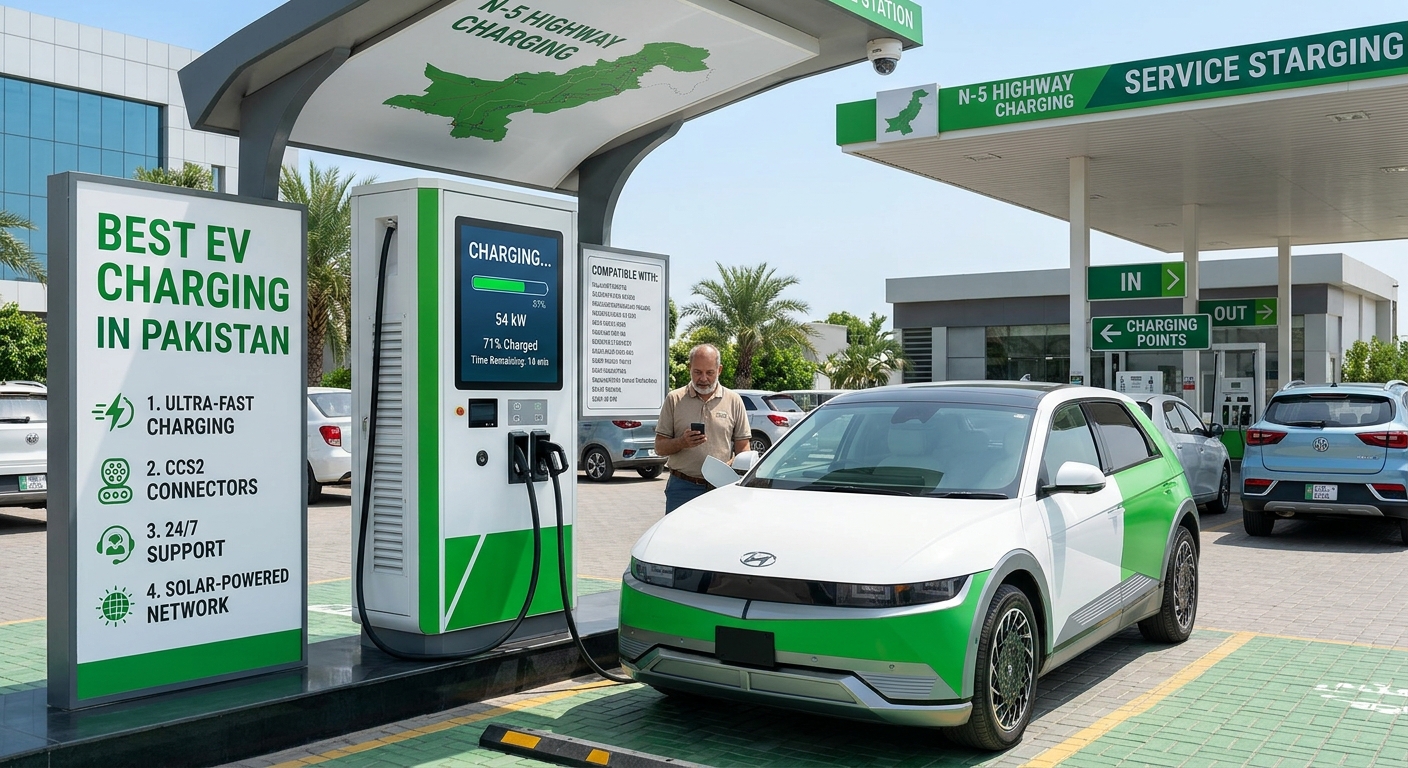
Electric vehicle (EV) adoption across Pakistan is accelerating as drivers seek to eliminate high fuel costs and reduce environmental impact. Delivering 20 to 44 miles of driving range per hour over a standard 230V/240V single-phase or 400V three-phase AC connection, installing a Level 2 home wallbox provides the most convenient way to keep electric cars charged daily. However, as local drivers evaluate available home wallboxes and commercial charging hardware, they encounter a common question: Which EV charger is best in Pakistan?
There is no single “best” electric vehicle (EV) charger for every driver in Pakistan. The ideal wallbox depends directly on your vehicle’s connector standard (GB/T vs. Type 2 vs. NACS), your home’s electrical service (Single-Phase 230V vs. Three-Phase 400V), solar inverter integration, and local voltage stability.
Under National Electrical Code (NEC Article 625 / Article 705) standards and local electrical safety guidelines, selecting the right charger configuration ensures safe operation, protects vehicle battery health, and minimizes installation costs.
For complete hardware reviews, installer guides, and panel load calculators, visit EV Charger Advisor.
1. Key Factors Influencing EV Charger Selection in Pakistan
Selecting the right charger for Pakistani home installations requires evaluating four distinct technical considerations:
A. Vehicle Charging Inlet Standard (GB/T vs. Type 2)
-
GB/T Standard (Chinese Import Vehicles): Popular electric vehicles imported into Pakistan (such as BYD, MG ZS EV, Dongfeng, and Rinco Aria) commonly feature the Chinese GB/T AC connector. Installing a wallbox with a native GB/T connector eliminates the need for daily plug adapters.
-
Type 2 / IEC 62196 Standard (European & Global Vehicles): European imports and mainstream global brands (such as Audi e-tron, Porsche Taycan, and Hyundai Kona) utilize the Type 2 connector.
-
Universal Socket Wallboxes: Choosing a charger with a universal Type 2 socket allows you to plug in detachable cables for both Type 2 and GB/T vehicles, providing future-proof flexibility.
B. Household Power Supply: Single-Phase vs. Three-Phase
-
Single-Phase Supply (230V): Common in standard residential homes. A 7kW / 32A single-phase wallbox is the maximum AC charging speed supported on single-phase connections.
-
Three-Phase Supply (400V): Available in larger homes or commercial properties. A 22kW / 32A three-phase wallbox delivers faster AC charging for vehicles with 11kW or 22kW onboard chargers.
To learn more about how charger power levels and wire sizes compare, check out our guide on EV charging types.
2. Rooftop Solar Integration & Grid Voltage Protection
With high grid electricity tariffs in Pakistan, pairing EV chargers with rooftop solar PV systems offers significant operating cost savings:
A. Solar Surplus Tracking & Load Balancing
-
Solar-Match Smart Wallboxes: Wallboxes equipped with Current Transformer (CT) clamp sensors monitor live solar generation from hybrid inverters (such as Solis, Huawei, or Growatt). This enables charging exclusively from free rooftop solar energy during peak daylight hours.
-
Dynamic Load Management: Automatically throttles charger current when home air conditioning or water pumps run, preventing main breaker trips on capacity-constrained electrical connections.
B. Voltage Stabilization & Earth Protection
Residential power grids in some regions experience voltage fluctuations and neutral grounding irregularities:
-
Built-in Over/Under Voltage Protection: Protects sensitive internal EV charging electronics during grid voltage spikes or sags.
-
Integrated PEN Fault / Earth Protection: Ensures safe electrical grounding without requiring dedicated ground rods, preventing shock hazards during earth fault conditions.
To explore Wi-Fi-enabled smart wallboxes engineered with integrated load management features, read our guide on smart chargers.
3. Top Recommended EV Charger Classes in Pakistan
Evaluating popular charger categories helps match hardware to specific vehicle types and home infrastructure:
A. Native GB/T 7kW Smart Wallbox (Best for Chinese EVs)
-
Output: 7.4 kW (230V / 32A Single-Phase)
-
Best For: BYD, MG ZS EV, and Chinese import EVs.
-
Key Feature: Direct GB/T plug connection with integrated Wi-Fi app scheduling and solar tracking.
B. Universal Type 2 7kW / 22kW Wallbox (Best for Versatility)
-
Output: 7.4 kW (Single-Phase) or 22 kW (Three-Phase)
-
Best For: Audi e-tron, European EVs, and multi-EV households.
-
Key Feature: Universal socket format allowing plug swaps for both Type 2 and GB/T connector cables.
C. Heavy-Duty Portable / Plug-In Chargers (Best for Travel)
-
Output: 3.5 kW to 7 kW (Adjustable Amperage)
-
Best For: Emergency backup charging and long-distance travel.
-
Key Feature: Plug-and-play capability with industrial 32A blue CEE plugs or standard 16A outlets.
Comparison Table: EV Charger Options for Pakistan
| Charger Category | Max Power Output | Connector Type | Voltage Supply | Ideal Vehicle Match |
| 7kW GB/T Wallbox | 7.4 kW (32A) | Native GB/T AC | 230V Single-Phase | BYD, MG ZS EV, Chinese EVs |
| 7kW Type 2 Wallbox | 7.4 kW (32A) | Type 2 (IEC 62196) | 230V Single-Phase | Audi e-tron, European Imports |
| 22kW Universal Wallbox | 22.0 kW (32A) | Universal Type 2 Socket | 400V Three-Phase | Multi-EV Homes & Commercial |
| Portable 3.5kW EVSE | 3.5 kW (16A) | GB/T or Type 2 | 230V Single-Phase | Emergency / Backup Charging |
Summary & Key Takeaways
-
No Single “Best” Charger: The ideal charger depends on your car’s inlet port (GB/T vs Type 2), household voltage supply, and solar PV setup.
-
7kW Single-Phase Is Standard: A 7kW / 32A wallbox provides optimal overnight charging speeds for most residential homes.
-
Prioritize Solar Matching: Choose smart wallboxes with CT clamp sensors to charge directly from rooftop solar panels and lower daily fuel costs.
-
Insist on Voltage Protection: Ensure chosen hardware features built-in over/under voltage protection to handle local grid power variations safely.













Leave a Reply