
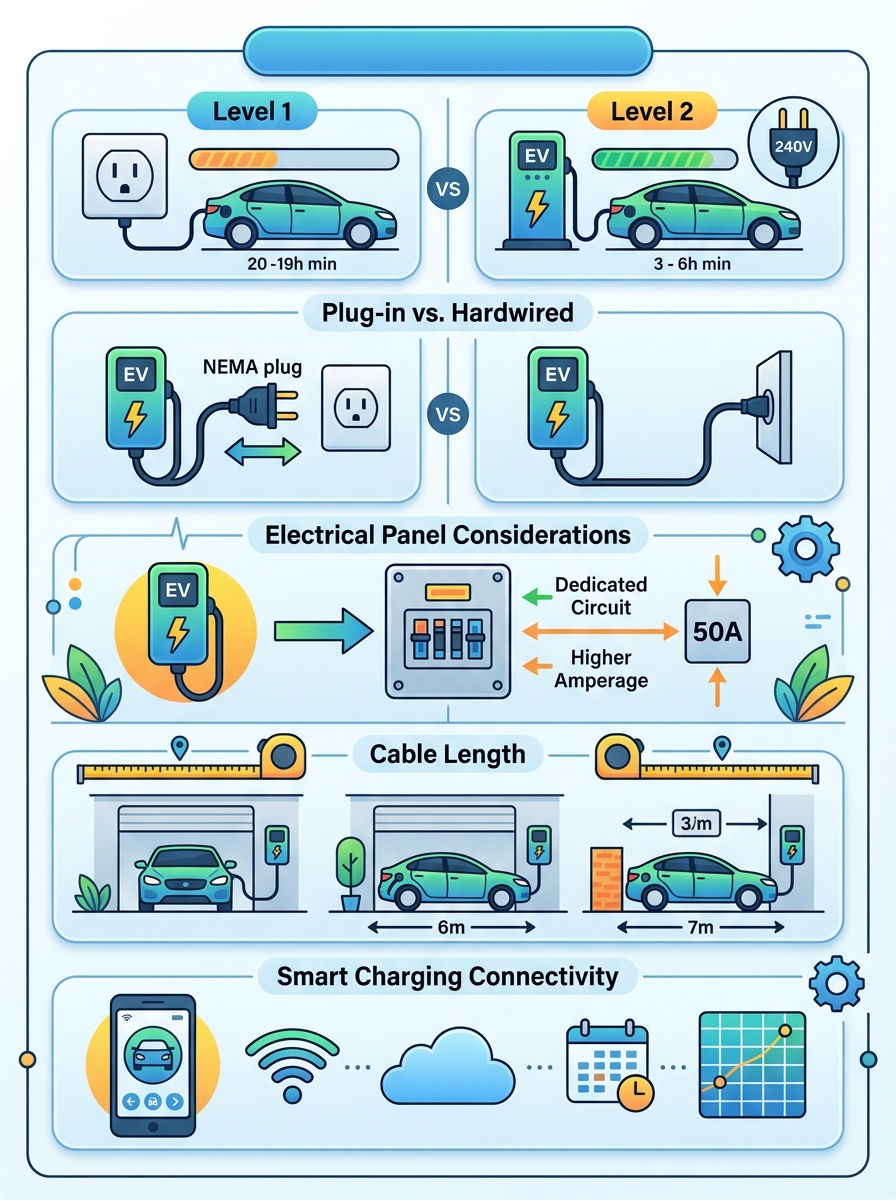
Installing a dedicated residential electric vehicle (EV) charging station turns your garage or driveway into a convenient refueling hub, supplying 20 to 44 miles of driving range per hour over a high-voltage 240-volt single-phase branch circuit. Moving beyond standard 120-volt Level 1 trickle charging requires evaluating vehicle battery requirements, panel capacity, and wallbox features. Selecting the ideal equipment requires matching hardware capabilities to your daily lifestyle.
Choosing the right home EV charger depends on matching your daily driving habits, your home’s electrical capacity, and the charging speed your electric vehicle can accept.
Under National Electrical Code (NEC Article 625) standards, evaluating key factors—such as plug-in versus hardwired connections, smart energy controls, and overcurrent breaker protection—ensures a safe, future-proof home charging setup.
For complete hardware reviews, installer guides, and panel load calculators, visit EV Charger Advisor.
1. Key Factors When Selecting a Home EV Charger
Evaluating four primary parameters helps narrow down the ideal wallbox for your residence:
A. Charging Speed & Amperage Selection
Your vehicle’s onboard charger limits maximum AC charging speed. Matching charger output to vehicle capacity avoids over-purchasing power you cannot use:
-
32-Amp Chargers (7.68 kW Output): Requires a dedicated 40A circuit breaker and #8 AWG copper wire. Adds 20 to 28 miles of range per hour. Ideal for plug-in hybrids and standard daily commutes.
-
40-Amp Chargers (9.60 kW Output): Requires a dedicated 50A circuit breaker and #6 AWG copper wire. Adds 30 to 38 miles of range per hour. Available in both plug-in (NEMA 14-50) and hardwired formats.
-
48-Amp Chargers (11.52 kW Output): Requires a dedicated 60A circuit breaker and #6 AWG copper wire. Adds 36 to 44 miles of range per hour. Requires direct hardwiring under NEC standards.
B. Hardwired vs. Plug-In Receptacle Installation
-
Plug-In (NEMA 14-50 / NEMA 6-50): Offers portability and easy unit replacement, but limits continuous charging output to 40 Amps (9.60 kW) and requires an upstream 240V GFCI circuit breaker under NEC 625.54.
-
Hardwired Direct Connection: Direct terminal connections support maximum 48-Amp output (11.52 kW), eliminate wall socket contact wear, avoid costly GFCI breaker requirements, and provide superior outdoor weather resistance.
To learn more about how charger power levels and wire sizes compare, check out our guide on EV charging types.
2. Smart Features, Solar Tracking, & Electrical Panel Assessment
Advanced wallbox capabilities optimize daily energy management and lower operating costs:
A. Smart Wallbox vs. Standard (“Dumb”) Charger
-
Standard EVSE: Simple plug-and-charge operation with no app connectivity or Wi-Fi configuration.
-
Smart EVSE: Features integrated Wi-Fi or Bluetooth to enable automated Time-of-Use (TOU) scheduling, real-time energy metering, dynamic load balancing, and remote mobile controls.
B. Solar PV Integration & Load Management
If your home features solar panels or a capacity-constrained electrical service panel (such as 100A or 150A):
-
Solar-Diverting Chargers: Models like the myenergi Zappi or Emporia Smart EVSE use Current Transformer (CT) clamps to monitor real-time solar export, diverting excess rooftop power directly into the vehicle battery.
-
Dynamic Load Management (EVEMS): Systems installed pursuant to NEC 625.42 automatically monitor total household power draw, throttling charging speed when high-amperage home appliances (e.g., HVAC or oven) run to prevent main panel overloads without costly electrical upgrades.
To explore Wi-Fi-enabled smart wallboxes engineered with integrated load management features, read our guide on smart chargers.
3. Physical Design & Connector Compatibility
Physical placement and cable ergonomics dictate daily convenience:
-
Cable Length Standard: Choose a unit with an 18- to 25-foot cable to reach charge ports comfortably regardless of how the vehicle is parked.
-
Connector Type Selection:
-
J1772 (Type 1): Standard AC connector for non-Tesla EVs in North America.
-
NACS (J3400): Native connector for Tesla vehicles and adopted by major automakers for future models. Adapters readily bridge J1772 and NACS chargers.
-
-
NEMA 3R / NEMA 4 Enclosure Ratings: For outdoor driveway installations, ensure the wallbox carries a weatherproof rating to protect internal components against rain, ice, and extreme temperatures.
Comparison Table: Home EV Charger Selection Matrix
| Charger Parameter | Entry-Level Plug-In | Standard Level 2 | Maximum Speed Hardwired |
| Max Continuous Amps | 32 Amps | 40 Amps | 48 Amps |
| Max Power Output | 7.68 kW | 9.60 kW | 11.52 kW |
| Circuit Breaker Sizing | 40A Double-Pole Breaker | 50A Double-Pole Breaker | 60A Double-Pole Breaker |
| Wiring Conductor Gauge | #8 AWG Copper Wire | #6 AWG Copper Wire | #6 AWG Copper Wire |
| Connection Method | NEMA 14-50 or Hardwired | NEMA 14-50 or Hardwired | Hardwired Only |
| Range Added / Hour | 20 – 28 Miles / Hour | 30 – 38 Miles / Hour | 36 – 44 Miles / Hour |
| Best For | PHEVs & Daily Commutes | Standard Electric Cars | Long-Range BEVs & Trucks |
Summary & Key Takeaways
-
Match Vehicle Accept Rate: Choose an amperage output that complements your EV’s onboard AC charger and daily driving distance.
-
Hardwiring Offers Highest Performance: Direct hardwiring supports 48A (11.52 kW) charging while eliminating socket wear and upstream GFCI breaker costs.
-
Consider Smart Energy Features: Wi-Fi-enabled wallboxes allow off-peak scheduling, solar tracking, and load balancing to optimize energy costs.
-
Adhere to NEC Code Sizing: Continuous loads require circuit breaker overcurrent protection and wiring sized to 125% of maximum charger draw.













Leave a Reply