
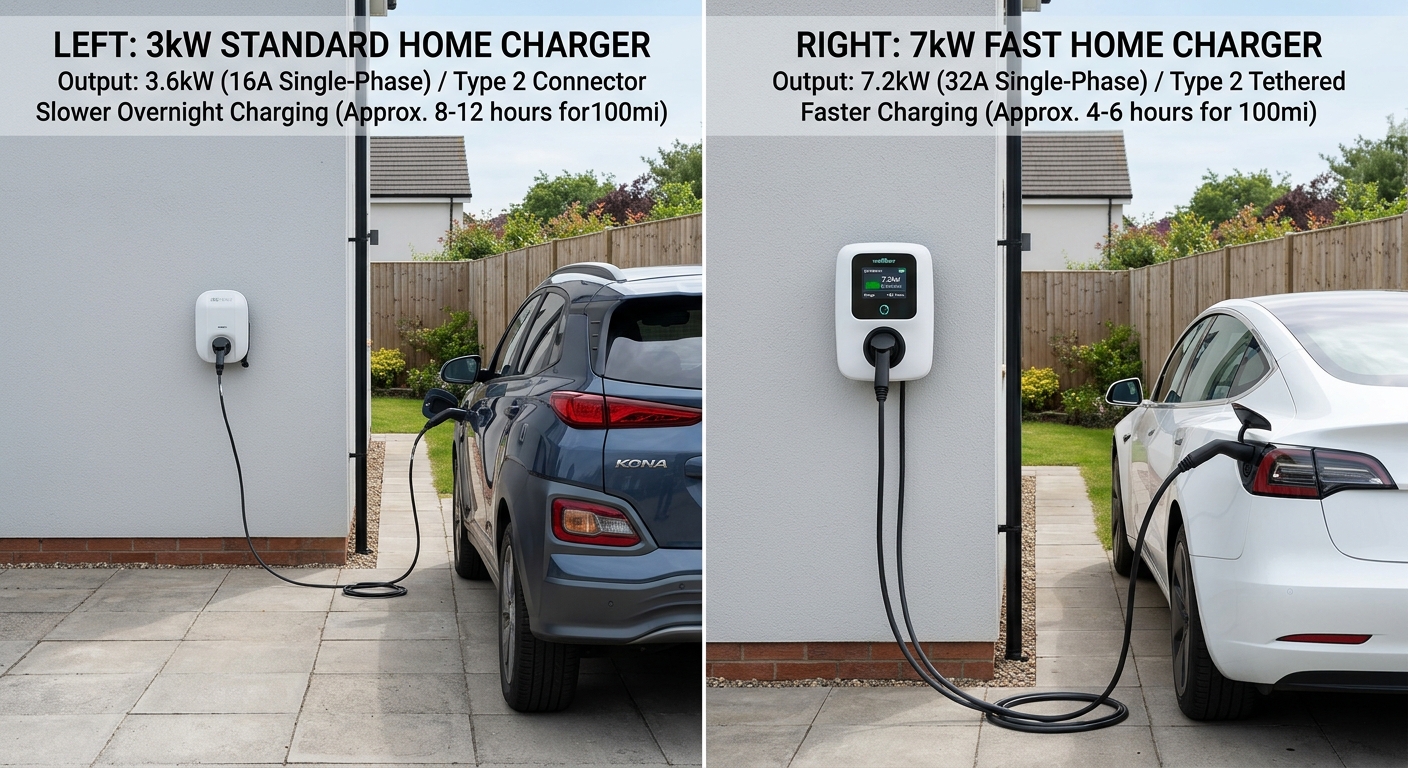
Installing a dedicated residential electric vehicle (EV) charging station provides reliable, predictable home refueling. When planning a home installation, choosing the appropriate power rating is essential for balancing charging speed, electrical capacity, and overall installation costs. Homeowners comparing entry-level and standard Level 2 options frequently evaluate two common charging speeds: a 3kW charger versus a 7kW charger.
A 7kW EV charger is generally better and more practical for most all-electric vehicle (BEV) owners who charge at home.
Under National Electrical Code (NEC Article 625) standards, evaluating electrical panel capacity, branch circuit breaker sizing, and daily driving demands ensures your selected wallbox delivers optimal performance and long-term utility.
For complete hardware reviews, installer guides, and panel load calculators, visit EV Charger Advisor.
1. Technical Breakdown: 3kW vs. 7kW Charging Infrastructure
The core difference between a 3kW and a 7kW charger lies in voltage supply, continuous current draw, and power output:
A. 3kW EV Charger (Slow Level 2 / Enhanced Level 1)
-
Electrical Parameters: Operates at 230V/240V with a 13-amp to 16-amp continuous current draw (typically 3.3 kW to 3.7 kW output) on a dedicated 20-amp single-pole or double-pole circuit.
-
Replenishment Rate: Adds 10 to 14 miles of driving range per hour.
-
Best Suited For: Plug-in hybrid electric vehicles (PHEVs) with smaller battery packs (10–15 kWh) or drivers with very short daily commutes (under 20 miles).
B. 7kW EV Charger (Standard Residential Level 2)
-
Electrical Parameters: Operates at 230V/240V with a 32-amp continuous current draw (7.4 kW output) on a dedicated 40-amp double-pole circuit breaker.
-
Replenishment Rate: Adds 25 to 30 miles of driving range per hour.
-
Best Suited For: Battery electric vehicles (BEVs) with medium-to-large battery packs (50–100 kWh) requiring full overnight battery recovery.
To learn more about how charger power levels and wire sizes compare, check out our guide on EV charging types.
2. Performance & Overnight Replenishment Metrics
Comparing charging times across typical battery sizes highlights the operational advantage of a 7kW charger:
A. Charging a Standard 60 kWh Battery Pack
-
3kW Charger (13A/16A Draw): Takes approximately 16 to 18 hours for a full charge. If plugged in at 8:00 PM, the vehicle will not reach 100% until past noon the following day.
-
7kW Charger (32A Draw): Takes approximately 7 to 8 hours for a full charge, easily completing a full battery replenishment during off-peak overnight electricity windows.
B. Time-of-Use (TOU) Efficiency
Utility companies frequently offer lower electricity rates during off-peak overnight hours (e.g., midnight to 6:00 AM). A 7kW charger enables vehicles to complete charging within these restricted 6-hour windows, whereas a 3kW charger often requires running into higher daytime rate tiers.
To explore Wi-Fi-enabled smart wallboxes engineered with integrated load management features, read our guide on smart chargers.
3. Electrical Circuit & Code Compliance (NEC Article 625)
Installing either unit requires adherence to continuous load safety rules:
-
NEC 125% Overcurrent Protection Rule: Pursuant to NEC 625.42, circuit breakers and conductor wiring must be rated to 125% of continuous load:
-
3kW Charger (16A Draw): Requires a dedicated 20A circuit breaker and #12 AWG copper wire.
-
7kW Charger (32A Draw): Requires a dedicated 40A double-pole breaker and #8 AWG copper wire.
-
-
Panel Headroom & Load Management: A 7kW charger requires 40 amps of breaker capacity. On older main service panels (such as 100A panels), an Electric Vehicle Energy Management System (EVEMS) can be installed to monitor total panel load and prevent service overloads without replacing the main panel.
Comparison Table: 3kW vs. 7kW EV Charger Specifications
| Specification / Feature | 3kW EV Charger | 7kW EV Charger |
| Supply Voltage | 230V / 240V Single-Phase | 230V / 240V Single-Phase |
| Continuous Amperage | 13A – 16A Continuous | 32A Continuous |
| Power Output | 3.3 kW – 3.7 kW | 7.4 kW |
| Required Circuit Breaker | 20A Double-Pole Breaker | 40A Double-Pole Breaker |
| Conductor Wire Gauge | #12 AWG Copper Wire | #8 AWG Copper Wire |
| Range Added per Hour | 10 – 14 Miles / Hour | 25 – 30 Miles / Hour |
| Overnight Charge (60 kWh) | ~16 – 18 Hours | ~7 – 8 Hours |
| Recommended Vehicle Type | PHEVs & Hybrid Cars | Battery Electric Vehicles (BEVs) |
Summary & Key Takeaways
-
7kW Is Recommended for BEVs: A 7kW charger provides the ideal balance of speed, efficiency, and full overnight battery replenishment for all-electric vehicles.
-
3kW Is Sufficient for PHEVs: A 3kW charger is best suited for plug-in hybrids or low-mileage drivers who do not require rapid overnight range recovery.
-
Capture Off-Peak Rates: The faster charging rate of a 7kW unit allows drivers to capitalize fully on cheap off-peak electricity windows.
-
Adhere to NEC Code Sizing: Sizing a 7kW (32A continuous) charger requires a dedicated 40A double-pole circuit breaker and #8 AWG copper conductors.













Leave a Reply