
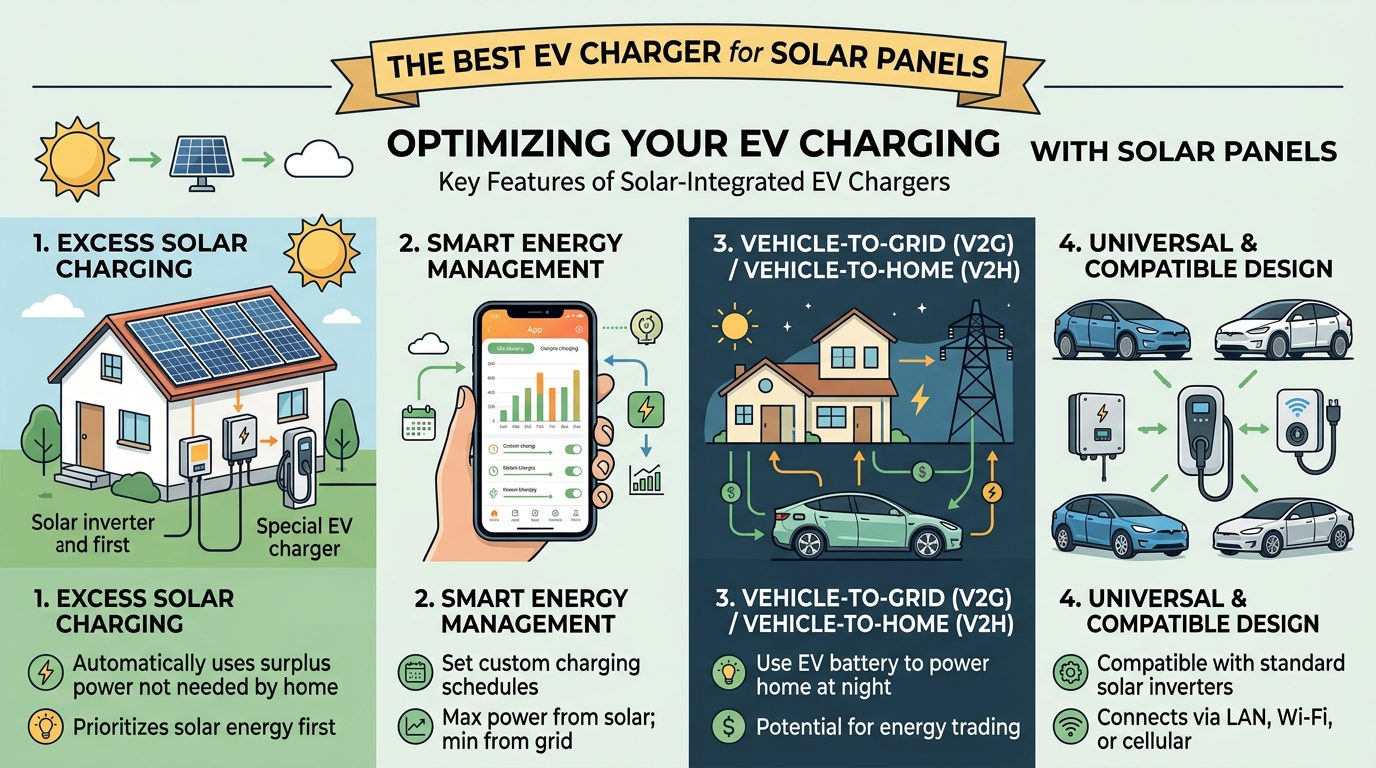
Pairing an electric vehicle (EV) with a residential solar photovoltaic (PV) array provides the ultimate sustainable energy loop, enabling drivers to power their vehicles with zero-emission solar energy. Operating over a high-voltage 240-volt single-phase or 400-volt three-phase branch circuit, installing a smart Level 2 wallbox delivers 20 to 44 miles of driving range per hour. However, standard EV chargers do not differentiate between grid power and clean rooftop solar energy. When homeowners seek the most intelligent, battle-tested solar-diverting wallbox hardware on the market, one device leads the industry: the myenergi Zappi.
The short answer is: the myenergi Zappi (v2.1) is widely recognized as the best EV charger for solar panels due to its native inverter-agnostic CT clamp tracking, granular Eco/Eco+ solar surplus diversion modes, integrated PEN fault protection, and seamless myenergi ecosystem integration.
Under National Electrical Code (NEC Article 625 / Article 705) standards, utilizing a smart wallbox like the Zappi allows you to capture daytime solar production, eliminate grid-import costs during peak hours, and preserve panel headroom.
For complete hardware reviews, installer guides, and panel load calculators, visit EV Charger Advisor.
1. Why the myenergi Zappi Leads the Solar Charging Category
Unlike standard chargers that require third-party automation apps or rigid API connections, the Zappi features hardware-level grid monitoring:
MYENERGI ZAPPI SOLAR TRACKING ARCHITECTURE:
[Solar PV System] ──► [Home Inverter] ──► [Main Service Panel] ◄── [myenergi Zappi EVSE]
                                                │
                                       [CT Clamp / harvi Sensor]
                                        (Reads Import/Export Live)
A. The Three Dedicated Charging Modes
-
Eco+ Mode (100% Green Solar Surplus): The Zappi continuously reads incoming solar export via Current Transformer (CT) clamp sensors. Charging activates only when surplus solar generation exceeds the minimum EV charging threshold (1.4 kW / 6A single-phase). If a cloud passes and surplus drops, charging pauses automatically to avoid drawing grid power.
-
Eco Mode (Solar Prioritized with Grid Floor): The Zappi prioritizes solar surplus while maintaining a user-defined minimum continuous charge rate (e.g., 6A) by blending grid energy when solar generation drops, guaranteeing the vehicle continues charging steadily.
-
Fast Mode (Maximum Speed): Ignores solar export and draws maximum capacity from grid and solar combined (7.4 kW single-phase or 22 kW three-phase) for rapid replenishment.
B. Inverter-Agnostic Hardware Integration
Because the Zappi monitors energy flow using external wired CT clamps or wireless harvi transmitters, it works with any solar inverter brand (e.g., Enphase, SolarEdge, Fronius, Sungrow, or Tesla Powerwall) without requiring software brand integration or proprietary inverter protocols.
To learn more about how charger power levels and wire sizes compare, check out our guide on EV charging types.
2. Electrical Sizing & Safety Compliance (NEC 625 & NEC 705)
Hardwiring a Zappi solar wallbox requires strict adherence to electrical safety standards:
-
NEC 125% Overcurrent Protection Rule: EV charging is classified as a continuous load. Sizing a 32-Amp single-phase Zappi ($7.68\text{ kW}$) requires a dedicated 40-Amp double-pole circuit breaker paired with #8 AWG copper conductors. A 48-Amp variant requires a 60-Amp breaker and #6 AWG copper wire.
-
NEC 705.12 (The 120% Busbar Rule): When combining solar inverter output and EV charger supply breakers inside a main electrical panel, the total supply breaker amperage cannot exceed 120% of the panel busbar rating.
-
Hardwired Reliability: Direct hardwiring ensures stable real-time data transmission between the CT sensors and the Zappi wallbox, preventing communication dropouts during dynamic charging sessions.
To explore Wi-Fi-enabled smart wallboxes engineered with integrated load management features, read our guide on smart chargers.
Step-by-Step Mathematical Example: Zappi Solar Surplus Diversion Math
Let us analyze a daily solar charging session using the myenergi Zappi in Eco+ Mode connected to a 6.5 kW Solar Array on a 240V Single-Phase Supply ($\eta = 0.90$) feeding an EV with an efficiency of 3.5 Miles per kWh.
Given Parameters:
-
Solar PV Array Live Production ($P_{\text{solar}}$): $5.80 \text{ kW (5,800 Watts)}$
-
Home Household Appliance Consumption ($P_{\text{house}}$): $1.60 \text{ kW (1,600 Watts)}$
-
EV Charging Efficiency ($\eta_{\text{EV}}$): $90\% \quad (0.90)$
-
Session Duration in Eco+ Mode ($t$): $4.50 \text{ Hours}$
Calculation 1: Live Net Solar Surplus Available ($P_{\text{surplus}}$)
Calculation 2: Dynamically Adjusted Charging Current ($I_{\text{charging}}$)
Because $17.5\text{A}$ exceeds the minimum $6\text{A}$ ($1.44\text{ kW}$) activation floor, the Zappi routes 100% of this surplus into the car without importing any grid power.
Calculation 3: Total Free Solar Energy Added to Battery ($E_{\text{net}}$)
Calculation 4: Free Driving Range Added
Result Breakdown: Operating in Eco+ mode for 4.5 hours captures 18.90 kWh of surplus solar power, transferring 17.01 kWh of net energy (~59.5 miles of free driving) directly into the EV battery with zero grid imports.
Comparison Table: myenergi Zappi vs. Standard EV Chargers
| Feature / Specification | myenergi Zappi v2.1 | Standard Smart Charger | Dumb / Unmanaged EVSE |
| Native Solar Modes | Eco+, Eco, Fast (Built-in) | App-Based / Limited | None (Full Grid Draw) |
| Inverter Compatibility | 100% Brand-Agnostic (CT) | Requires API match | N/A |
| Single / 3-Phase Options | 7.4 kW / 22 kW Variants | 7.6 kW Single-Phase | 7.6 kW Single-Phase |
| Minimum Activation Threshold | 1.4 kW (6A continuous) | Varies (often 3.7 kW) | N/A |
| PEN Fault Protection | Built-in (No earth rod needed) | Varies by manufacturer | None |
Summary & Key Takeaways
-
The Gold Standard for Solar EV Charging: The myenergi Zappi is the leading solar EV charger due to its granular Eco and Eco+ solar surplus tracking modes.
-
Works with Any Solar System: Uses CT clamps to read grid import/export in real time, making it compatible with all inverter brands.
-
Supports 100% Free Solar Driving: Eco+ mode ensures charging occurs exclusively when surplus solar power is exported to the grid.
-
Follow NEC Sizing Rules: Sizing a continuous 32A single-phase unit requires a dedicated 40A double-pole breaker and #8 AWG copper wire.













Leave a Reply