
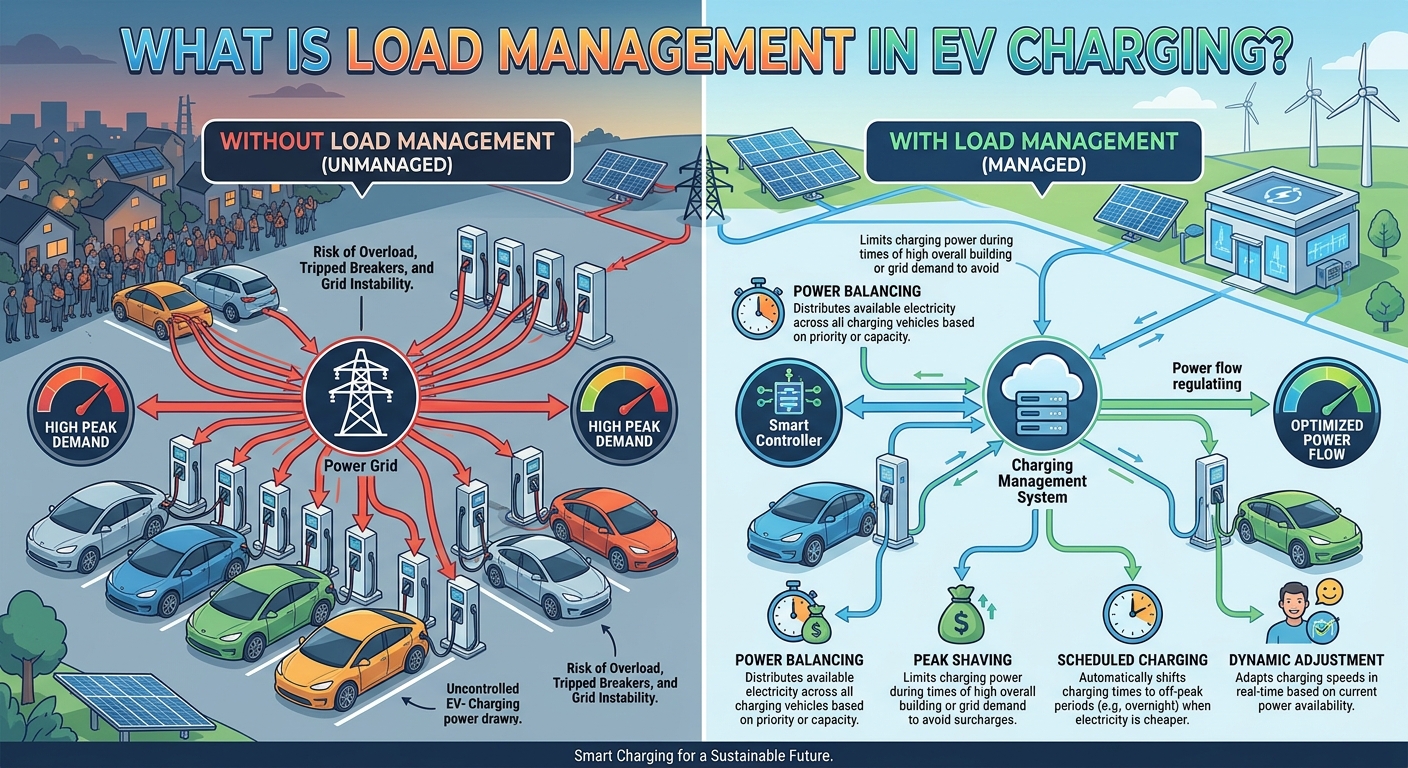
Transitioning to electric mobility delivers whisper-quiet vehicle operation, zero tailpipe emissions, and low daily fuel costs. Operating on high-voltage 240-volt single-phase or three-phase branch circuits, installing Level 2 wallboxes delivers 20 to 44 miles of driving range per hour. However, as households and commercial sites add multiple high-amperage EV chargers alongside heavy HVAC, heat pump, and industrial loads, physical electrical panel constraints create severe installation bottlenecks. A primary technical question arises: What is load management in EV charging?
The short answer is: load management in EV charging—often called an Electric Vehicle Energy Management System (EVEMS) or Dynamic Load Management (DLM)—is the process of controlling and optimizing electrical power distribution in real time to ensure that total vehicle charging demand does not exceed the maximum physical capacity of a home, building, or grid connection point.
Recognized under National Electrical Code (NEC Article 625.42) standards, implementing smart load management allows property owners to add fast Level 2 EV charging without undergoing expensive main electrical service panel or utility transformer upgrades.
For complete hardware reviews, installer guides, and panel load calculators, visit EV Charger Advisor.
1. Static vs. Dynamic Load Management
EV load management architectures are categorized into two primary technical operational strategies:
A. Static Load Sharing (Fixed Equal Sharing)
-
How It Works: A fixed electrical capacity threshold (e.g., 40 Amps) is pre-allocated across a dedicated cluster of connected chargers.
-
Operational Profile: If one vehicle plugs in, it draws the full 40A ($9.6\text{ kW}$). If a second vehicle plugs into the shared network, the static system splits the available amperage equally, capping both chargers at 20A ($4.8\text{ kW}$) each.
-
Limitation: Static systems ignore real-time home appliance usage and remain locked to a conservative fixed headroom value.
B. Dynamic Load Management (Real-Time CT Monitoring)
-
How It Works: Current Transformer (CT) clamp sensors are installed directly on the incoming main utility service lines. The sensors continuously measure the property’s total live energy draw (HVAC, water heaters, kitchen appliances).
-
Operational Profile: The EVSE dynamically modulates charging speed millisecond by millisecond based on available panel headroom. When home loads spike (e.g., an electric dryer turns on), the charger throttles down. When household demand drops at night, the EVSE automatically scales up to maximum continuous speed (48A / $11.52\text{ kW}$).
To learn more about how charger power levels and wire sizes compare, check out our guide on EV charging types.
2. National Electrical Code (NEC) Compliance & Safety Rules
Implementing an automated EVEMS requires strict adherence to electrical installation standards:
-
NEC Article 625.42 (EVEMS Code Exemption): Standard NEC panel calculations require adding EV chargers at 125% of continuous load rating. However, Article 625.42 explicitly states that when an approved EVEMS is installed, the charger’s full nameplate load does not need to be added to feeder/service calculations, bypassing main panel upgrades.
-
Fail-Safe Response Protocols: If the CT clamp sensor communication wire (RS-485 or local Wi-Fi) loses signal, the EVSE system must automatically default to a pre-configured fail-safe low amperage (e.g., 6 Amps) to prevent tripping main main service breakers.
-
Hardwired Reliability: Hardwiring dynamic load management equipment ensures stable communication and eliminates thermal degradation associated with plug-in receptacles.
To explore Wi-Fi-enabled smart wallboxes engineered with integrated load management features, read our guide on smart chargers.
Step-by-Step Mathematical Example: Dynamic Load Balancing Calculation
Let us analyze a home with a 100-Amp Main Service Panel ($240\text{V}$ single-phase supply = $24.0\text{ kW}$ capacity) operating an 80% NEC Continuous Duty Limit of 80 Amps ($19.20\text{ kW}$ max safe panel load) equipped with a 48-Amp Level 2 EV Charger ($11.52\text{ kW}$ max output) managed by dynamic CT clamps.
Given Parameters:
-
Main Service Panel Capacity ($I_{\text{panel}}$): $100 \text{ Amps (24,000 Watts at 240V)}$
-
NEC Safe Continuous Limit ($I_{\text{safe}}$): $100\text{A} \times 0.80 = \mathbf{80 \text{ Amps (19,200 Watts)}}$
-
Active Household Baseline Load ($P_{\text{house}}$):
-
Central HVAC Unit: $20.0 \text{ Amps (4,800 W)}$
-
Electric Water Heater: $18.5 \text{ Amps (4,440 W)}$
-
Lighting & Refrigerator: $8.0 \text{ Amps (1,920 W)}$
-
-
Total Baseline Household Load ($I_{\text{house}}$): $20.0 + 18.5 + 8.0 = \mathbf{46.5 \text{ Amps (11,160 Watts)}}$
-
Max EVSE Nameplate Capacity ($I_{\text{EV-max}}$): $48.0 \text{ Amps (11,520 Watts)}$
Calculation 1: Available Amperage Headroom for EV Charging ($I_{\text{headroom}}$)
Calculation 2: Dynamically Adjusted EV Charger Output ($P_{\text{EV-actual}}$)
Because $33.5\text{A}$ is lower than the charger’s maximum $48.0\text{A}$ capability, the EVEMS dynamically throttles EVSE continuous draw to 33.5 Amps:
Calculation 3: Nighttime Load Shift Adjustment
At 11:00 PM, the electric water heater and HVAC shut off, reducing household baseline load ($I_{\text{house}}$) down to 6.0 Amps ($1,440\text{W}$):
Because $74.0\text{A}$ exceeds the charger’s maximum hardware rating ($48.0\text{A}$), the EVEMS automatically scales the charger up to its full continuous speed:
Result Breakdown: Dynamic Load Management keeps total panel consumption strictly below the 80A safety ceiling, throttling charging down to 8.04 kW during peak household usage and automatically ramping up to full 11.52 kW speed overnight.
Comparison Table: Load Management System Architectures
| Feature / Metric | Unmanaged Standard Charger | Static Load Sharing | Dynamic Load Management (EVEMS) |
| Panel Upgrade Required? | YES (If panel headroom < 60A) | Frequently Required | NO (Avoids main panel upgrades) |
| Monitoring Hardware | None | Fixed Internal Firmware | Incoming Main Panel CT Clamps |
| Real-Time Load Adaptation | NO (Fixed Draw) | No (Fixed Shared Cap) | YES (Adapts in milliseconds) |
| NEC Article Compliance | NEC 625.41 (125% Rule) | NEC 625.42 | NEC 625.42 Dynamic Exemption |
| Solar PV Surplus Matching | No | No | YES (Supports Eco/Eco+ Modes) |
Summary & Key Takeaways
-
Prevents Electrical Overloads: Dynamic load management continuously monitors total electrical consumption, adjusting EV charging draw in real time.
-
Avoids Costly Panel Upgrades: Installing an EVEMS satisfies NEC 625.42 rules, letting homeowners add fast Level 2 charging without upgrading 100A main service panels.
-
Uses CT Sensor Hardware: Current Transformer (CT) clamps installed on incoming main service lines deliver live power consumption data to the wallbox.
-
Maximizes Overnight Speeds: Throttles continuous current during high household appliance usage and restores full 48A ($11.52\text{ kW}$) speed when home loads drop.













Leave a Reply