
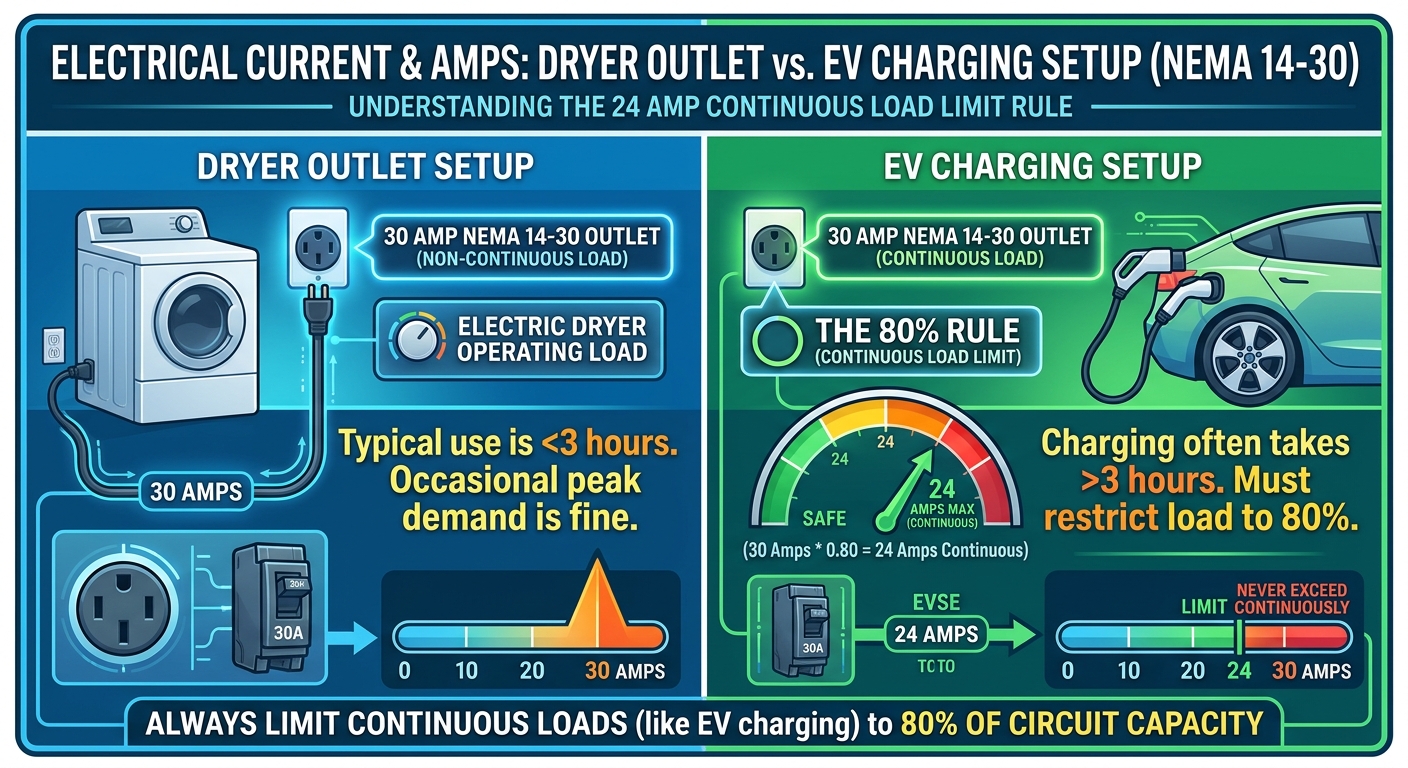
Upgrading to an electric vehicle (EV) brings smooth acceleration, low daily fuel costs, and zero local tailpipe emissions. Delivering 18 to 22 miles of driving range per hour over a high-voltage 240-volt single-phase branch circuit, tapping into an existing 240V dryer outlet is one of the fastest and most accessible ways to get Level 2 home charging without paying thousands for a main electrical service upgrade. However, before plugging in your vehicle or purchasing a portable charger, a crucial electrical safety question must be addressed: How many amps can a dryer outlet supply for EV charging?
The short answer is: a standard 30-amp dryer outlet can supply a maximum of 24 amps of continuous current for EV charging under National Electrical Code (NEC Article 625) safety rules.
While a residential dryer circuit is protected by a 30-amp double-pole circuit breaker, attempting to draw a full 30 amps continuously will overheat your home’s wiring, melt the wall receptacle, and pose a severe fire hazard.
For complete hardware reviews, installer guides, and panel load calculators, visit EV Charger Advisor.
1. The NEC 80% Continuous Duty Rule Explained
Understanding why a 30-amp dryer circuit is capped at 24 amps requires examining electrical safety codes regarding heavy continuous loads:
A. Continuous Load Classification (NEC 625.42)
Under the National Electrical Code, electric vehicle charging is classified as a continuous load—defined as any electrical load where the maximum current is expected to continue for 3 hours or more.
B. The 80% Derating Standard
To prevent circuit breakers, conductors, and wall receptacles from experiencing dangerous thermal buildup during extended operation, NEC 210.20 and NEC 625.42 mandate that continuous loads must not exceed 80% of the circuit breaker’s total rating:
C. Thermal Hazards of Drawing 30 Amps Continuous
Standard clothes dryers operate on intermittent heating cycles, drawing full power only in short bursts as internal heating elements cycle on and off. In contrast, an EV charger draws steady, unyielding current for 6 to 10+ hours. Drawing 30 amps continuously on a 30-amp breaker rated for 24-amp continuous duty causes terminal screw loosening, insulation degradation, and receptacle melting.
To learn more about how charger power levels and wire sizes compare, check out our guide on EV charging types.
2. Hardware & Setup Requirements for 24A Dryer Charging
To safely draw 24 amps from a 240-volt dryer receptacle, ensure your setup meets these four structural and technical standards:
-
Adjustable or Smart EVSE: Use a portable charger or wallbox that can be manually or automatically derated to 24 Amps (5.76 kW output). Never plug an unmanaged 32A or 40A charger into a dryer circuit.
-
Official NEMA Adapters: If using a Tesla Mobile Connector or similar charger, pair it with an official NEMA 14-30 (4-prong) or NEMA 10-30 (3-prong) adapter. These adapters contain built-in microchips that automatically signal the vehicle to cap draw at exactly 24A.
-
Automatic Smart Splitter: If sharing the outlet with a clothes dryer, install an automatic smart switch (such as a NeoCharge or Splitvolt module). It automatically pauses EV charging whenever the clothes dryer turns on, preventing main panel overloads.
-
Industrial-Grade Receptacles: Ensure the wall receptacle is in excellent physical condition. Replace worn, loose builder-grade outlets with heavy-duty industrial receptacles to handle sustained thermal expansion.
To explore Wi-Fi-enabled smart wallboxes engineered with integrated load management features, read our guide on smart chargers.
Step-by-Step Mathematical Example: Power Delivery & Charging Speed Math
Let us perform a technical calculation to determine the gross power delivery, net power entering the battery, percentage voltage drop ($\Delta V$), and total charging duration to add 35 kWh of energy (a typical daily replenishment) using a 24-Amp continuous draw on a 30-Amp / 240-Volt Dryer Circuit running 50 feet ($15.24\text{ m}$) on #10 AWG Copper Wire ($R = 0.00124 \Omega/\text{ft}$) at 90% AC/DC conversion efficiency ($\eta = 0.90$).
Given Parameters:
-
Circuit Breaker Rating: $30 \text{ Amps}$
-
Safe Continuous Current ($I$): $30\text{A} \times 0.80 = \mathbf{24 \text{ Amps}}$
-
Supply Line Voltage ($V$): $240 \text{ Volts}$
-
One-Way Cable Distance ($L$): $50 \text{ feet}$
-
Conductor Resistance for #10 AWG Copper ($R_{\text{wire}}$): $0.00124 \Omega \text{ per foot}$
-
Target Energy Needed ($E_{\text{net}}$): $35 \text{ kWh}$
-
Conversion Efficiency ($\eta$): $90\% \quad (0.90)$
Calculation 1: Continuous Gross Power Output ($P_{\text{gross}}$)
Calculation 2: Net Power Delivered to Battery Cells ($P_{\text{net}}$)
Calculation 3: Voltage Drop ($\Delta V$) Calculation
For a single-phase 240V circuit ($2 \times L = 100\text{ ft}$ total conductor loop path):
Calculation 4: Required Charging Session Duration ($T$)
Result Breakdown: Supplying power at a safe 24-amp continuous limit ($5.76\text{ kW}$) delivers 35 kWh of range in 6 hours and 45 minutes with a minimal 1.24% voltage drop, demonstrating that a 24A rate easily handles overnight vehicle charging.
Comparison Table: Dryer Outlet Amperage Limits vs. Dedicated EV Circuits
| Circuit Type | Double-Pole Breaker Size | Max Continuous Amperage | Power Output (240V) | Conductor Gauge | Driving Range Added / Hour |
| Standard Dryer Circuit | 30 Amps | 24 Amps (80% Rule) | 5.76 kW | #10 AWG Copper | ~18 – 22 Miles / Hour |
| Medium EV Circuit | 40 Amps | 32 Amps (80% Rule) | 7.68 kW | #8 AWG Copper | ~25 – 30 Miles / Hour |
| High-Power Plug Circuit | 50 Amps | 40 Amps (80% Rule) | 9.60 kW | #6 AWG Copper | ~30 – 38 Miles / Hour |
| Dedicated Hardwired EVSE | 60 Amps | 48 Amps Continuous | 11.52 kW | #6 AWG Copper Wire | ~36 – 44 Miles / Hour |
Summary & Key Takeaways
-
24 Amps Is the Maximum Limit: Under NEC Article 625, a 30-amp dryer circuit can safely supply a maximum of 24 amps of continuous current.
-
Follow the 80% Rule: Continuous loads drawing power for 3+ hours must be derated to 80% of the circuit breaker’s nameplate capacity.
-
Never Draw 30 Amps Continuous: Drawing a full 30 amps causes severe thermal stress, trips circuit breakers, and risks melting wall receptacles.
-
Use Smart Switches or Adapters: Pair your charger with official auto-derating adapters or a smart dryer splitter to manage household loads safely.













Leave a Reply