
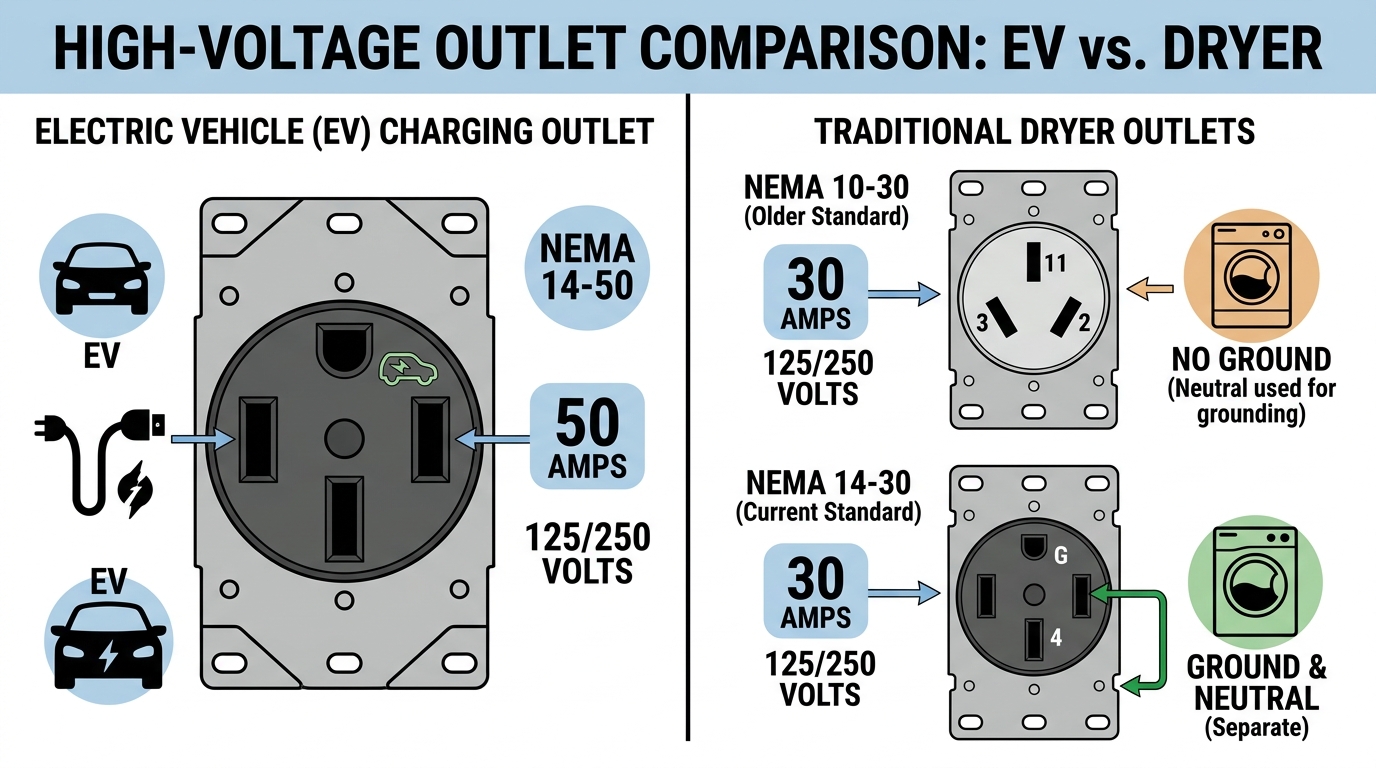
Transitioning to an electric vehicle (EV) brings low fuel costs, quiet operation, and zero local tailpipe emissions. While basic 120-volt Level 1 chargers plug into standard wall sockets, high-speed Level 2 home charging relies on a 240-volt single-phase supply to deliver 20 to 44 miles of driving range per hour. When setting up high-voltage power in a garage or laundry area, many homeowners notice heavy-duty 240V outlets and ask: Is an EV charging outlet the same as a dryer outlet?
The short answer is: no, an EV charging outlet is not the same as a dryer outlet. While they share the same 240-volt electrical voltage and can look identical, they are not built for the same type of electrical load, nor do they operate on the same circuit breaker amperage.
Understanding the physical, technical, and safety differences between dryer receptacles (NEMA 14-30 / 10-30) and dedicated EV charging outlets (NEMA 14-50 / 6-50) under National Electrical Code (NEC Article 625) standards is essential to prevent circuit overloads, thermal degradation, and electrical fire hazards.
For complete hardware reviews, installer guides, and panel load calculators, visit EV Charger Advisor.
1. Key Technical Differences: Dryer Outlets vs. EV Charging Outlets
Although both outlet types deliver 240-volt electricity, they differ fundamentally in design specifications, continuous duty tolerances, and power throughput:
A. Continuous Load Ratings & The NEC 125% Rule
-
EV Charging Outlets (NEMA 14-50 / 6-50): Built for 50-Amp branch circuits using heavy #6 AWG copper wire. Under NEC 625.42, EV charging is classified as a continuous load (drawing maximum current for 3 hours or more). Following the 80% continuous duty rule, a 50A circuit delivers 40 Amps continuous draw ($9.6 \text{ kW}$ output).
-
Dryer Outlets (NEMA 14-30 / 10-30): Built for 30-Amp branch circuits using lighter #10 AWG copper wire. Applying the 80% continuous rule limits safe continuous draw to 24 Amps ($5.76 \text{ kW}$ output).
-
Thermal Endurance: Clothes dryers run in intermittent heating cycles (turning heating elements on and off for 30–45 minutes). In contrast, an EV charger draws maximum current continuously for 6 to 10+ hours, generating far higher sustained thermal stress.
B. Physical Plug Configurations & Receptacle Grades
-
NEMA 14-30 (Dryer): Features a 4-prong plug with a distinct L-shaped neutral pin rated specifically for 30-Amp circuits.
-
NEMA 14-50 (EV Range Outlet): Features a 4-prong plug with a straight neutral pin rated for 50-Amp circuits.
-
Commercial-Grade WallSockets: Standard builder-grade NEMA 14-50 outlets (designed for kitchen ranges moved once every decade) can melt under daily EV plugging. EV installations require industrial-grade receptacles (e.g., Hubbell or Bryant) with heavy brass contacts to withstand daily thermal expansion.
To learn more about how charger power levels and wire sizes compare, check out our guide on EV charging types.
2. Can You Plug an EV Charger Into a Dryer Outlet?
You can use a dryer outlet for EV charging only if key safety conditions are satisfied:
-
De-Rating Amperage to 24 Amps: You must use a charger or Mobile Connector adapter (like Tesla’s NEMA 14-30 adapter) that automatically de-rates continuous output to 24 Amps max. Plugging a 32A or 40A charger into a 30A dryer outlet will trip circuit breakers and melt wiring.
-
Use an Automatic Smart Splitter: If sharing the outlet with a clothes dryer, install an automatic smart switch (such as a NeoCharge module) to prevent both appliances from operating simultaneously.
-
Consider Hardwiring Instead: Direct hardwiring to a dedicated 60A circuit eliminates outlet contact points completely, supports maximum 48A ($11.52\text{ kW}$) speed, and avoids requiring expensive 240V GFCI circuit breakers.
To explore Wi-Fi-enabled smart wallboxes engineered with integrated load management features, read our guide on smart chargers.
Step-by-Step Mathematical Example: Power Delivery & Voltage Drop Comparison
Let us perform a technical calculation comparing the continuous power output, wire sizing requirements, and percentage voltage drop ($\Delta V$) for a Dryer Outlet (NEMA 14-30 @ 24A continuous) vs. a Dedicated EV Outlet (NEMA 14-50 @ 40A continuous) on a 60-foot ($18.29\text{ m}$) run.
Given Parameters:
-
Supply Voltage ($V$): $240 \text{ Volts}$
-
One-Way Cable Distance ($L$): $60 \text{ feet}$
-
Dryer Circuit: #10 AWG Copper ($R = 0.00124 \Omega/\text{ft}$), 30A Breaker, 24A Continuous
-
EV Circuit: #6 AWG Copper ($R = 0.000491 \Omega/\text{ft}$), 50A Breaker, 40A Continuous
Calculation 1: Dryer Circuit Power & Voltage Drop ($24\text{A}$ Draw on #10 AWG)
Calculation 2: Dedicated EV Circuit Power & Voltage Drop ($40\text{A}$ Draw on #6 AWG)
Result Breakdown: While a 30A dryer outlet delivers 5.76 kW ($24\text{A}$ continuous), a dedicated 50A EV outlet delivers 9.60 kW ($40\text{A}$ continuous)—providing 66.7% more charging speed with a lower 0.98% voltage drop using heavy #6 AWG copper wire.
Comparison Table: Dryer Outlet vs. EV Charging Outlet
| Feature / Metric | Dryer Outlet (NEMA 14-30) | EV Charging Outlet (NEMA 14-50) | Dedicated Hardwired EVSE |
| Circuit Breaker Size | 30 Amps Double-Pole | 50 Amps Double-Pole | 60 Amps Double-Pole |
| Max Continuous Draw | 24 Amps (80% Limit) | 40 Amps (80% Limit) | 48 Amps Continuous |
| Power Output (240V) | 5.76 kW | 9.60 kW | 11.52 kW |
| Wire Gauge Required | #10 AWG Copper | #6 AWG Copper | #6 AWG Copper Wire |
| Range Added / Hour | ~18 – 22 Miles | ~30 – 38 Miles | ~36 – 44 Miles |
| Duty Cycle Profile | Intermittent (30–45 min) | Continuous (6–10+ hrs) | Continuous (6–10+ hrs) |
Summary & Key Takeaways
-
Not Identical: Dryer outlets (30A / NEMA 14-30) and EV outlets (50A / NEMA 14-50) use different breaker sizes, wire gauges, and pin shapes.
-
Respect Amperage Limits: Sizing for a dryer outlet limits continuous charging to 24 Amps ($5.76\text{ kW}$). Drawing 30A or 40A on a dryer circuit causes severe fire risks.
-
Use Industrial-Grade Receptacles: High continuous EV loads require industrial-grade wall outlets to resist thermal stress and contact wear.
-
Hardwiring Delivers Maximum Performance: Direct hardwiring to a 60A breaker provides maximum 48A ($11.52\text{ kW}$) output and eliminates wall socket degradation.













Leave a Reply