
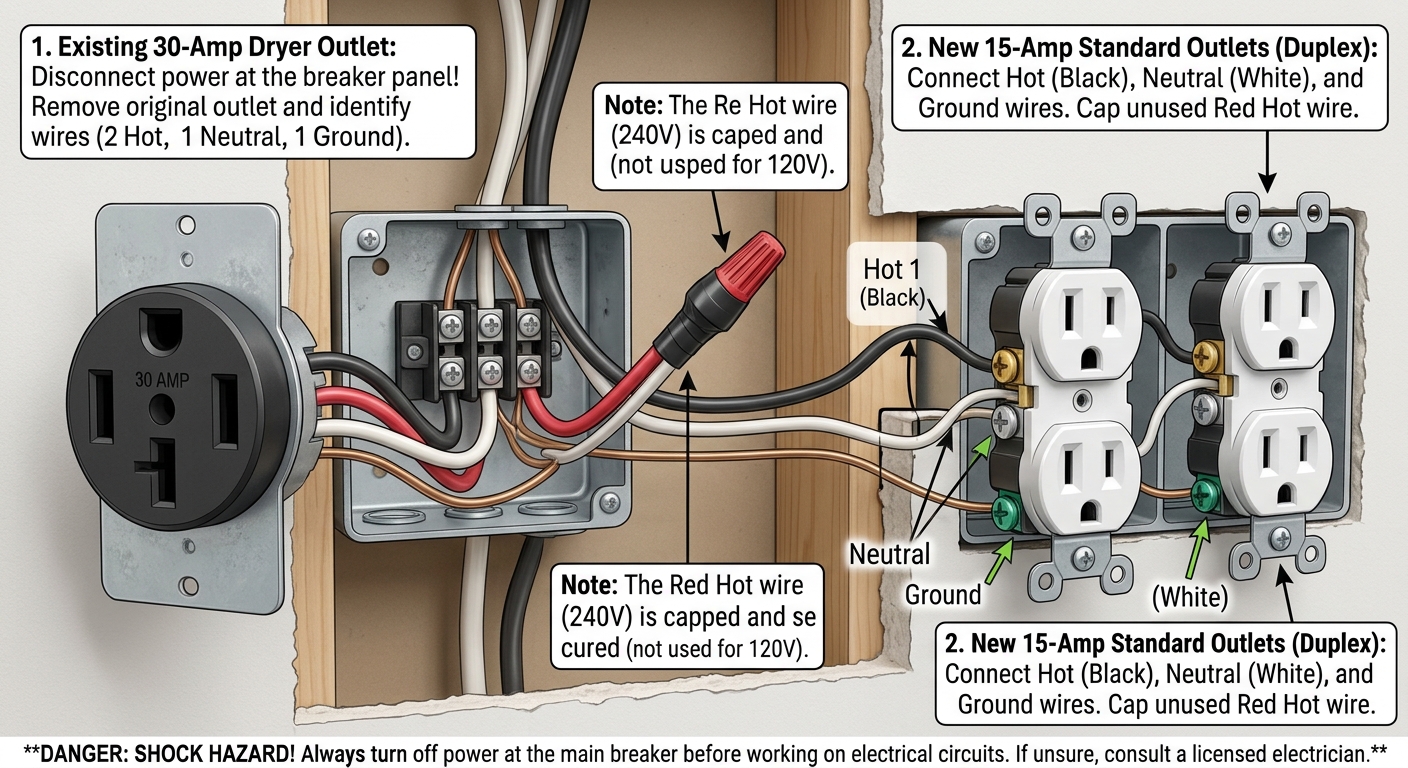
Whether you are reorganizing a laundry room, switching to a gas dryer, or repurposing garage space for workshops and electric vehicle (EV) equipment, dealing with an unused high-voltage 240-volt dryer receptacle is a common homeowner project. Standard household appliances—such as power tools, vacuum cleaners, and Level 1 EV chargers—run on standard 120-volt single-phase power. Converting an existing 240V/30A dryer outlet into a standard 120V (15-Amp or 20-Amp) duplex outlet allows you to reuse existing electrical infrastructure while ensuring full electrical code compliance.
However, converting high-voltage branch circuits requires more than simply swapping out the wall socket. Under the National Electrical Code (NEC Article 210 / Article 240), proper circuit breaker de-rating, wire color identification, and equipment grounding are mandatory to prevent electrical fires, wire overheating, and shock hazards.
For complete hardware reviews, installer guides, and panel load calculators, visit EV Charger Advisor.
1. Pre-Conversion Inspection: 4-Wire vs. 3-Wire Circuits
Before opening your main breaker panel or purchasing wall outlets, you must identify the physical conductor wiring inside the junction box:
A. 4-Wire Circuits (Modern Code Compliant – NEMA 14-30)
-
Conductor Setup: Contains four wires: Black (Hot 1), Red (Hot 2), White (Neutral), and Bare/Green (Equipment Ground).
-
Conversion Feasibility: 100% Code Compliant. The presence of a separate neutral and grounded conductor allows an easy, safe conversion to a 120V outlet.
B. 3-Wire Legacy Circuits (Pre-1996 – NEMA 10-30)
-
Conductor Setup: Contains three wires: Black (Hot 1), Red (Hot 2), and White (Combined Neutral/Ground).
-
Conversion Feasibility: Requires Rewiring or GFCI Rules. Because pre-1996 NEC codes allowed dryers to ground to the neutral wire, modern 120V duplex receptacles cannot legally be installed without a dedicated equipment ground wire, unless protected by a GFCI circuit breaker labeled “No Equipment Ground” under NEC 406.4(D)(2).
To learn more about how charger power levels and wire sizes compare, check out our guide on EV charging types.
2. The Two Primary Conversion Methods
Electricians use two primary methods to convert a dryer circuit safely:
Method 1: Permanent Hardwired Conversion (Recommended)
This method converts the entire branch circuit permanently down to a standard 120V receptacle:
-
Breaker Replacement: Replace the double-pole 30-Amp 240V breaker inside the main distribution panel with a single-pole 15-Amp or 20-Amp 120V breaker.
-
Capping the Unused Hot Conductor: Connect the Black wire to the new 120V single-pole breaker, connect the White wire to the main neutral busbar, connect the Bare Ground wire to the ground busbar, and cap the unused Red wire at both ends using wire nuts and electrical tape.
-
Receptacle Installation: Replace the heavy NEMA 14-30 wall socket with a standard 20A Commercial-Grade Duplex Receptacle.
Method 2: Using a UL-Listed Plug-In Power Adapter (No Rewiring)
If you are renting or want a non-permanent setup, you can purchase a UL-listed NEMA 14-30P to 5-15R/5-20R Power Adapter:
-
Built-in Overcurrent Protection: The adapter plugs directly into your 240V dryer outlet and features an integrated 15A or 20A fuse / thermal breaker to safely step down the output to 120V without modifying panel wiring.
To explore Wi-Fi-enabled smart wallboxes engineered with integrated load management features, read our guide on smart chargers.
Step-by-Step Mathematical Example: Circuit Sizing & Wire Ampacity Math
Let us analyze the electrical safety parameters of converting a 30-Amp 240V dryer branch circuit wired with #10 AWG Copper Wire down to a 20-Amp 120V household outlet running 50 feet ($15.24\text{ m}$) at a maximum continuous load of 16 Amps ($1.92\text{ kW}$).
Given Parameters:
-
Original Cable Gauge: #10 AWG Copper Wire (Ampacity rated at 30 Amps)
-
New Circuit Breaker Rating: $20 \text{ Amps (Single-Pole)}$
-
Continuous Load Current ($I$): $16 \text{ Amps}$
-
Nominal Line Voltage ($V$): $120 \text{ Volts}$
-
One-Way Conductor Length ($L$): $50 \text{ feet}$
-
Conductor Resistance for #10 AWG Copper ($R_{\text{wire}}$): $0.00124 \Omega \text{ per foot}$
Calculation 1: Maximum Continuous Power Output ($P_{\text{max}}$)
Calculation 2: NEC Overcurrent Protection Compliance Check
Under NEC 240.4, overcurrent protection (circuit breaker size) must protect the smallest component on the circuit:
-
Wire Safety Rule: Oversized wire (#10 AWG) is fully legal and safe on a smaller breaker (20A) because it reduces line resistance and voltage drop.
-
Device Safety Rule: You must downsize the breaker to 20A so the breaker trips before a 15A/20A wall outlet or plugged-in appliance experiences a short-circuit thermal overload.
Calculation 3: Voltage Drop ($\Delta V$) Calculation
For a single-phase 120V circuit ($2 \times L = 100\text{ ft}$ total loop path length):
Calculation 4: Percentage Voltage Drop (%)
Result Breakdown: Replacing the 30A double-pole breaker with a 20A single-pole breaker while keeping the original heavy #10 AWG copper wire safely delivers 1.92 kW of 120V power with a low 1.65% voltage drop.
Comparison Table: Dryer Outlet Conversion Parameters
| Parameter / Feature | Original 240V Dryer Circuit | Converted 120V Standard Circuit |
| Supply Voltage | 240V AC Single-Phase | 120V AC Single-Phase |
| Circuit Breaker | 30A Double-Pole Breaker | 15A or 20A Single-Pole Breaker |
| Outlet Receptacle | NEMA 14-30 or 10-30 Socket | NEMA 5-15R or 5-20R Duplex Outlet |
| Conductor Gauge | #10 AWG Copper Wire | #10 AWG Copper (Oversized for Safety) |
| Active Wires Used | Hot 1, Hot 2, Neutral, Ground | Hot 1 (Black), Neutral (White), Ground (Bare) |
| Status of Red Wire | Connected to Hot 2 | Disconnected & Capped at Both Ends |
Summary & Key Takeaways
-
Always Replace the Circuit Breaker: You must replace the 30A 240V double-pole breaker with a 15A or 20A 120V single-pole breaker inside the main panel to protect 120V appliances.
-
Cap the Unused Hot Conductor: Disconnect and safely terminate the Red hot wire at both the main breaker panel and wall outlet box using wire nuts.
-
Heavy Wire Is Advantageous: Reusing existing #10 AWG copper conductors on a 20A breaker provides lower line resistance and minimal voltage drop over long wire runs.
-
Use Fused Adapters for Temporary Setups: If using a plug-in adapter, ensure it includes built-in 15A/20A overcurrent fuses.













Leave a Reply