
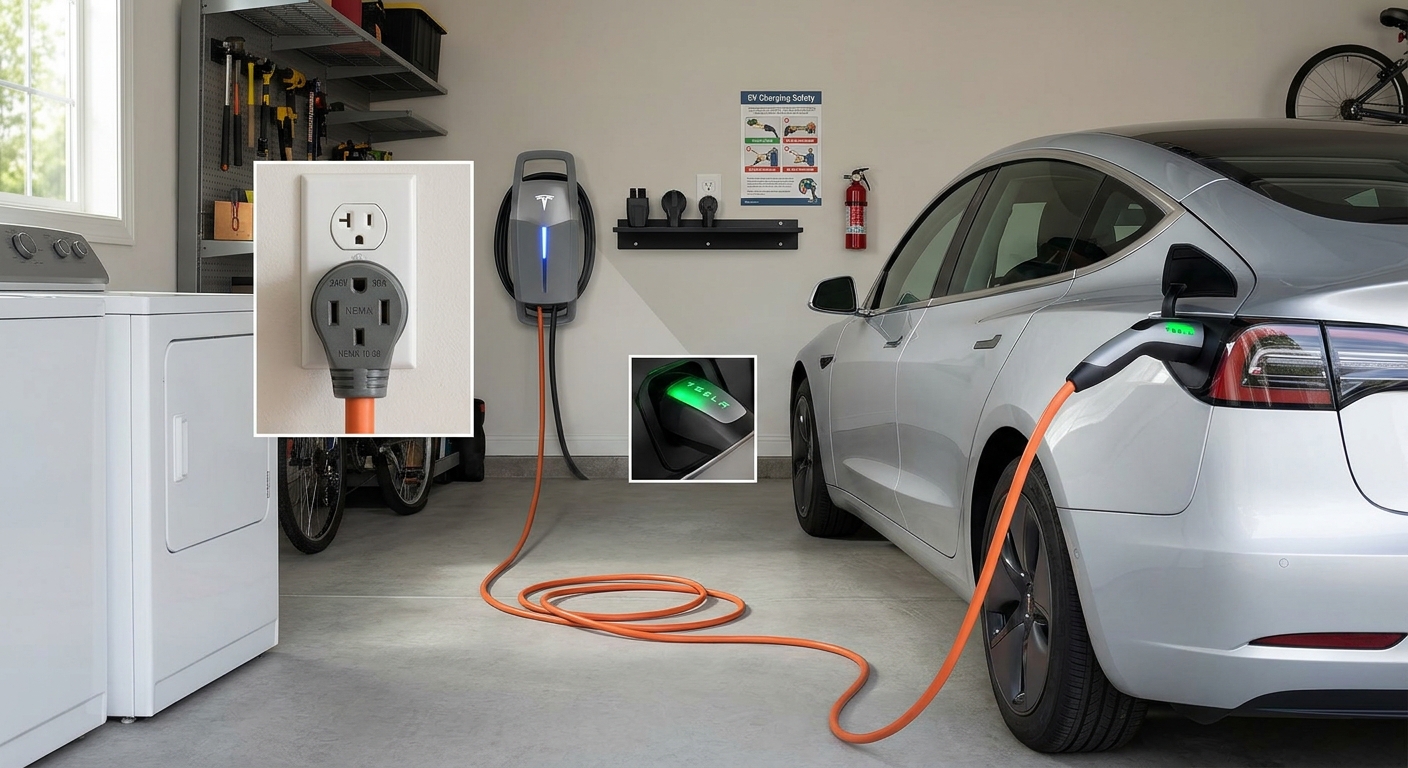
Upgrading to an electric vehicle (EV) brings immediate daily fuel savings, quiet acceleration, and zero local tailpipe emissions. Operating over a high-voltage 240-volt single-phase branch circuit, Level 2 home charging delivers 20 to 30 miles of driving range per hour—drastically faster than a standard 120-volt wall outlet. However, when new EV owners look for a quick 240V plug in their garage or laundry room, they often spot an existing heavy-duty receptacle and ask: Can I charge an EV from a dryer outlet?
The short answer is: yes, you can charge an electric vehicle from a 240-volt dryer outlet, but you must strictly follow key safety rules under the National Electrical Code (NEC Article 625) to avoid creating a severe electrical fire hazard or tripping circuit breakers.
While utilizing an existing 240V dryer receptacle (typically NEMA 10-30 or NEMA 14-30) avoids initial electrical wiring costs, doing so safely requires understanding continuous amperage limits, dedicated circuit rules, and smart switching hardware.
For complete hardware reviews, installer guides, and panel load calculators, visit EV Charger Advisor.
1. Key Safety Rules for Charging an EV from a Dryer Outlet
Before plugging a portable Level 2 EV charging cable into a dryer outlet, you must verify three mandatory safety conditions:
A. Rule 1: Respect the NEC 80% Continuous Duty Rule
-
The Continuous Duty Requirement (NEC 625.42): EV charging is classified as a continuous load (drawing maximum current for 3 hours or more).
-
Amperage De-Rating: Under electrical safety codes, a continuous load cannot exceed 80% of the circuit breaker’s maximum rating.
-
30-Amp Dryer Outlet Limit: A standard 30-Amp dryer circuit is rated for a maximum continuous draw of 24 Amps ($30\text{A} \times 0.80 = \mathbf{24\text{A}}$).
-
Hazard Warning: Plugging a standard 32A or 40A portable EV charger into a 30A dryer outlet will overheat the wiring, melt the receptacle, and pose a severe fire hazard. You must manually or automatically de-rate your charger output to 24 Amps or 16 Amps.
B. Rule 2: NEMA 10-30 vs. NEMA 14-30 Outlet Identification
-
Older Homes (NEMA 10-30): 3-prong ungrounded outlets installed prior to 1996. They feature two hot wires and a shared neutral/ground wire. Charging on a NEMA 10-30 requires a certified adapter with proper grounding safeguards.
-
Modern Homes (NEMA 14-30): 4-prong grounded outlets with two hots, a dedicated neutral, and a dedicated safety ground wire—offering much safer grounding for EV charging.
C. Rule 3: Use an Automatic Smart Dryer Switch (Splitter)
Plugging and unplugging heavy NEMA 30-Amp plugs daily causes physical socket degradation and arcing. To share a single dryer outlet between your clothes dryer and EV charger safely:
-
Install an Automatic Smart Dryer Switch (such as a NeoCharge or Splitvolt module).
-
How It Works: Both appliances remain plugged in. The smart switch prioritizes your clothes dryer; whenever the dryer starts, it automatically pauses EV charging and resumes charging when the laundry cycle ends.
To learn more about how charger power levels and wire sizes compare, check out our guide on EV charging types.
2. Dryer Outlet Charging vs. Hardwired Dedicated Level 2 Station
While a dryer outlet offers a temporary budget-friendly solution, hardwiring a dedicated Level 2 wallbox provides significant advantages:
-
Faster Charging Speed: A 30A dryer circuit capped at 24A continuous draw delivers 5.76 kW (~20 miles of range/hr). In contrast, a dedicated hardwired 60A circuit allows 48A continuous draw, delivering 11.52 kW (~44 miles of range/hr).
-
Eliminates Receptacle Heating: NEMA dryer outlets are designed for occasional appliance plugs, not continuous daily 8-hour EV thermal stress. Commercial-grade hardwiring eliminates socket degradation completely.
-
Avoids Nuisance Breaker Trips: Dedicated circuits ensure your EV charger operates independently without interfering with household laundry routines.
To explore Wi-Fi-enabled smart wallboxes engineered with integrated load management features, read our guide on smart chargers.
Step-by-Step Mathematical Example: Dryer Circuit Power & Charging Speed Calculation
Let us perform a technical calculation to determine the maximum continuous power output, percentage voltage drop ($\Delta V$), and charging duration to add 30 kWh of energy to an EV using a NEMA 14-30 Dryer Receptacle ($240\text{V}$ AC supply) running 45 feet ($13.72\text{ m}$) on #10 AWG Copper Wire ($R = 0.00124 \Omega/\text{ft}$) capped at 24 Amps continuous draw ($\eta = 0.90$).
Given Parameters:
-
Dryer Circuit Breaker Rating: $30 \text{ Amps}$
-
Max Allowed Continuous Draw (80% Rule): $30\text{A} \times 0.80 = \mathbf{24 \text{ Amps}}$
-
Supply Voltage ($V$): $240 \text{ Volts}$
-
One-Way Wire Length ($L$): $45 \text{ feet}$
-
Conductor Resistance ($R_{\text{wire}}$): $0.00124 \Omega \text{ per foot}$
-
Target Energy Replenishment ($E$): $30 \text{ kWh}$
-
Conversion Efficiency ($\eta$): $90\% \quad (0.90)$
Calculation 1: Continuous Gross Power Output ($P_{\text{gross}}$)
Calculation 2: Net Power Delivered to Battery Cells ($P_{\text{net}}$)
Calculation 3: Voltage Drop ($\Delta V$) Math
For a single-phase 240V circuit ($2 \times L = 90\text{ ft}$ total conductor loop path):
Calculation 4: Required Charging Session Duration ($T$)
Result Breakdown: Charging an EV from a 30A dryer outlet at a safe 24A continuous rate ($5.76\text{ kW}$) adds 30 kWh of range in 5 hours and 47 minutes with a minimal 1.12% voltage drop.
Comparison Table: Dryer Outlet Charging vs. Dedicated Hardwired Setup
| Feature / Parameter | NEMA 10-30 / 14-30 Dryer Outlet | Dedicated Hardwired Wallbox |
| Circuit Breaker Size | 30 Amps Double-Pole | 60 Amps Double-Pole |
| Max Continuous Current | 24 Amps (80% Rule Limit) | 48 Amps Continuous |
| Power Output (240V) | 5.76 kW | 11.52 kW |
| Miles of Range Added / Hour | ~18 – 22 Miles / Hour | ~36 – 44 Miles / Hour |
| Conductor Gauge Required | #10 AWG Copper | #6 AWG Copper Wire |
| Smart Switch Needed? | YES (If sharing with laundry dryer) | NO (Dedicated EV Circuit) |
Summary & Key Takeaways
-
Yes, But Follow Safety Limits: You can charge from a 30A dryer outlet, but continuous charging draw must be capped at 24 Amps (80% NEC rule).
-
Never Draw 30A Continuous: Drawing 30 Amps continuously on a 30A breaker will overheat electrical wiring and trigger circuit breakers.
-
Use a Smart Automatic Splitter: If sharing the outlet with a clothes dryer, install an automatic smart switch to prevent simultaneous appliance operation.
-
Hardwiring Is Faster & Safer: Upgrading to a dedicated hardwired 60A circuit delivers double the speed (11.52 kW) and eliminates outlet wear.













Leave a Reply