
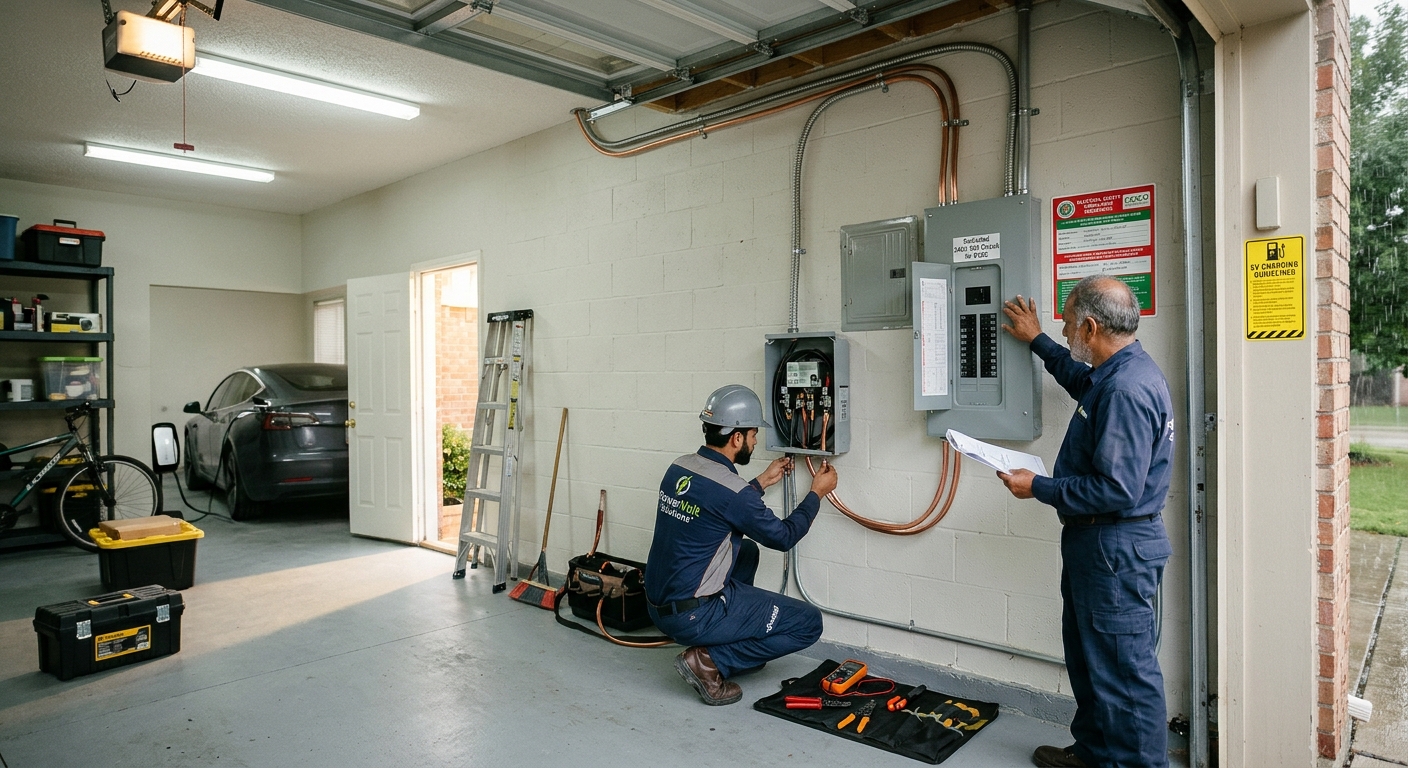
Transitioning to electric vehicle (EV) ownership brings instant daily fuel savings, smooth and responsive driving performance, and zero local tailpipe emissions. While public charging stations serve highway travel, the majority of refueling happens right at home. When preparing your garage or driveway for an EV, deciding between using a standard Level 1 cable or upgrading to a faster Level 2 charging station defines your installation requirements, electrical modifications, and daily charging speeds.
While a Level 1 charger simply plugs into an existing 120-volt household outlet, upgrading to a Level 2 wallbox requires a dedicated 240-volt single-phase branch circuit capable of restoring 20 to 44 miles of driving range per hour.
Understanding physical, electrical, and regulatory requirements under National Electrical Code (NEC Article 625) standards ensures your installation is safe, code-compliant, and tailored to your daily driving habits.
For complete hardware reviews, installer guides, and panel load calculators, visit EV Charger Advisor.
1. Level 1 vs. Level 2 Requirements Breakdown
The installation requirements vary drastically depending on whether you rely on a basic Level 1 portable cordset or install a hardwired Level 2 charging station:
A. Level 1 Charging Requirements (120V Standard AC)
-
Electrical Supply: Standard 120-Volt AC single-phase circuit.
-
Breaker & Outlet: Dedicated 15-Amp or 20-Amp single-pole circuit breaker with a standard NEMA 5-15 or NEMA 5-20 wall receptacle.
-
Charging Speed: Delivers 3 to 5 miles of range per hour ($1.44\text{ kW}$ output at 12A continuous draw).
-
Installation Work: None required if a dedicated, properly grounded 120V outlet is already located near your parking space.
B. Level 2 Charging Requirements (240V High-Voltage AC)
-
Electrical Supply: Dedicated 208V to 240-Volt AC single-phase branch circuit.
-
Breaker & Wire Gauge: Requires a dedicated 40-Amp to 60-Amp double-pole circuit breaker paired with heavy copper conductors (#6 AWG copper wire for 60A circuits).
-
Charging Speed: Delivers 20 to 44 miles of range per hour ($7.68\text{ kW}$ to $11.52\text{ kW}$ output).
-
Installation Work: Requires main electrical panel load calculations, dedicated wiring runs, optional municipal permits, and professional installation by a certified electrician.
To learn more about how charger power levels and wire sizes compare, check out our guide on EV charging types.
2. Four Essential Requirements for Installing a Level 2 Charger
Upgrading to a high-speed Level 2 station requires satisfying four primary electrical and structural criteria:
-
Dedicated Electrical Panel Capacity: EV charging is classified as a continuous load under NEC Article 625. Your main service panel must have adequate spare capacity (headroom) to support a 60A circuit. If your panel is maxed out (e.g., an older 100A panel), you can install a dynamic Electric Vehicle Energy Management System (EVEMS) to avoid a costly panel upgrade.
-
Dedicated Circuit Breaker (NEC 125% Rule): Because chargers draw maximum current continuously for 3+ hours, circuit breakers and wires must be sized at 125% of the charger’s continuous current draw ($48\text{A} \times 1.25 = \mathbf{60\text{A breaker}}$).
-
Dedicated Parking Space & Cable Reach: Mount the wallbox close to where your car is parked. Standard EVSE charging cables are 18 to 25 feet long. NEC rules mandate mounting heights between 18 inches (indoor) or 24 inches (outdoor) and 48 inches above ground level.
-
Direct Hardwiring vs. NEMA 14-50 Receptacles: Direct hardwiring is recommended over plug-in outlets. Hardwiring supports maximum 48A (11.52 kW) continuous output, avoids receptacle degradation/heating, and eliminates the requirement for expensive upstream 240V GFCI breakers.
To explore Wi-Fi-enabled smart wallboxes engineered with integrated load management features, read our guide on smart chargers.
Step-by-Step Mathematical Example: Level 1 vs. Level 2 Charging Speed & Sizing Math
Let us compare the charging time, breaker sizing, and power output for a vehicle battery needing 40 kWh of energy replenishment using a Level 1 cordset ($120\text{V} / 12\text{A}$ continuous) versus a Level 2 Hardwired Station ($240\text{V} / 48\text{A}$ continuous) at 90% AC/DC conversion efficiency ($\eta = 0.90$).
Given Parameters:
-
Net Energy Needed in Battery ($E$): $40 \text{ kWh}$
-
Conversion Efficiency ($\eta$): $90\% \quad (0.90)$
-
Gross AC Energy Required ($E_{\text{gross}}$): $40 / 0.90 = \mathbf{44.44 \text{ kWh}}$
Calculation 1: Level 1 Setup Sizing & Time ($120\text{V} / 12\text{A}$ Continuous)
Calculation 2: Level 2 Setup Sizing & Time ($240\text{V} / 48\text{A}$ Continuous)
Result Breakdown: While a Level 1 setup takes over 30.8 hours to restore 40 kWh of range, upgrading to a Level 2 charger on a 60A circuit (#6 AWG copper wire) reduces charging time to under 3.9 hours—delivering an 87.5% reduction in charging duration.
Comparison Table: Requirements Summary Matrix
| Metric / Requirement | Level 1 Charging Setup | Level 2 Charging Setup |
| Voltage Supply | 120V AC Single-Phase | 208V – 240V AC Single-Phase |
| Continuous Current | 12 Amps | 32 Amps to 48 Amps |
| Breaker Rating (NEC 125%) | 15A or 20A Single-Pole | 40A to 60A Double-Pole |
| Conductor Gauge | #14 AWG or #12 AWG Copper | #8 AWG or #6 AWG Copper |
| Power Output (kW) | $1.44\text{ kW}$ | $7.68\text{ kW}$ to $11.52\text{ kW}$ |
| Typical Range Added | 3 – 5 miles / hour | 20 – 44 miles / hour |
| Permit & Electrician Needed? | Rarely (Plugs into existing outlet) | YES (Electrical permit & licensed installer) |
Summary & Key Takeaways
-
Level 1 Needs No Major Upgrades: Plugs into an existing dedicated 120V outlet but takes 30+ hours for a full charge.
-
Level 2 Requires Dedicated 240V Circuit: Sizing a Level 2 48A charger requires a dedicated 60A double-pole breaker and #6 AWG copper conductors.
-
Follow the NEC 125% Rule: EV chargers are continuous loads; overcurrent protection devices must be rated at 1.25 times continuous draw.
-
Hardwiring Is Best Practice: Direct hardwiring delivers maximum 48A ($11.52\text{ kW}$) speed while eliminating plug degradation and extra GFCI breaker costs.













Leave a Reply