
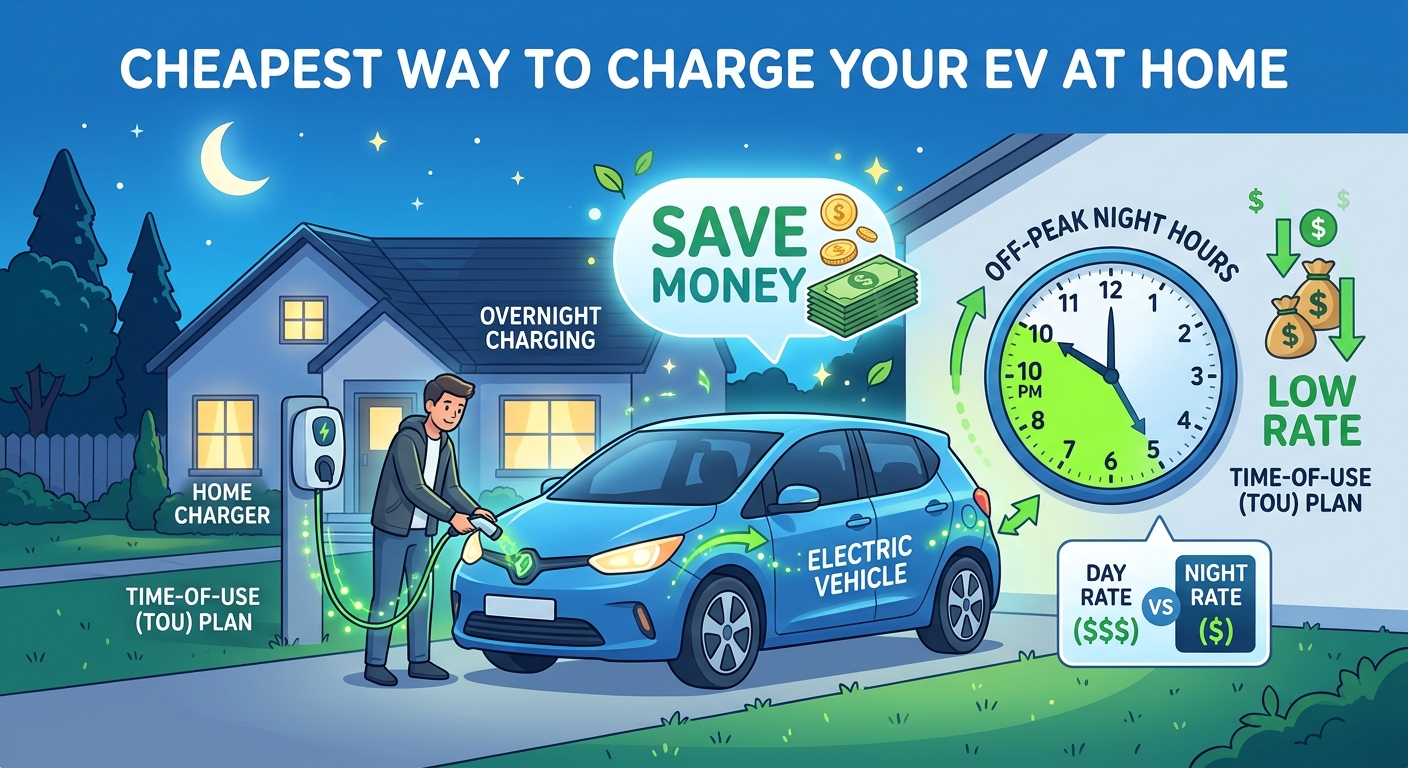
Upgrading your personal transportation to an electric vehicle (EV) unlocks whisper-quiet vehicle operation, zero local tailpipe emissions, and massive long-term fuel savings. Delivering 20 to 44 miles of driving range per hour over a high-voltage 240-volt single-phase branch circuit, installing a home Level 2 wallbox makes routine energy replenishment simple and predictable. However, as utility rate structures evolve and gasoline prices fluctuate, a critical financial question arises: What is the cheapest way to charge an EV at home?
The short answer is: the absolute cheapest way to charge an EV at home is by routing excess self-generated home solar power directly into your vehicle using a solar-smart Level 2 charger—reducing your effective fuel cost to near zero ($0.00 to $0.05/kWh). The second-cheapest method is utilizing Time-of-Use (TOU) overnight utility off-peak rates ($0.06 to $0.14/kWh).
By aligning your vehicle charging schedule with excess solar generation or off-peak grid hours under National Electrical Code (NEC Article 625 / Article 705) guidelines, you can maximize financial return and achieve payback on your home charger setup quickly.
For complete hardware reviews, installer guides, and panel load calculators, visit EV Charger Advisor.
1. The Three Tiers of Home EV Charging Costs
To minimize your monthly utility bill, it helps to rank the three primary home fueling methods by effective per-kilowatt-hour ($/\text{kWh}$) cost:
A. Tier 1: Excess Rooftop Solar Diversion ($0.00 – $0.05 / kWh)
-
How It Works: A solar-aware Level 2 wallbox (like the Wallbox Pulsar Plus or Emporia Charger) uses Current Transformer (CT) clamp sensors to track excess daytime solar PV generation. It automatically routes surplus electricity into your EV battery instead of exporting it back to the utility grid for low feed-in credits.
-
Effective Cost: Near zero (equivalent only to the minor opportunity cost of lost grid feed-in credits).
B. Tier 2: Time-of-Use (TOU) Super Off-Peak Overnight Rates ($0.06 – $0.14 / kWh)
-
How It Works: Electric utilities charge significantly lower rates during late-night hours (e.g., 12:00 AM to 6:00 AM) when overall grid demand is low. Smart wallboxes allow you to schedule automatic charging strictly during these off-peak windows.
-
Effective Cost: 50% to 70% cheaper than standard daytime residential tariffs.
C. Tier 3: Unmanaged Peak/Flat Grid Rates ($0.20 – $0.35+ / kWh)
-
How It Works: Plugging in your EV during peak evening hours (4:00 PM to 9:00 PM) on standard flat-rate utility tariffs.
-
Effective Cost: Highest residential cost, though still significantly cheaper than commercial public DC fast chargers ($0.45 – $0.55/kWh).
To learn more about how charger power levels and wire sizes compare, check out our guide on EV charging types.
2. Hardware & Setup Requirements for Maximum Savings
Achieving the lowest possible home charging rates requires configuring three essential technical components:
-
Smart Level 2 Wallbox with Wi-Fi: Ensure your wallbox supports automated Time-of-Use (TOU) scheduling or solar-matching modes via smartphone apps.
-
Dedicated Circuit Sizing (NEC 125% Rule): Operating a continuous Level 2 charger requires a dedicated 60-Amp double-pole circuit breaker and #6 AWG copper wire (THHN/THWN-2) to handle continuous 48A output ($11.52\text{ kW}$) safely.
-
Utility Smart Meter & TOU Plan: Contact your local power utility to switch your home account to an EV-specific Time-of-Use (TOU) tariff plan.
To explore Wi-Fi-enabled smart wallboxes engineered with integrated load management features, read our guide on smart chargers.
Step-by-Step Mathematical Example: Annual Cost Comparison Math
Let us calculate the net annual cost difference for a driver commuting 12,000 miles per year in an EV achieving an energy efficiency rating of 3.5 Miles per kWh ($3,428.57\text{ kWh/year}$ consumed) across three different charging strategies vs. a gasoline vehicle.
Given Parameters:
-
Annual Driving Energy Needed ($E$): $12,000 / 3.5 = \mathbf{3,428.57 \text{ kWh / year}}$
-
Option A (Excess Daytime Solar Diversion): $\$0.04 \text{ per kWh}$ (Opportunity Feed-In Cost)
-
Option B (Super Off-Peak TOU Grid Rate): $\$0.10 \text{ per kWh}$
-
Option C (Standard Flat-Rate Grid Tariff): $\$0.22 \text{ per kWh}$
-
Option D (Gasoline ICE Vehicle – 30 MPG at $3.80/gal): $\$0.1267 \text{ per mile}$ ($12,000 \times 0.1267 = \mathbf{\$1,520.40/year}$)
Calculation 1: Annual Cost Charging via Excess Home Solar ($C_{\text{solar}}$)
Calculation 2: Annual Cost Charging via Off-Peak TOU Rates ($C_{\text{off-peak}}$)
Calculation 3: Annual Cost Charging via Standard Flat-Rate Grid ($C_{\text{flat}}$)
Calculation 4: Annual Net Savings (Solar vs. Gasoline)
Result Breakdown: Charging via excess home solar power costs just $137.14 per year, saving $1,383.26 annually compared to gasoline and cutting annual fueling costs by 81.8% compared to standard flat-rate grid charging.
Comparison Table: Home EV Charging Cost Matrix
| Charging Method | Typical Cost per kWh | Annual Cost (12,000 Miles) | Hardware Required | Financial Savings vs. Gasoline |
| Excess Home Solar PV | $0.00 – $0.05 | ~$137 | Solar PV + Solar-Smart Wallbox | 91% Fuel Savings |
| Overnight Off-Peak TOU Grid | $0.06 – $0.14 | ~$343 | Smart Level 2 Charger + TOU Plan | 77% Fuel Savings |
| Standard Peak Flat-Rate Grid | $0.20 – $0.35 | ~$754 | Standard Level 2 Charger | 50% Fuel Savings |
| Gasoline ICE Vehicle (30 MPG) | N/A ($3.80/gal) | ~$1,520 | Gasoline Internal Combustion Engine | Baseline (0% Savings) |
Summary & Key Takeaways
-
Home Solar Is Cheapest: Using excess self-generated daytime solar power lowers your effective charging cost to roughly $0.00 to $0.05 per kWh.
-
Overnight Off-Peak Is Second Best: If solar is unavailable, schedule your smart charger to run during late-night TOU off-peak utility hours ($0.06 – $0.14/kWh).
-
Use Solar-Smart Wallboxes: Invest in a smart charger equipped with CT clamps to track real-time solar generation automatically.
-
Follow NEC 125% Rules: Hardwire your 48A charger to a dedicated 60A double-pole circuit breaker with #6 AWG copper wire for safety and code compliance.













Leave a Reply