
Installing a residential solar photovoltaic (PV) array paired with a Home Battery Energy Storage System (BESS—such as a Tesla Powerwall, Enphase IQ Battery, or SolarEdge Energy Bank) is the gold standard for clean energy resilience and lower utility bills. Delivering 20 to 44 miles of driving range per hour over a high-voltage 240-volt single-phase branch circuit, hardwiring a home Level 2 EV wallbox makes daily vehicle replenishment simple and convenient. However, because electric vehicle battery packs are massive ($60\text{ kWh}$ to $100\text{ kWh}+$), many homeowners encounter an unexpected issue: plugging in their EV at night rapidly depletes their entire home storage battery within hours, leaving zero backup power for essential household appliances. A critical question arises: How do you prevent EV charging from draining your home solar battery?
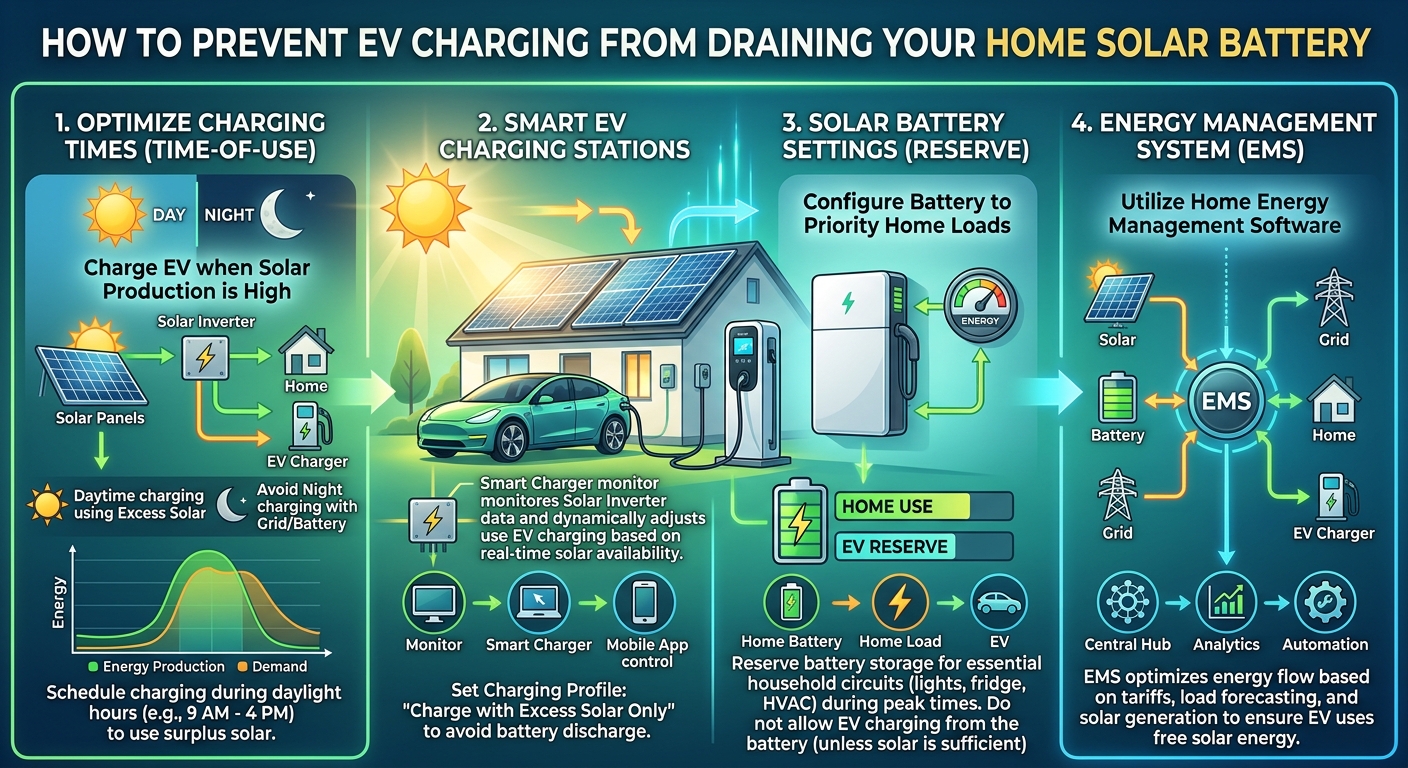
The short answer is: you can prevent EV charging from draining your home solar battery by configuring software reserve thresholds in your battery app, setting up Home Energy Management Systems (HEMS) with dynamic CT clamps, wiring the EV charger upstream on the non-backed-up side of your automatic transfer switch, or using smart time-of-use (TOU) charging schedules.
By properly configuring your software settings, adjusting hardware wiring, or scheduling charging times under National Electrical Code (NEC Article 625 / Article 706) standards, you can protect your emergency home battery reserves while enjoying high-speed Level 2 EV charging.
For complete hardware reviews, installer guides, and panel load calculators, visit EV Charger Advisor.
1. The Three Primary Strategies to Protect Your Home Battery
Homeowners and installers can choose between software-driven, hardware-wiring, and tariff-scheduling solutions to prevent unwanted battery drain:
A. Software Controls: Reserve Limits & Ecosystem Pairing
-
Set a Backup Reserve Percentage: In your home battery management app (e.g., Tesla or Enphase app), set a minimum battery reserve limit (e.g., 20% to 50%). Once the home battery drains down to this threshold, the system automatically stops supplying power to the EV charger and switches to utility grid power.
-
Native Ecosystem Integration: When using a charger and battery from the same manufacturer (such as an Enphase EVSE + Enphase Battery or Tesla Wall Connector + Powerwall), activate “Solar-Only” charging modes. The system automatically pauses EV charging whenever solar PV generation drops below household load, preventing the storage battery from discharging into the vehicle.
B. Physical Hardware Wiring: Upstream Non-Backed-Up Panel Installation
-
Non-Essential Circuit Wiring: Rather than wiring the EV charger downstream inside the backed-up essential loads panel, your electrician wires the dedicated 60A double-pole breaker directly into the main service panel upstream of the Automatic Transfer Switch (ATS) or Gateway.
-
How It Protects Your Battery: Because the EV charger sits outside the isolated battery backup loop, the home battery physically cannot discharge into the EV charger during nighttime hours or grid power outages.
C. Smart Time-of-Use (TOU) & Nighttime Scheduling
-
Off-Peak Grid Charging: Program your smart EV wallbox to charge during late-night hours (e.g., 12:00 AM to 6:00 AM) when utility off-peak rates are lowest.
-
Battery Discharge Inhibit: Configure your battery inverter to lock out battery discharge during designated overnight charging hours, forcing the EV wallbox to draw power directly from the grid at low off-peak tariffs while preserving 100% of your solar battery capacity for peak morning home usage.
To learn more about how charger power levels and wire sizes compare, check out our guide on EV charging types.
2. Electrical Safety & Protection Chain Standards
Whether your charger is wired upstream or controlled via smart software, your installation must adhere to strict NEC requirements:
-
NEC 625.42 Continuous Duty Rule: Sizing for a 48-Amp continuous EV wallbox requires a dedicated 60-Amp double-pole circuit breaker and heavy-gauge #6 AWG copper wire (THHN/THWN-2).
-
NEC 706 Energy Storage Requirements: Stationary energy storage systems must include rapid shutdown controls and load-shedding mechanisms to prevent total battery collapse when high-amperage continuous loads (like EV chargers) activate.
-
Hardwired Reliability: Hardwiring directly eliminates thermal plug degradation, avoids expensive industrial GFCI receptacle requirements, and guarantees stable communication between your charger and HEMS sensors.
To explore Wi-Fi-enabled smart wallboxes engineered with integrated load management features, read our guide on smart chargers.
Step-by-Step Mathematical Example: Battery Reserve Protection & Load Shedding Math
Let us analyze a home equipped with a 13.5 kWh Home Storage Battery ($100\text{A}$ main panel supply, $240\text{V}$ single-phase) operating a 32-Amp Level 2 EV Charger ($7.68\text{ kW}$ output) where the homeowner sets a 30% Backup Reserve Threshold.
Given Parameters:
-
Total Nameplate Battery Capacity ($C_{\text{total}}$): $13.5 \text{ kWh}$
-
Configured Backup Reserve Threshold ($R$): $30\% \quad (0.30)$
-
Initial Battery Charge Level at Dusk ($SOC$): $90\% \quad (0.90)$
-
Continuous EV Charger Draw ($P_{\text{EV}}$): $32\text{A} \times 240\text{V} / 1000 = \mathbf{7.68 \text{ kW}}$
-
Baseline Evening Household Load ($P_{\text{house}}$): $1.20 \text{ kW}$
-
Battery Discharge Efficiency ($\eta$): $92\% \quad (0.92)$
Calculation 1: Total Usable Battery Energy Before Reaching 30% Reserve ($E_{\text{usable}}$)
Calculation 2: Rapid Drain Duration Without Software Restrictions ($T_{\text{drain}}$)
If the EV charger operates unmanaged alongside household loads ($P_{\text{total}} = 7.68\text{ kW} + 1.20\text{ kW} = 8.88\text{ kW}$):
Calculation 3: Protected Evening Runtime for Household Loads Alone ($T_{\text{house}}$)
When software load-shedding disconnects the EV charger and reserves energy exclusively for household loads ($P_{\text{house}} = 1.20\text{ kW}$):
Result Breakdown: Without software restrictions, an unmanaged 32A EV charger drains the usable battery capacity in 50 minutes. Setting a 30% software reserve threshold or load-shedding rule shuts off the EV charger, preserving 6.2+ hours of essential home backup power.
Comparison Table: Methods to Prevent Home Battery Drain
| Protection Method | Primary Mechanism | Hardware / Wiring Cost | Complete Battery Isolation? | Flexibility |
| App Reserve Percentage | Software threshold limit in battery app | $0 (Built-in software) | Partial (Stops at reserve limit) | High (Adjustable anytime) |
| Upstream Non-Backup Wiring | Wires charger outside ATS transfer switch | $100 – $300 (Electrician labor) | YES (100% Isolated) | Fixed (Cannot charge from battery) |
| TOU Schedule Lockout | Schedules EV charger during off-peak grid hours | $0 (Smart wallbox feature) | High (Grid powers EV at night) | High (Easy app programming) |
| Integrated HEMS Ecosystem | CT clamps track real-time solar surplus | $200 – $500 (Sensor modules) | YES (Charges ONLY on excess solar) | Maximum Efficiency & Protection |
Summary & Key Takeaways
-
Use Software Reserve Controls: Set a 20% to 50% backup reserve threshold in your home battery app to stop EV charging automatically before depletion.
-
Wire Upstream for Full Isolation: Have an electrician wire the charger on the non-backed-up main panel side of your Automatic Transfer Switch (ATS).
-
Program TOU Grid Hours: Schedule EV charging during super off-peak nighttime hours while locking out battery discharge.
-
Follow NEC Rules: Sizing high-amperage 240V branch circuits requires a dedicated 60A breaker and #6 AWG copper wire.













Leave a Reply