
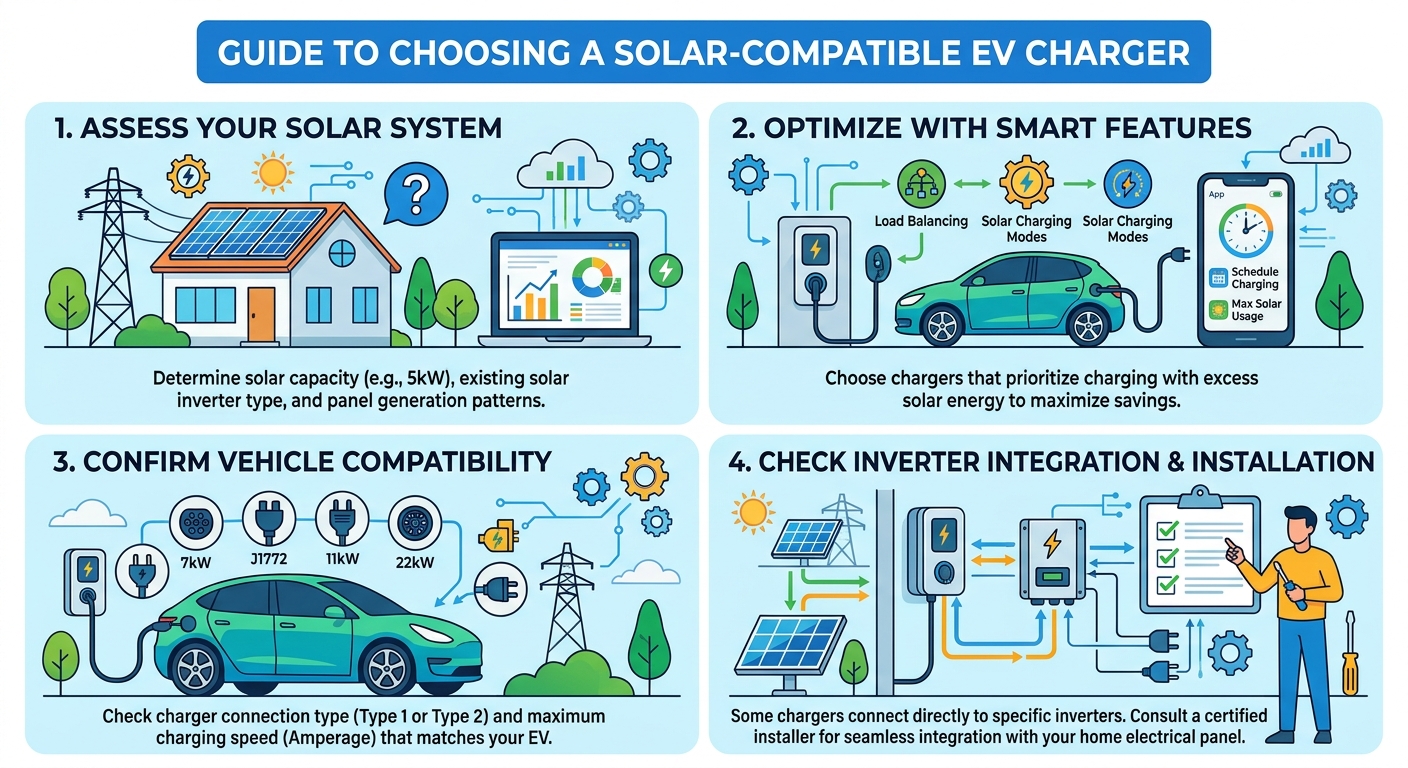
Pairing electric vehicle (EV) charging with a residential solar photovoltaic (PV) array is the most cost-effective and environmentally clean strategy for personal transportation. Delivering 20 to 44 miles of driving range per hour over a high-voltage 240-volt single-phase branch circuit, installing a solar-aware Level 2 wallbox transforms your driveway into a zero-emissions fueling station. However, not all EV chargers interact with solar systems in the same way. Choosing the wrong wallbox can lead to unnecessary utility grid fees, wasted solar export, or complex wiring retrofits. A primary buyer question arises: How do you choose a solar-compatible EV charger for home?
The short answer is: choosing a solar-compatible EV charger requires evaluating four key factors: native dynamic solar-tracking capabilities (using CT clamps or energy meters), flexible charging modes (Eco vs. 100% Green Eco+), seamless software integration with your inverter/battery ecosystem, and proper circuit breaker sizing compliant with National Electrical Code (NEC Article 625 / Article 705) standards.
By balancing your solar setup, electrical grid, and charging habits, you can select a wallbox that maximizes self-consumption savings and minimizes fossil-fuel reliance.
For complete hardware reviews, installer guides, and panel load calculators, visit EV Charger Advisor.
1. Key Features to Look for in a Solar-Smart EV Charger
When evaluating Level 2 wallboxes for home solar integration, ensure the unit includes these four essential technical capabilities:
A. Dynamic Solar Diversion (CT Clamp Monitoring)
-
How It Works: A solar-compatible charger relies on external Current Transformer (CT) clamp sensors attached to your incoming main utility lines.
-
Why It Matters: The CT clamps measure real-time electricity export to the grid. When your solar panels produce more power than your home appliances consume, the charger dynamically ramps up charging current to absorb the excess solar energy before it spills back into the utility grid.
B. Flexible Charging Modes (Fast, Eco, and 100% Green / Eco+)
Look for wallboxes that offer customizable software charging profiles:
-
Fast Mode: Operates at full continuous power (48A / $11.52\text{ kW}$), pulling power simultaneously from solar and the grid.
-
Eco Mode (Solar + Grid Hybrid): Prioritizes solar energy, pulling a small baseline from the grid only when solar generation drops below the minimum EVSE threshold (1.4 kW / 6A).
-
100% Green / Eco+ Mode: Charges only when excess solar production exceeds 1.4 kW. If clouds pass over or home loads increase, the charger automatically pauses until solar surplus recovers.
C. Inverter & Home Battery Storage Ecosystem Compatibility
If your home features a solar battery storage system (such as Tesla Powerwall, Enphase IQ, or SolarEdge), ensure the charger communicates seamlessly with your battery management system (BMS). This prevents the EV charger from unintentionally draining your home backup battery during high-tariff evening hours.
To learn more about how charger power levels and wire sizes compare, check out our guide on EV charging types.
2. Hardware & Electrical Sizing Requirements
Selecting the right charger requires matching the wallbox to your home’s electrical panel capacity and solar array size:
-
Breaker Sizing & Continuous Duty (NEC 125% Rule): EV chargers operate continuously for 3+ hours. Operating a maximum 48-Amp continuous solar wallbox requires a dedicated 60-Amp double-pole circuit breaker and #6 AWG copper wire (THHN/THWN-2).
-
Minimum Solar Array Threshold: Because international safety standards require a minimum of 6 Amps ($1.44\text{ kW}$ at $240\text{V}$) to initiate an EV AC charging session, your solar system should consistently yield at least 2.0 kW to 3.0 kW of peak surplus for practical solar-only charging.
-
Hardwired vs. Plug-In: Choose a direct hardwired wallbox connection. Hardwiring supports maximum continuous output ($11.52\text{ kW}$ vs. $7.68\text{ kW}$ plug-in limit), eliminates plug wear, and avoids expensive 240V GFCI receptacle requirements.
To explore Wi-Fi-enabled smart wallboxes engineered with integrated load management features, read our guide on smart chargers.
Step-by-Step Mathematical Example: Solar Self-Consumption Savings Math
Let us calculate the net annual savings and payback period for a homeowner driving 12,000 miles per year in an EV achieving 3.5 Miles per kWh ($3,428.57\text{ kWh/year}$ consumed) who upgrades from a basic charger to a Solar-Smart EV Wallbox ($650 hardware + $450 install) paired with an existing solar system.
Given Parameters:
-
Annual Driving Energy Needed ($E$): $12,000 / 3.5 = \mathbf{3,428.57 \text{ kWh / year}}$
-
Standard Grid Tariff Rate ($R_{\text{grid}}$): $\$0.22 \text{ per kWh}$
-
Solar Feed-In Tariff / Export Credit ($R_{\text{export}}$): $\$0.05 \text{ per kWh}$
-
Net Value of Self-Consumed Solar Energy: $\$0.22 – \$0.05 = \mathbf{\$0.17 \text{ saved per kWh}}$
-
Target Solar Energy Absorption Ratio: $80\% \quad (2,742.86 \text{ kWh from solar / } 685.71 \text{ kWh from grid})$
-
Total Upgrade Investment: $\$1,100.00$
Calculation 1: Annual Cost Charging Exclusively on Utility Grid ($C_{\text{grid}}$)
Calculation 2: Annual Cost with Solar-Smart Charger ($C_{\text{solar}}$)
Calculation 3: Net Annual Energy Savings ($\Delta C$)
Calculation 4: Payback Period Calculation
Result Breakdown: Directing excess solar generation into your EV battery saves $466.29 annually in avoided grid electricity costs, allowing the solar charger setup to achieve 100% payback in under 2.5 years.
Comparison Table: Top Solar-Compatible Home EV Chargers
| Charger Model | Dynamic Solar Tracking Method | Solar Modes Available | Ecosystem / Inverter Support | Max Output Power |
| Wallbox Pulsar Plus | Power Boost CT Meter | Eco & Full-Green (Eco+) | Universal (Any Solar Array) | 48A (11.52 kW) |
| Zappi myenergi | Built-in CT Clamps | Eco, Eco+, and Fast | Universal / Home Battery Aware | 32A – 48A |
| Emporia Smart EVSE | Vue 3 Energy Monitor Integration | Excess Solar Optimization | Universal (Emporia Ecosystem) | 48A (11.52 kW) |
| Enphase IQ EV Charger | Enphase Energy System Integration | 100% Green / Scheduled | Enphase Solar Inverters | 32A – 48A |
Summary & Key Takeaways
-
Prioritize Dynamic CT Clamps: Select a wallbox equipped with current transformer (CT) clamps to track real-time solar export.
-
Look for 100% Green Modes: Eco+ modes pause charging during cloud cover, ensuring 0% fossil-fuel utility grid draw.
-
Check Solar Output Thresholds: Your solar array must yield at least 1.4 kW to 2.0 kW of surplus power to initiate AC solar charging.
-
Follow NEC 125% Rules: Size overcurrent breakers and #6 AWG copper wiring at 125% of continuous charger output.













Leave a Reply