
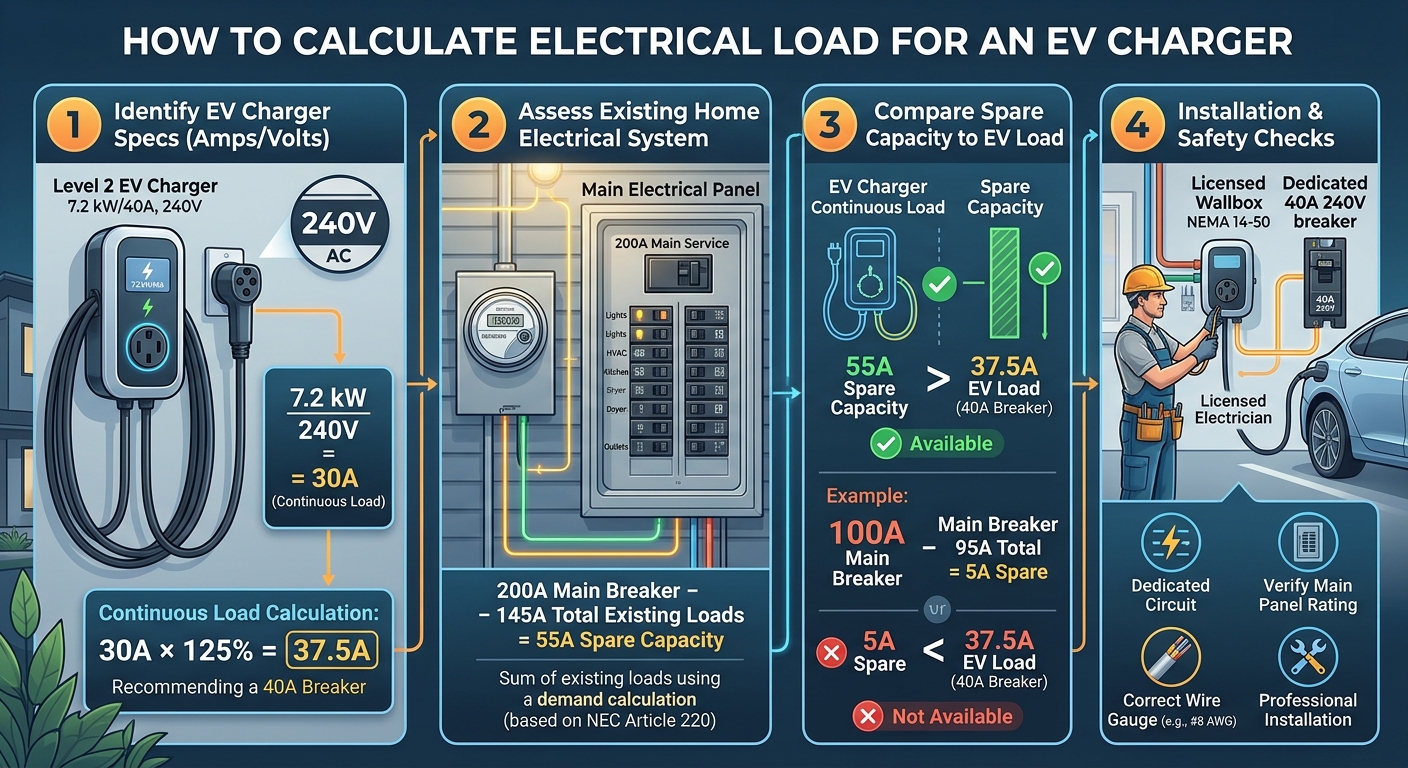
Upgrading your home for electric vehicle (EV) charging delivers immediate fuel savings, whisper-quiet vehicle operation, and zero local tailpipe emissions. Delivering 20 to 44 miles of driving range per hour over a high-voltage 240-volt single-phase branch circuit, Level 2 wallboxes transform vehicle charging into an effortless overnight routine. However, when homeowners or commercial property owners realize their main electrical service panel lacks the spare capacity for a dedicated 60A circuit breaker, a primary question arises: Which EV charger has the best load management system?
the EV chargers with the best load management systems are the Wallbox Pulsar Plus (with Power Boost), the Emporia Pro EV Charger (with PowerSmart / Vue 3 integration), and the Tesla Wall Connector (Gen 3 / Universal with Neurio Meter or Group Power Sharing).
These industry-leading systems utilize an Electric Vehicle Energy Management System (EVEMS) compliant with National Electrical Code (NEC Article 625 / Article 750) rules. By measuring real-time household electrical demand using current transformer (CT) sensor clamps, they dynamically scale charging output to keep total energy draw safely within main panel limits, helping homeowners avoid $1,500 to $5,000+ in electrical service panel upgrades.
For complete hardware reviews, installer guides, and panel load calculators, visit EV Charger Advisor.
1. Detailed Reviews of the Top 3 EV Chargers with Load Management
Evaluating the top EV chargers reveals distinct technical strengths depending on your garage setup and budget:
A. Wallbox Pulsar Plus (Best Overall Dynamic Load Management)
-
System Name: Power Boost Technology
-
How It Works: Connects to an external DIN-rail mounted power meter and dual CT clamps inside your main panel. It measures whole-home amperage in real time and automatically throttles charging speed when major appliances (HVAC, clothes dryer, electric range) cycle on.
-
Standout Feature: Offers exceptional multi-charger load balancing, solar matching (Full-Green and Eco Mode), and rapid real-time power adjustment.
B. Emporia Pro EV Charger (Best Value & Energy Ecosystem)
-
System Name: PowerSmart Load Management
-
How It Works: Ships bundled directly with the Emporia Vue 3 Energy Monitor. CT clamps measure whole-home electricity draw and communicate wirelessly or hardwired with the charger via the Emporia app.
-
Standout Feature: Delivers high-end dynamic load management for older 60A or 100A panels at an aggressive price point.
C. Tesla Wall Connector Gen 3 / Universal (Best Multi-EV Power Sharing)
-
System Name: Group Power Management & Dynamic Power Management (DPM)
-
How It Works: Supports software-based group power sharing for up to 6 Wall Connectors linked wirelessly on a single circuit breaker. When paired with an approved Neurio meter setup, it also supports full dynamic panel load management.
-
Standout Feature: Seamless wireless mesh network between chargers with zero additional data cables required for group circuit sharing.
To learn more about how charger power levels and wire sizes compare, check out our guide on EV charging types.
2. Key Criteria to Evaluate When Buying an EVEMS Charger
Before choosing a load-managed wallbox, ensure the hardware meets four technical requirements:
-
NEC 625.42 & 750 Listing: Verify that the EVSE and energy management hardware are UL-listed for automatic load management to ensure local electrical inspector sign-off.
-
Response Time: The system must respond within seconds to sudden household spike loads (e.g., an electric water heater turning on) to prevent thermal breaker tripping.
-
Failsafe Safe-Mode Operations: If network communication between the CT clamps and the wallbox fails, the charger must automatically fall back to a safe lower current limit (typically 6A to 12A).
-
Wireless vs. Hardwired CT Communication: RS-485 wired data connections provide high reliability across long conduit runs, while Wi-Fi CT monitoring offers easier installation near adjacent electrical panels.
To explore Wi-Fi-enabled smart wallboxes engineered with integrated load management features, read our guide on smart chargers.
Step-by-Step Mathematical Example: Dynamic Load Balancing Response Calculation
Let us perform a technical load calculation for a home equipped with a 100-Amp Main Panel ($240\text{V}$ single-phase supply = $24.0\text{ kW}$ peak rating) operating a Wallbox Pulsar Plus with Power Boost.
Given Parameters:
-
Main Panel Service Rating ($P_{\text{panel}}$): $100\text{A} \times 240\text{V} = 24.0 \text{ kW}$
-
NEC 80% Safe Continuous Threshold: $24.0 \text{ kW} \times 0.80 = \mathbf{19.2 \text{ kW (80 Amps)}}$
-
Baseline House Load (Lights, TV, Fridge): $3.2 \text{ kW (13.33 Amps)}$
-
Heavy Appliance Spike Load (HVAC + Dryer + Cooking): $+12.8 \text{ kW (53.33 Amps)}$
-
EV Charger Max Rating ($I_{\text{max}}$): $48 \text{ Amps continuous } (11.52 \text{ kW})$
Calculation 1: Available EV Charging Power During Baseline House Load
Since $16.00\text{ kW}$ exceeds the charger’s max output ($11.52\text{ kW}$), the EVEMS safely allows full 48A output:
Calculation 2: Throttled Power Delivery When Heavy Appliances Turn ON
Total house load jumps to $3.20\text{ kW} + 12.80\text{ kW} = \mathbf{16.00 \text{ kW (66.67 Amps)}}$:
Calculation 3: Dynamically Throttled Amperage Output ($I_{\text{throttled}}$)
Result Breakdown: When heavy appliances activate, the dynamic load management system throttles EV output from 48 Amps ($11.52\text{ kW}$) down to 13.33 Amps ($3.2\text{ kW}$) in real time, keeping overall home consumption at exactly 80.0 Amps, preventing main panel overloads.
Comparison Table: Top EV Chargers with Load Management Systems
| Charger Model | Load Management Technology | CT Clamp Hardware Included? | Multi-Charger Power Sharing | Main Panel Upgrade Avoidance |
| Wallbox Pulsar Plus | Power Boost Dynamic Meter | Optional / Bundle | Up to 25 Units | Exceptional (Best for Small Panels) |
| Emporia Pro EV Charger | PowerSmart + Vue 3 Monitor | YES (Bundled) | Software App-based | Exceptional (Best Budget Value) |
| Tesla Wall Connector | DPM (Neurio) / Group Sharing | Optional Neurio Meter | Up to 6 Units (Wireless) | High (Great for Multi-Tesla Garages) |
Summary & Key Takeaways
-
Top Contenders: Wallbox Pulsar Plus, Emporia Pro, and Tesla Wall Connector offer the best EVEMS load management systems on the market.
-
Saves Thousands on Upgrades: Dynamic CT monitoring adjusts charging speeds in real time, allowing 48A wallboxes on 100A service panels.
-
Emporia Offers Best Value: The Emporia Pro ships bundled directly with the Vue 3 energy monitor and CT clamps.
-
Wallbox Excels at Solar & Dynamic Balancing: Wallbox Power Boost delivers high responsiveness and integrated solar-matching modes.













Leave a Reply