
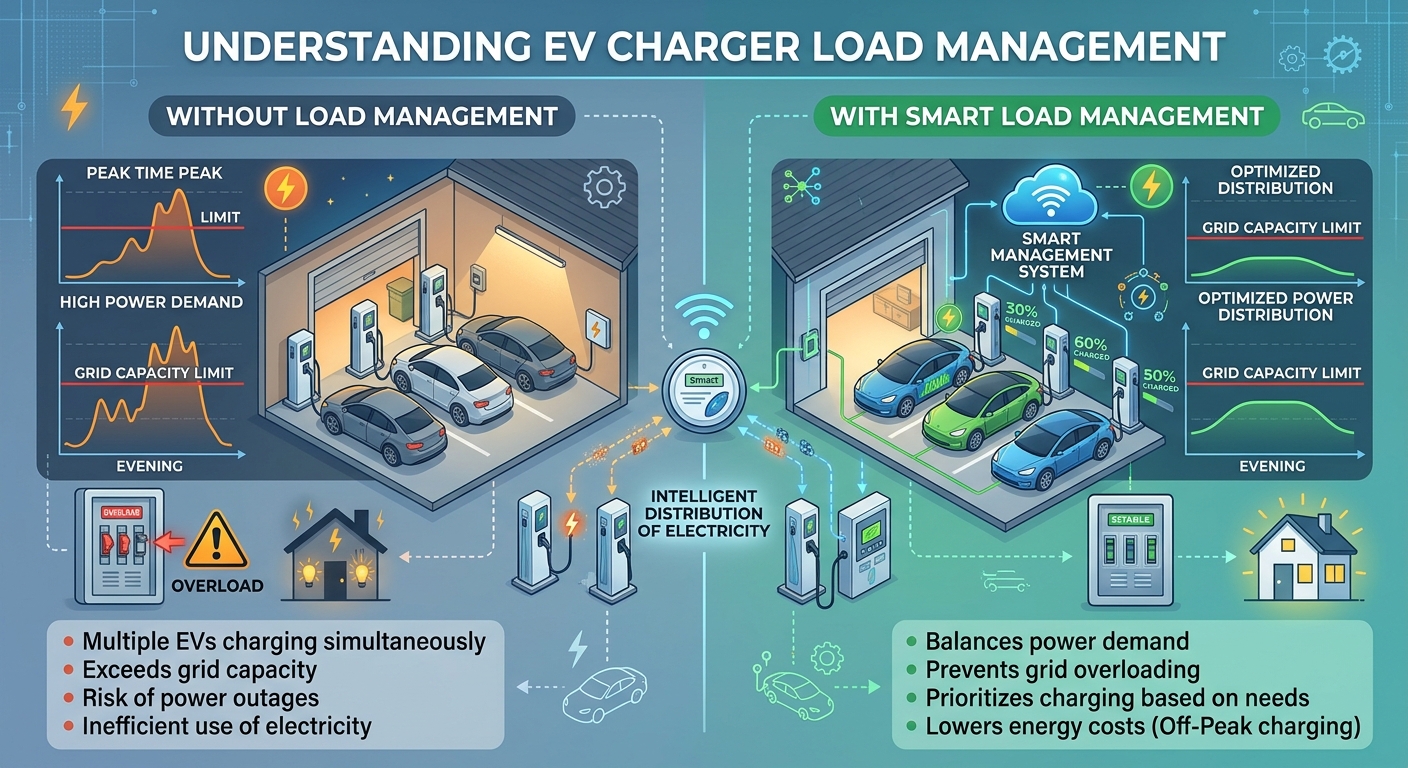
Upgrading your home or commercial property for electric vehicle (EV) charging provides low-cost energy replenishment, quiet daily vehicle performance, and zero local tailpipe emissions. Delivering 20 to 44 miles of driving range per hour over a high-voltage 240-volt single-phase branch circuit, home Level 2 wallboxes transform routine charging into an effortless overnight process. However, as property owners add multiple chargers or evaluate main electrical service panel limits, a primary technical question arises: What is load management on an EV charger?
The short answer is: load management (also known as an Electric Vehicle Energy Management System, or EVEMS) is an automated system that controls and optimizes how electrical power is distributed across EV chargers so that total energy demand never exceeds the safe, rated capacity of a home’s main electrical panel or a commercial building’s grid connection.
Under National Electrical Code (NEC Article 625) standards, installing load management hardware or smart power-sharing protocols allows property owners to add Level 2 charging points without spending thousands of dollars on main service panel or transformer upgrades.
For complete hardware reviews, installer guides, and panel load calculators, visit EV Charger Advisor.
1. How EV Charger Load Management Works: Static vs. Dynamic
Load management operates via continuous software monitoring and pilot signaling to regulate charging speeds in real time:
A. Static Load Management (Equal Power Sharing)
-
How It Works: A fixed electrical limit is established across a group of networked wallboxes (e.g., a single 60A circuit breaker providing 48 Amps continuous output).
-
Operation: When one EV plugs in, it receives full 48A output ($11.52\text{ kW}$). When a second EV plugs in on the same circuit, the wallboxes automatically split the available current, delivering 24 Amps each ($5.76\text{ kW}$).
B. Dynamic Load Management (EVEMS / Load Shedding)
-
How It Works: A current transformer (CT) sensor clamp is attached to the home or building’s main electrical service lines.
-
Operation: The system measures whole-building power draw in real time. When high-draw appliances turn on (such as an HVAC heat pump, electric water heater, or oven), the EVEMS instantly throttles down EV charging speed to prevent panel overload. Once domestic appliances cycle off, EV charging automatically resumes maximum speed.
To learn more about how charger power levels and wire sizes compare, check out our guide on EV charging types.
2. Why Load Management Is Essential for Multi-EV Homes & Commercial Sites
Implementing load management delivers distinct financial and infrastructure advantages:
-
Eliminates Costly Panel Service Upgrades: Upgrading a home’s main panel from 100A to 200A—or replacing a commercial site transformer—can cost $1,500 to $10,000+. Load management safely operates chargers within existing panel headroom.
-
Strict NEC 625 Compliance: NEC Article 625 classifies EV charging as a continuous load (125% breaker sizing rule). NEC 625.40 exceptions permit multiple wallboxes or high-amperage chargers on limited feeders only when managed by an approved EVEMS.
-
Prevents Main Circuit Breaker Trips: By acting faster than thermal circuit breakers, load management monitors continuous ampacity, keeping line temperatures low and preventing sudden loss-of-power trips.
To explore Wi-Fi-enabled smart wallboxes engineered with native load management features, read our guide on smart chargers.
Step-by-Step Mathematical Example: Dynamic Load Balancing Calculation
Let us analyze a home equipped with a 100-Amp Main Service Panel ($240\text{V}$ single-phase, $24.0\text{ kW}$ peak capacity) using a Dynamic EVEMS.
Given Parameters:
-
Total Main Panel Capacity ($P_{\text{panel}}$): $100\text{A} \times 240\text{V} = \mathbf{24.0 \text{ kW}}$
-
NEC 80% Safe Continuous Threshold: $24.0 \text{ kW} \times 0.80 = \mathbf{19.2 \text{ kW (80 Amps)}}$
-
Active Household Appliance Draw ($P_{\text{house}}$): $12.4 \text{ kW}$ (HVAC + Dryer + Cooking)
-
Maximum Wallbox Rating ($I_{\text{max}}$): $48 \text{ Amps continuous } (11.52 \text{ kW})$
Calculation 1: Available Headroom Power for EV Charging ($P_{\text{available}}$)
Calculation 2: Dynamically Adjusted EV Charger Current ($I_{\text{EV}}$)
Calculation 3: Power Recovery When Household Loads Turn Off
When household load drops to $4.0\text{ kW}$ ($P_{\text{house}} = 4.0\text{ kW}$):
Since $15.20\text{ kW}$ exceeds the wallbox’s maximum $11.52\text{ kW}$ rating, the EVEMS safely restores full output:
Result Breakdown: Dynamic load management automatically scales EV charging between 28A ($6.8\text{ kW}$) during peak appliance usage and 48A ($11.52\text{ kW}$) during low-demand periods, keeping total home consumption below safe NEC panel limits.
Comparison Table: Unmanaged vs. Managed EV Charging Systems
| Feature / Scenario | Unmanaged EV Charging | Static Power Sharing | Dynamic EVEMS Load Management |
| Power Distribution | Fixed continuous draw | Fixed split between chargers | Real-time dynamic adjustment |
| Main Panel Risk | High risk of breaker tripping | Zero risk on dedicated circuit | Zero risk on total panel service |
| Panel Upgrade Needed? | Often YES ($1,500–$3,000) | No (Saves circuit space) | NO (Avoids main panel upgrade) |
| Multi-Vehicle Support | Requires multiple circuits | Shares 1 dedicated circuit | Manages multiple vehicles & home |
| NEC Compliance | Standard NEC 625 | NEC 625.40 Exception | NEC 625.42 & 750 Energy Management |
Summary & Key Takeaways
-
Prevents Electrical Overloads: Load management automatically controls charging rates so total power consumption never exceeds panel limits.
-
Saves Thousands on Upgrades: Installing an EVEMS allows homeowners to add Level 2 charging without upgrading 100A or 150A service panels.
-
Static vs. Dynamic: Static systems split power between chargers; dynamic systems monitor whole-building energy draw in real time.
-
NEC Code Compliant: Load management systems satisfy NEC Article 625 requirements for continuous load management.













Leave a Reply