
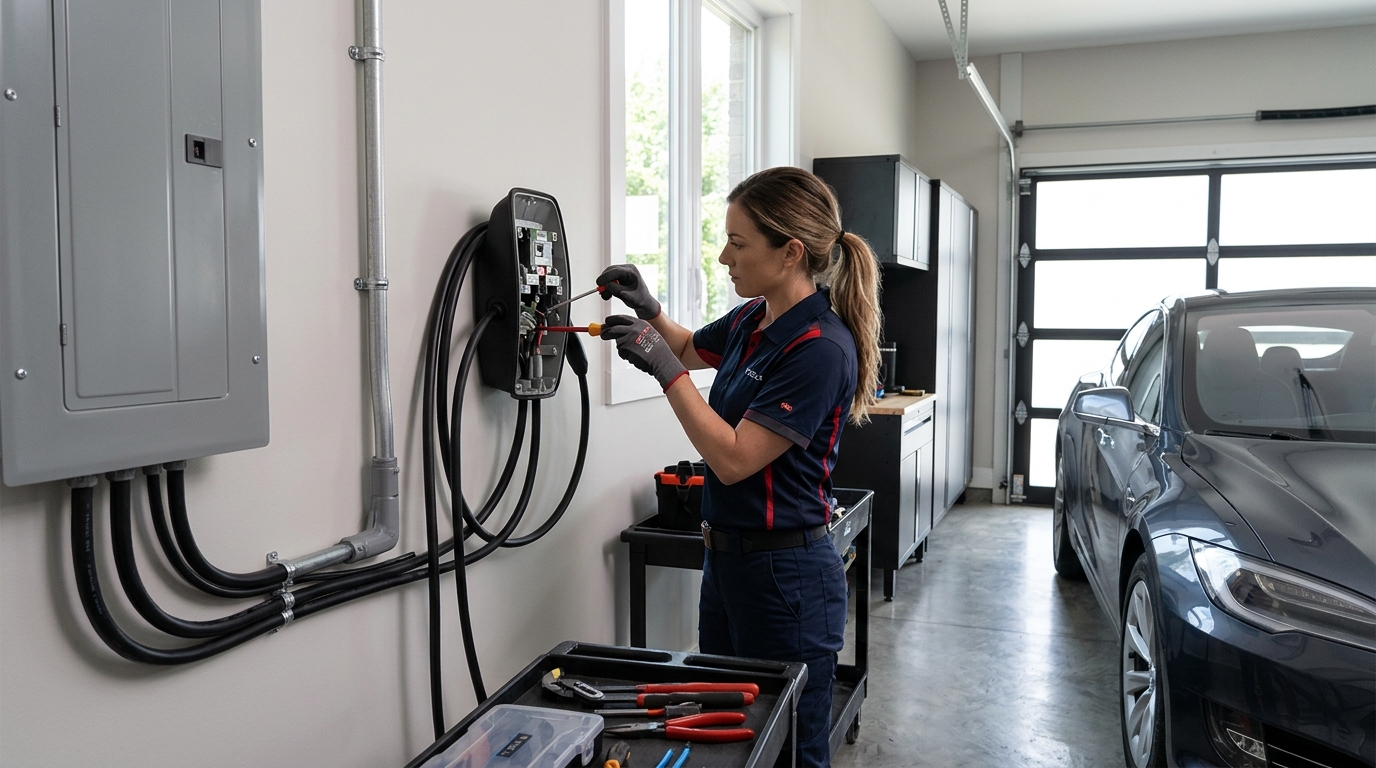
Upgrading to an electric vehicle (EV) transforms daily driving into a quiet, efficient experience backed by the ultimate convenience of home charging. Delivering up to 44 miles of driving range per hour over a high-voltage 240-volt single-phase branch circuit, installing a Tesla Wall Connector (Gen 3 or Universal model) is the gold standard for home energy replenishment. However, as homeowners prepare to hire an installation professional, an essential hiring question arises: Can any electrician install a Tesla Wall Connector?
The short answer is: yes, any licensed electrician can legally install a Tesla Wall Connector; however, hiring an electrician with specific EVSE experience—or choosing a Tesla Certified Installer—ensures strict compliance with National Electrical Code (NEC Article 625) standards, proper wire sizing, and error-free app commissioning.
While the physical installation involves standard high-voltage AC wiring ($L_1, L_2$, and Ground), EV charging represents a continuous, multi-hour heavy load that leaves zero room for amateur wiring mistakes or improper panel load calculations.
For complete hardware reviews, installer guides, and panel load calculators, visit EV Charger Advisor.
1. Licensed Electrician vs. Tesla Certified Installer
Understanding your options when hiring a professional helps you select the right installer for your budget and timeline:
A. Any Licensed & Insured Electrician
-
Qualifications: Holds a valid state/local Journeyman or Master Electrician license, carries liability insurance, and pulls necessary municipal permits.
-
Capabilities: Qualified to perform main panel load calculations, install 60A double-pole circuit breakers, pull heavy copper conductors (#6 AWG), and securely hardwire the Wall Connector.
-
Things to Verify: Confirm they have prior experience with 240V continuous EV load installations and are comfortable performing Wi-Fi commissioning via the Tesla One app.
B. Tesla Certified Installers
-
Qualifications: Independent licensed electrical contractors who have completed specialized Tesla training on Wall Connector hardware, load management, and software setup.
-
Primary Advantage: Listed directly on Tesla’s official installer directory, offering turnkey quotes, expert troubleshooting for complex installations, and seamless warranty handling.
To learn more about how charger power levels and wire sizes compare, check out our guide on EV charging types.
2. Critical Installation Rules Any Electrician MUST Follow
To ensure your Wall Connector operates safely at full 48-Amp continuous output ($11.52\text{ kW}$), your electrician must adhere to four strict technical guidelines:
-
Strict Application of the NEC 125% Continuous Duty Rule: EV charging operates continuously for hours. Delivering 48A output requires sizing overcurrent protection at 125% of continuous load ($48\text{A} \times 1.25 = \mathbf{60\text{A breaker}}$).
-
Correct Conductor Rating (#6 AWG Copper): Conductors must be rated for at least 90°C terminal limits (THHN/THWN-2). Aluminum conductors are strictly prohibited by Tesla specifications.
-
DO NOT Install External GFCI Breakers: The Tesla Wall Connector includes built-in internal CCID50 ground-fault protection. Installing an external GFCI circuit breaker causes double-GFCI interference and frequent false trips. Use a standard non-GFCI breaker.
-
App Commissioning & Wi-Fi Setup: After hardwiring, the electrician must connect to the Wall Connector’s internal setup network via the Tesla One app to pair internal software settings with your panel’s exact circuit breaker capacity.
To explore Wi-Fi-enabled smart wallboxes engineered with integrated load management features, read our guide on smart chargers.
Step-by-Step Mathematical Example: Circuit Sizing & Thermal Overhead Math
Let us perform a technical calculation to determine the required breaker rating, continuous power delivery, and thermal copper resistance loss ($P_{\text{loss}}$) for a 48-Amp Tesla Wall Connector ($240\text{V}$ single-phase supply) running 50 feet ($15.24\text{ m}$) on #6 AWG Copper Wire ($R = 0.000491 \Omega/\text{ft}$).
Given Parameters:
-
Continuous Charging Draw ($I$): $48 \text{ Amps}$
-
Nominal Line Voltage ($V$): $240 \text{ Volts}$
-
One-Way Circuit Distance ($L$): $50 \text{ feet}$
-
Conductor Resistance ($R_{\text{wire}}$): $0.000491 \Omega \text{ per foot}$
Calculation 1: Dedicated Breaker Rating (NEC 125% Continuous Duty Rule)
Calculation 2: Delivered Charging Power Output ($P_{\text{gross}}$)
Calculation 3: Conductor Thermal Resistance Power Loss ($P_{\text{loss}}$)
For a single-phase $240\text{V}$ circuit ($2 \times L = 100\text{ ft}$ total conductor loop):
Calculation 4: Wiring Efficiency Percentage ($\eta_{\text{wire}}$)
Result Breakdown: Proper wiring by a licensed electrician using #6 AWG copper wire ensures 99.02% transmission efficiency, keeping line heat loss down to a low 113 Watts across the entire 50-foot run.
Comparison Table: Tesla Installation Professional Evaluation Matrix
| Evaluation Factor | Licensed General Electrician | Tesla Certified Installer |
| Legal License & Permitting | Fully Licensed & Qualified | Fully Licensed & Qualified |
| Tesla Hardware Experience | Varies (Verify past EV jobs) | Extensive / Factory-Trained |
| App Commissioning Familiarity | Basic to Moderate | Expert (Routine Setup) |
| Average Installation Cost | $500 – $1,200 | $750 – $1,500 |
| Best Suited For | Standard, straightforward garage runs | Complex runs, panel upgrades & load sharing |
Summary & Key Takeaways
-
Any Licensed Electrician Can Install: You do not strictly need a Tesla Certified Installer; any licensed electrical contractor can safely complete the installation.
-
Require EVSE Experience: Ensure your chosen electrician understands NEC 625 continuous load calculations and panel sizing.
-
Always Hardwire on a 60A Breaker: Maximum 48A charging requires direct hardwiring, a dedicated 60A double-pole breaker, and #6 AWG copper wire.
-
Skip External GFCI Breakers: The Wall Connector features internal ground-fault protection; using an external GFCI breaker causes false tripping.













Leave a Reply