
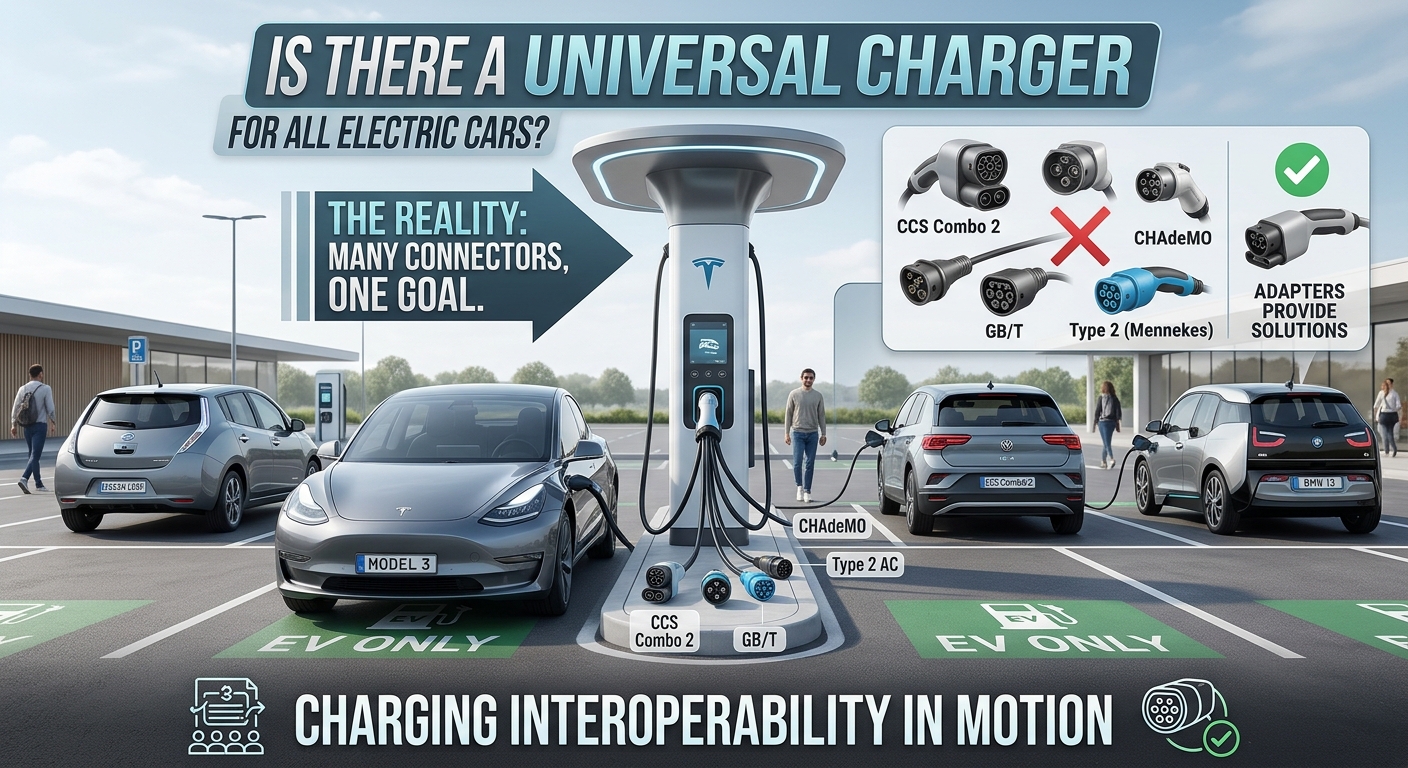
Adopting an electric vehicle (EV) brings rapid daily fuel savings, smooth performance, and zero local tailpipe emissions. Delivering 20 to 44 miles of driving range per hour over a high-voltage 240-volt single-phase branch circuit, installing a home Level 2 wallbox transforms vehicle replenishment into an effortless overnight routine. However, as prospective EV buyers explore public charging networks and home wallbox options, a primary practical question arises: Is there a universal charger for all electric cars?
The short answer is: no, there is no single universal charger that works natively for every electric car globally; however, regional standardizations (such as NACS in North America and Type 2/CCS2 in Europe) paired with universal adapters make cross-brand charging simpler than ever before.
Understanding how regional plug standards differ between Alternating Current (AC) home wallboxes and Direct Current (DC) public fast chargers ensures complete peace of mind wherever you drive.
For complete hardware reviews, installer guides, and panel load calculators, visit EV Charger Advisor.
1. Why Standard Plugs Vary Across Regions & Charging Levels
The absence of a single worldwide plug is due to varying regional grid voltages (120V/240V single-phase vs. 400V three-phase) and competing automaker design choices over the past decade:
A. North American Market Standards
-
NACS (SAE J3400): Developed originally by Tesla, NACS handles both AC Level 2 home charging and high-speed DC fast charging through a single compact handle. It has officially been adopted by virtually every major automaker in North America.
-
J1772 (Type 1) & CCS1: The legacy North American standard for AC charging (J1772) and DC fast charging (CCS1) found on older non-Tesla EVs.
B. European & International Standards
-
Type 2 (Mennekes): The mandated European standard for AC charging, supporting 400V three-phase grid power up to 22 kW.
-
CCS2 (Combined Charging System Type 2): Europe’s universal standard for high-power DC fast charging (up to 350 kW).
To learn more about how charger power levels and wire sizes compare, check out our guide on EV charging types.
2. Adapters: The Bridge to Universal Charging Compatibility
While a single factory plug type does not exist worldwide, inexpensive physical adapters make almost any charger universal for your vehicle:
-
Passive AC Wallbox Adapters (NACS $\leftrightarrow$ J1772): A low-cost adapter allows a Tesla driver to plug into a standard J1772 home wallbox, or a non-Tesla driver to charge from a Tesla Universal Wall Connector or NACS destination charger.
-
Active DC Fast-Charging Adapters (CCS1 $\leftrightarrow$ NACS): Enables non-Tesla vehicles equipped with legacy CCS1 ports to access thousands of Tesla Supercharger stations seamlessly.
-
Universal Hardwired Home Chargers: Modern home wallboxes (such as the Tesla Universal Wall Connector) come equipped with integrated dual-connector handles (NACS + J1772 Magic Dock), making them universal out of the box for multi-EV garages.
To explore Wi-Fi-enabled smart wallboxes engineered with integrated dual-connector capabilities, read our guide on smart chargers.
Step-by-Step Mathematical Example: Universal Multi-Vehicle Charging Sizing Math
Let us calculate the total daily charging capacity and panel requirement for a home installing a Universal Dual-Connector Level 2 Wallbox operating on a single-phase $240\text{V}$ circuit at 40 Amps continuous output ($9.60\text{ kW}$) to replenish two EVs requiring 30 kWh each (60 kWh total) at 90% charging efficiency.
Given Parameters:
-
Total Energy Needed ($E_{\text{net}}$): $60 \text{ kWh}$
-
Nominal Line Voltage ($V$): $240 \text{ Volts}$
-
Continuous Charging Draw ($I$): $40 \text{ Amps}$
-
AC/DC Conversion Efficiency ($\eta$): $90\% \quad (0.90)$
Calculation 1: Continuous Power Delivery ($P_{\text{gross}}$)
Calculation 2: Net Power Delivered to Battery Packs ($P_{\text{net}}$)
Calculation 3: Required Total Charging Session Time ($T$)
Calculation 4: Required Panel Breaker Sizing (NEC 125% Continuous Duty Rule)
Result Breakdown: Operating on a single 50A circuit breaker, a 40A universal Level 2 wallbox delivers 9.60 kW of power, completely replenishing two electric vehicles (60 kWh total) overnight in under 7 hours.
Comparison Table: Major Global EV Plug Types & Capabilities
| Plug / Connector Standard | Primary Region | Supported Levels | Native Compatibility |
| NACS (SAE J3400) | North America | Level 2 AC / DC Fast | Tesla, Ford, GM, Rivian, Hyundai, Kia, etc. |
| J1772 (Type 1) | North America / Japan | Level 1 & Level 2 AC | Legacy Non-Tesla North American EVs |
| Type 2 (Mennekes) | Europe / UK / Aus | Level 2 AC (3-Phase) | Mandated European Standard (All EVs) |
| CCS2 | Europe / UK / Aus | DC Fast Charging | Universal European Highway Fast Chargers |
Summary & Key Takeaways
-
No Single Worldwide Plug: Different regions use tailored plug standards based on local electrical grid infrastructure.
-
NACS Is the North American Standard: Major automakers have standardized on NACS (J3400) for native AC and DC charging.
-
Adapters Solve Compatibility: Simple NACS-to-J1772 or CCS1 adapters allow virtually any EV to plug into non-native chargers.
-
Universal Home Chargers Exist: Wallboxes featuring dual-integrated handles provide native universal charging for multi-EV households.













Leave a Reply