
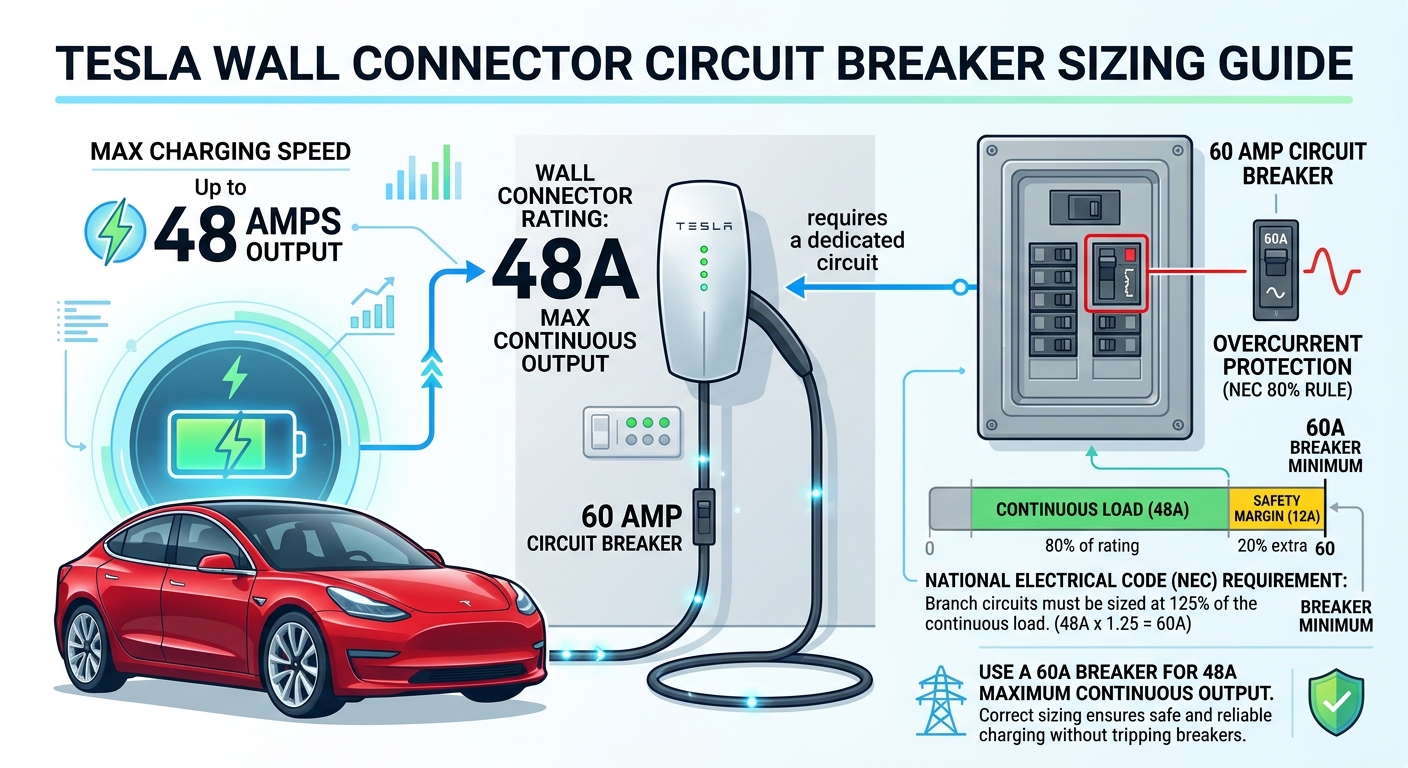
Transitioning to an electric vehicle (EV) delivers daily fuel savings, whisper-quiet acceleration, and zero local tailpipe emissions. Operating over a high-voltage 240-volt single-phase branch circuit, installing a dedicated Tesla Wall Connector (Gen 3 or Universal model) transforms vehicle replenishment into an effortless overnight routine. However, as homeowners consult electricians and evaluate main service panel capacity, a fundamental electrical question arises: What size breaker do you need for a Tesla Wall Connector?
The short answer is: to achieve the maximum charging output of 48 Amps (11.5 kW), you need a dedicated 60-amp double-pole circuit breaker paired with #6 AWG copper conductor wire.
Because electric vehicle charging is classified as a continuous electrical load under National Electrical Code (NEC Article 625) standards, circuit breakers must be rated at 125% of the continuous charging draw. However, if your electrical panel cannot support a full 60A circuit, the Tesla Wall Connector features adjustable software settings that allow it to safely operate on smaller breakers ranging from 15 Amps to 50 Amps.
For complete hardware reviews, installer guides, and panel load calculators, visit EV Charger Advisor.
1. The NEC 125% Rule: Why Maximum Charging Requires a 60A Breaker
Understanding why breaker sizing differs from active charging amperage requires looking at national electrical safety standards:
A. Continuous Load Requirements (NEC 625.42)
Any electrical appliance that draws maximum current for 3 hours or more continuously is defined as a continuous load. Under NEC codes, overcurrent protection devices (circuit breakers) and branch conductors must be sized at 125% of the continuous load rating:
-
For 48-Amp Maximum Charging Output: $48\text{A} \times 1.25 = \mathbf{60 \text{ Amps}}$.
-
For 40-Amp Charging Output: $40\text{A} \times 1.25 = \mathbf{50 \text{ Amps}}$.
-
For 32-Amp Charging Output: $32\text{A} \times 1.25 = \mathbf{40 \text{ Amps}}$.
B. De-rating Power for Smaller Panels
If a home load calculation reveals that a main electrical panel cannot accommodate a new 60A breaker, a licensed electrician can wire the Wall Connector to a smaller breaker. During initial commissioning via the Tesla One app, the installer programs the software to match the installed breaker rating.
To learn more about how charger power levels and wire sizes compare, check out our guide on EV charging types.
2. Hardware & Electrical Panel Requirements
Meeting Tesla’s official technical guidelines ensures safe long-term charging and prevents nuisance tripping:
-
Double-Pole 240V Circuit Breakers: The Wall Connector connects across two hot legs ($L_1, L_2$) plus an Equipment Grounding Conductor ($PE$). No neutral wire is required.
-
Conductor Wire Sizing (NEC Table 310.16):
-
60A Breaker (48A Output): Minimum #6 AWG Copper Wire (rated 90°C THHN/THWN-2).
-
50A Breaker (40A Output): Minimum #8 AWG Copper Wire.
-
-
Do NOT Use External GFCI Breakers: The Tesla Wall Connector includes integrated internal ground-fault protection (CCID). Installing an external GFCI breaker in the electrical panel creates dual-GFCI interference, causing false breaker trips. Install a standard non-GFCI double-pole breaker.
To explore Wi-Fi-enabled smart wallboxes engineered with integrated GFCI safety mechanisms, read our guide on smart chargers.
Step-by-Step Mathematical Example: Breaker Selection & Voltage Drop Math
Let us calculate the breaker rating, continuous output power, and percentage voltage drop ($\Delta V$) for a hardwired 48-Amp Tesla Wall Connector ($240\text{V}$ single-phase supply) installed on a 60-foot ($18.29\text{ m}$) conduit run using #6 AWG Copper Wire ($R = 0.000491 \Omega/\text{ft}$).
Given Parameters:
-
Continuous Charging Draw ($I$): $48 \text{ Amps}$
-
Nominal Line Voltage ($V$): $240 \text{ Volts}$
-
One-Way Cable Distance ($L$): $60 \text{ feet}$
-
Conductor Resistance ($R_{\text{wire}}$): $0.000491 \Omega \text{ per foot}$
Calculation 1: Minimum Circuit Breaker Sizing (125% Rule)
Calculation 2: Continuous Power Delivery Output ($P$)
Calculation 3: Voltage Drop ($\Delta V$) Calculation
For a single-phase 240V circuit ($2 \times L = 120\text{ ft}$ total conductor path length):
Calculation 4: Percentage Voltage Drop (%)
Result Breakdown: Pairing a 48A charger with a 60A double-pole breaker and #6 AWG copper wire delivers 11.52 kW of continuous output while operating at an efficient 1.18% voltage drop (well under the 3% maximum NEC threshold limit).
Comparison Table: Tesla Wall Connector Breaker Options & Speeds
| Circuit Breaker Rating | Continuous Amperage (80%) | Continuous Power at 240V | Minimum Copper Wire Gauge | Added Range per Hour |
| 60 Amps (Default) | 48 Amps | 11.52 kW | #6 AWG Copper | 36 to 44 miles/hr |
| 50 Amps | 40 Amps | 9.60 kW | #8 AWG Copper | 30 to 37 miles/hr |
| 40 Amps | 32 Amps | 7.68 kW | #8 AWG Copper | 22 to 30 miles/hr |
| 30 Amps | 24 Amps | 5.76 kW | #10 AWG Copper | 15 to 22 miles/hr |
| 20 Amps | 16 Amps | 3.84 kW | #12 AWG Copper | 9 to 13 miles/hr |
Summary & Key Takeaways
-
60A Breaker for Full Speed: Achieving maximum 48A charging (11.52 kW) requires a dedicated 60-amp double-pole breaker.
-
Flexible Breaker Support: Smaller breakers (15A to 50A) can be used if programmed in the Tesla One app during commissioning.
-
Use #6 AWG Copper Wire: Always pair a 60A circuit breaker with minimum #6 AWG 90°C THHN copper conductors.
-
Use Standard Non-GFCI Breakers: The Wall Connector features built-in ground-fault safety; external GFCI breakers cause nuisance tripping.













Leave a Reply