
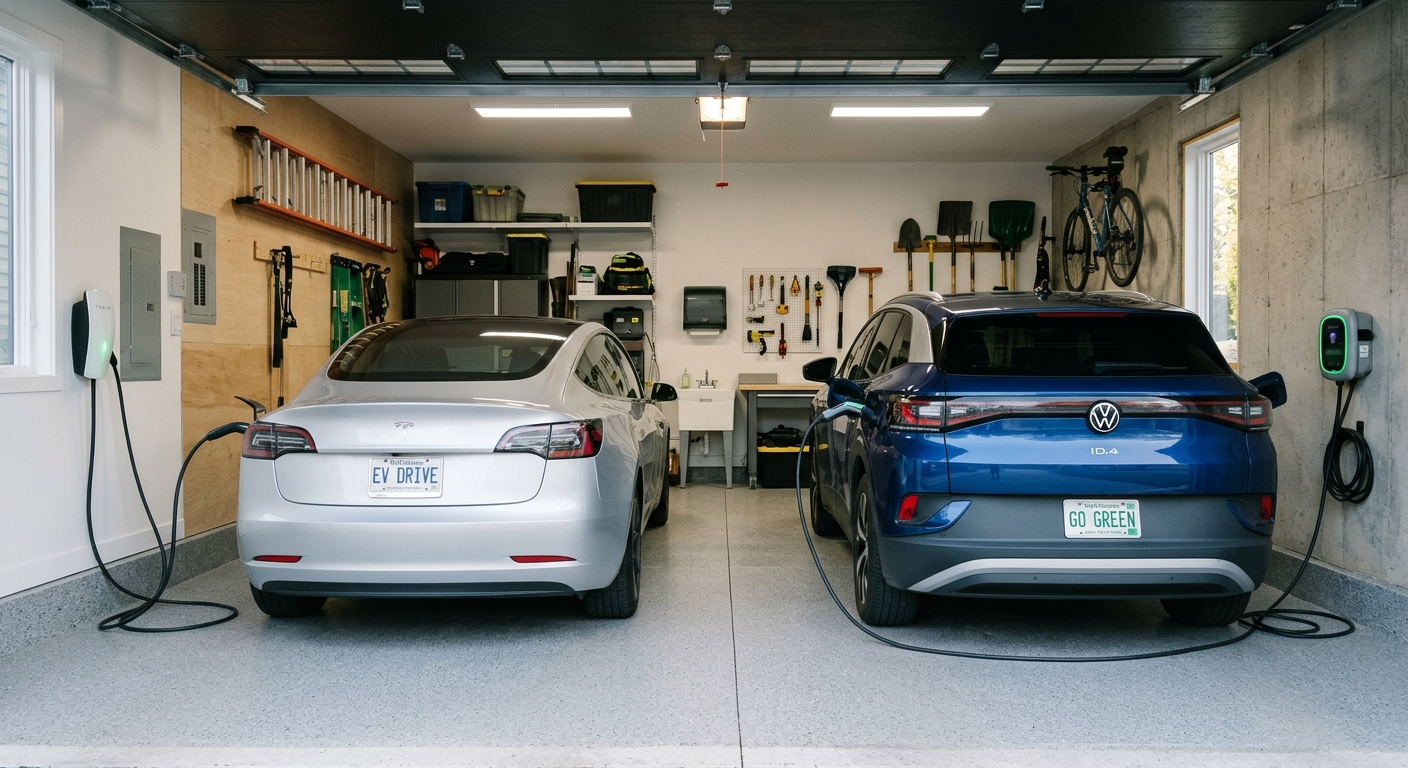
As multi-EV households become increasingly common, managing home charging infrastructure effectively is a top priority for electric vehicle owners. Delivering 20 to 44 miles of driving range per hour over a high-voltage 240-volt single-phase branch circuit, installing Level 2 wallboxes makes daily battery replenishment effortless. However, as families add a second electric car to their driveway, a primary technical question arises: Can you install two EV chargers at home for two electric cars?
The short answer is: yes, you can install two EV chargers at home for two electric cars, provided your home’s electrical panel and main utility service capacity can support the additional electrical load.
Installing two chargers can be accomplished either by running two separate dedicated branch circuits (if electrical panel capacity permits) or by using smart load-sharing (power-sharing) EV chargers that dynamically divide a single circuit’s capacity between both vehicles under National Electrical Code (NEC Article 625) standards.
For complete hardware reviews, installer guides, and panel load calculators, visit EV Charger Advisor.
1. Two Options for Multi-EV Home Installation
When setting up home charging for two electric vehicles, homeowners can choose between two primary installation methods:
A. Method 1: Dual Dedicated Branch Circuits (Maximum Charging Speed)
-
How It Works: A licensed electrician installs two cevchargeradvisor.onlineompletely separate dedicated 240V double-pole circuit breakers (e.g., two 50A or 60A breakers) in your electrical panel.
-
Performance: Allows both electric vehicles to charge simultaneously at full maximum speed (up to 48A / $11.52\text{ kW}$ each).
-
Requirement: Requires a robust main service panel (typically 200-Amp or 400-Amp service) with substantial spare capacity.evchargeradvisor.online
B. Method 2: Smart Power Sharing on a Single Shared Circuit (Cost-Effective)
-
How It Works: Two compatible hardwired smart wallboxes (such as Tesla Wall Connectors, Wallbox Pulsar Pluses, or Emporia Chargers) are connected to a single dedicated circuit (e.g., one 60A breaker).
-
Performance: When one car is plugged in, it gets 100% of the circuit’s continuous capacity (48A / $11.52\text{ kW}$). When both cars plug in simultaneously, the chargers automatically split the power equally (24A / $5.76\text{ kW}$ each).
-
Requirement: Avoids expensive main electrical service panel upgrades while maintaining 100% NEC compliance.
To learn more about how charger power levels and wire sizes compare, check out our guide on EV charging types.
2. Panel Load Calculations & NEC Code Compliance
Before installing two chargers, evaluating your home’s total electrical load is essential:
-
NEC 80% Continuous Load Rule: EV chargers are continuous loads that operate for 3+ hours continuously. Circuit breakers must be sized at 125% of the continuous draw. Operating two independent 48A chargers requires two 60A breakers ($96\text{A}$ total continuous load / $120\text{A}$ breaker capacity).
-
Standard Household Load Limits: An average home with a 100-Amp or 150-Amp main service panel cannot support two unthrottled 48A EV chargers alongside HVAC units, electric water heaters, and kitchen appliances.
-
Power-Sharing Compliance (NEC 625.40 Exception): NEC codes permit multiple wallboxes on a single branch circuit only if they utilize an approved Automatic Load Management System (ALMS) to restrict total continuous demand to the circuit rating.
To explore Wi-Fi-enabled smart wallboxes engineered with integrated load management features, read our guide on smart chargers.
Step-by-Step Mathematical Example: Panel Load Sizing & Shared Power Math
Let us compare the electrical panel capacity required for Two Independent 48A Wallboxes versus Two Power-Sharing 48A Wallboxes on a single-phase $240\text{V}$ residential supply.
Given Parameters:
-
Continuous Current per Charger ($I_{\text{unit}}$): $48 \text{ Amps}$
-
Nominal Line Voltage ($V$): $240 \text{ Volts}$
-
NEC Continuous Duty Multiplier: $1.25 \quad (125\%)$
Calculation 1: Electrical Demand for Dual Independent Circuits
Calculation 2: Electrical Demand for Power-Sharing Setups (Single 60A Breaker)
Calculation 3: Net Saved Electrical Capacity
Result Breakdown: Using smart power sharing preserves 60 Amps of panel capacity while guaranteeing both vehicles replenish over 40 kWh of range overnight in under 8 hours.
Comparison Table: Dual Independent Circuits vs. Power Sharing Setup
| Feature / Criteria | Dual Independent Circuits | Smart Power Sharing (Single Circuit) |
| Number of Breakers | Two 50A or 60A Breakers | One 60A Breaker |
| Max Power Output | 11.5 kW per vehicle simultaneously | 11.5 kW total split dynamically |
| Main Panel Requirement | 200A or 400A Panel Service | 100A or 150A Panel Service (Saves space) |
| Panel Upgrade Cost | High ($1,500 – $3,000 extra) | $0 (Avoids panel upgrade) |
| Overnight Replenishment | Full charge in ~4 to 5 hours | Full charge in ~7 to 8 hours for both |
Summary & Key Takeaways
-
Yes, You Can Install Two: Multi-EV home charging can be accomplished via dual independent circuits or smart power sharing.
-
Dual Circuits Offer Max Speed: Dedicated circuits deliver full 48A (11.5 kW) power to both cars simultaneously but require high main panel capacity.
-
Power Sharing Saves Money: Linking two smart wallboxes on a single 60A breaker splits power dynamically, avoiding expensive panel upgrades.
-
Follow NEC Rules: Power-sharing setups must be permanently hardwired using listed smart chargers compliant with NEC 625 load management exceptions.













Leave a Reply