
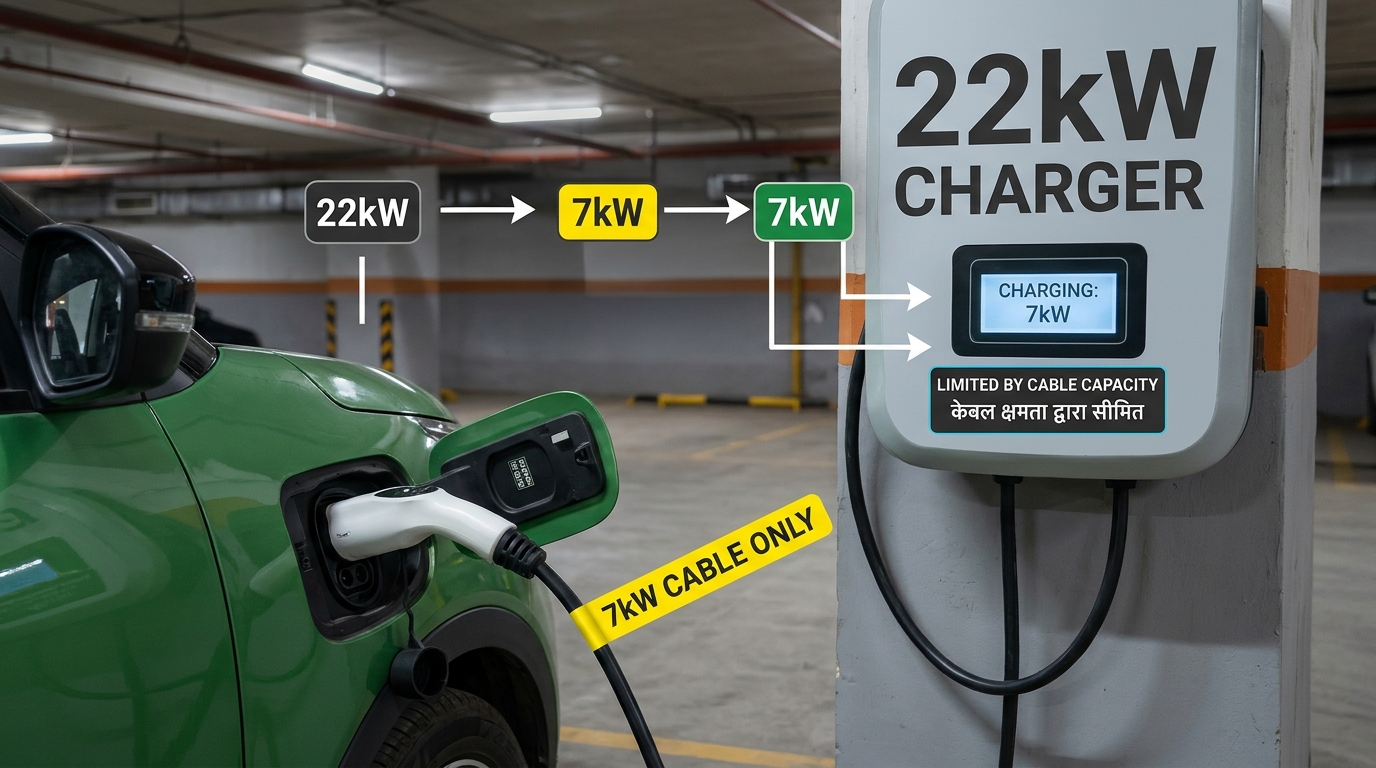
As electric vehicle (EV) adoption expands across home garages, commercial hubs, and public destination stations, drivers routinely encounter a wide range of charging hardware. Delivering 20 to 44 miles of driving range per hour over a high-voltage 240-volt single-phase branch circuit, home Level 2 wallboxes transform daily vehicle replenishment into an effortless overnight habit. However, when plugging in at public destination chargers equipped with unethered Type 2 sockets, a primary practical question arises: Can you charge an EV using a 7kW charging cable on a 22kW EV charger?
The short answer is: yes, you can safely use a 7kW charging cable on a 22kW EV charger; however, your actual charging speed will be limited to 7kW (or the maximum intake limit of your vehicle’s onboard AC charger) due to safety protocols built into international charging standards.
Electric vehicle supply equipment (EVSE) and Type 2 charging cables utilize physical pilot signal protocols (IEC 61851 / IEC 62196) that negotiate power delivery automatically, ensuring that no component is ever overloaded.
For complete hardware reviews, installer guides, and panel load calculators, visit EV Charger Advisor.
1. How Power Negotiation Works: The “Bottleneck” Principle
When you connect an electric car to a public or home wallbox, charging speed is determined by the lowest-rated link in a three-part electrical chain:
-
The Charging Station (EVSE): Provides up to 22 kW of power (3-phase AC at $400\text{V} / 32\text{A}$).
-
The Charging Cable: Rated for 7 kW (1-phase AC at $230\text{V} / 32\text{A}$).
-
The Vehicle Onboard Charger: Converts AC power from the wall into DC power for the battery pack (commonly $7.4\text{ kW}$, $11\text{ kW}$, or $22\text{ kW}$).
The Control Pilot & Resistor Coding Safety System
Type 2 charging cables contain a tiny internal resistor embedded within the connector head called a Resistor Coding (PP / Proximity Pilot) resistor:
-
Automatic Detection: The 22kW charging station measures the resistance value of the cable as soon as it is plugged in.
-
Current Restriction: Recognizing a 32A single-phase (7kW) cable, the station’s control board instantly throttles its maximum available output down to 32 Amps on 1 phase (7.4 kW).
-
Thermal Safety: This automatic handshake prevents the 22kW station from pushing 3-phase current through a single-phase cable, eliminating overheating and wire degradation.
To learn more about how charger power levels and wire sizes compare, check out our guide on EV charging types.
2. Single-Phase vs. Three-Phase Cable Architecture
To understand why a 7kW cable limits power delivery on a 22kW station, it helps to analyze their internal wire construction:
-
7kW Cable (Single-Phase Type 2): Contains 3 main power conductors—Line ($L_1$), Neutral ($N$), and Protective Earth ($PE$)—plus pilot signal wires. It carries a maximum of 32 Amps across 1 line ($230\text{V} \times 32\text{A} = 7.36\text{ kW}$).
-
22kW Cable (Three-Phase Type 2): Contains 5 main power conductors—Line 1 ($L_1$), Line 2 ($L_2$), Line 3 ($L_3$), Neutral ($N$), and Protective Earth ($PE$). It carries 32 Amps across all 3 lines simultaneously ($\sqrt{3} \times 400\text{V} \times 32\text{A} = 22.17\text{ kW}$).
Plugging a 7kW single-phase cable into a 22kW 3-phase socket simply leaves the $L_2$ and $L_3$ pins disconnected. The charger safe-guards the connection and routes power solely through $L_1$.
To explore Wi-Fi-enabled smart wallboxes engineered with native connector options, read our guide on smart chargers.
Step-by-Step Mathematical Example: Power Limit & Recharge Time Math
Let us perform a technical calculation to determine the charging power and time required to replenish 45 kWh of energy into an EV with an 11 kW onboard AC charger when using a 7kW Cable versus a 22kW Cable on a 22kW (3-Phase $400\text{V} / 32\text{A}$) Charging Station operating at 90% system conversion efficiency.
Given Parameters:
-
Required Energy Replenishment ($E_{\text{net}}$): $45 \text{ kWh}$
-
Charging Station Rating ($P_{\text{station}}$): $22.0 \text{ kW} \quad (3\text{-Phase } 400\text{V} / 32\text{A})$
-
Vehicle Onboard Charger Limit ($P_{\text{car}}$): $11.0 \text{ kW} \quad (3\text{-Phase } 400\text{V} / 16\text{A})$
-
Cable A Rating ($P_{\text{cableA}}$): $7.36 \text{ kW} \quad (1\text{-Phase } 230\text{V} / 32\text{A})$
-
Cable B Rating ($P_{\text{cableB}}$): $22.17 \text{ kW} \quad (3\text{-Phase } 400\text{V} / 32\text{A})$
-
AC/DC Conversion Efficiency ($\eta$): $90\% \quad (0.90)$
Calculation 1: Scenario A Power Delivery (Using 7kW Cable)
The effective system charging rate is determined by the minimum value:
Calculation 2: Scenario B Power Delivery (Using 22kW Cable)
Calculation 3: Net Time Difference
Result Breakdown: Using a 7kW cable on a 22kW station is 100% safe, but because the 7kW cable acts as the bottleneck, charging takes 2 hours and 15 minutes longer than using a 3-phase 22kW cable.
Comparison Table: Charging Hardware Power Matrix
| Station Output | Cable Rating | Vehicle Onboard Charger | Max Charging Speed Delivered | Bottleneck Factor |
| 22 kW (3-Phase) | 7 kW (1-Phase) | 7.4 kW (1-Phase) | 7.4 kW | Cable / Car |
| 22 kW (3-Phase) | 7 kW (1-Phase) | 11.0 kW (3-Phase) | 7.4 kW | Cable |
| 22 kW (3-Phase) | 22 kW (3-Phase) | 11.0 kW (3-Phase) | 11.0 kW | Car |
| 22 kW (3-Phase) | 22 kW (3-Phase) | 22.0 kW (3-Phase) | 22.0 kW | None (Max Speed) |
Summary & Key Takeaways
-
100% Safe & Compatible: You can use a 7kW cable on a 22kW charger without any electrical risk or damage to your vehicle.
-
Speed Capped at 7kW: Proximity pilot resistors in the cable force the station to limit power to 7kW (single-phase 32A).
-
Bottlenecked by Weakest Link: Total charging speed is governed by whichever component has the lowest rating among the station, cable, and onboard charger.
-
Upgrade for 3-Phase Vehicles: If your EV supports 11kW or 22kW 3-phase AC intake, buying a 22kW Type 2 cable unlocks significantly faster public charging.













Leave a Reply