
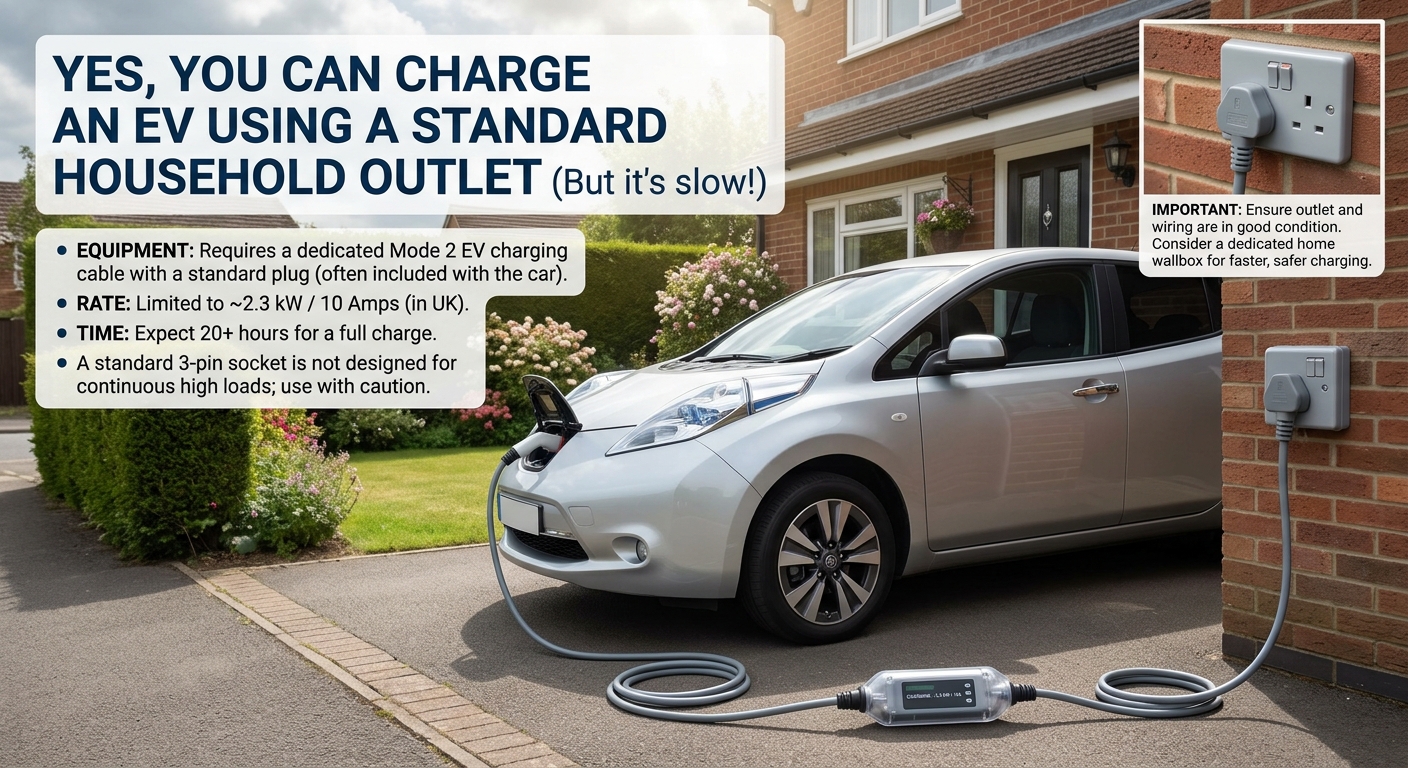
Adopting an electric vehicle (EV) delivers immediate savings on routine fuel costs, whisper-quiet performance, and zero local tailpipe emissions. While setting up a high-voltage 240-volt Level 2 home wallbox is popular for fast overnight replenishment, new or prospective EV owners often ask a fundamental starting question: Can you charge an EV using a standard household outlet?
The short answer is: yes, you can charge an electric vehicle using a standard household outlet (120V in North America / 230V in Europe and the UK) using the portable “Level 1” (or “Mode 2”) cable supplied with many vehicles or purchased separately.
While plugging into a standard wall socket works out-of-the-box without calling an electrician, it provides relatively slow charging speeds—adding 3 to 5 miles of driving range per hour in 120V regions—making it best suited for short daily commutes or temporary emergency top-ups.
For complete hardware reviews, installer guides, and panel load calculators, visit EV Charger Advisor.
1. How Standard Household Outlet Charging Works (Level 1 / Mode 2)
Plugging an EV into a standard household wall outlet requires no special grid infrastructure, but performance varies based on regional household voltages:
A. North American Standard Outlets (120V / 12A – Level 1)
-
Outlet Type: Standard NEMA 5-15 3-prong household receptacle protected by a 15A or 20A single-pole circuit breaker.
-
Continuous Draw: Under National Electrical Code (NEC Article 625) continuous load rules (80% maximum safety margin), a Level 1 charger draws a continuous 12 Amps at 120 Volts.
-
Power Output: 1.44 kW ($120\text{V} \times 12\text{A}$).
-
Range Replenishment: Restores 3 to 5 miles of range per hour.
B. UK & European Standard Outlets (230V / 10A–13A – Mode 2)
-
Outlet Type: UK 3-pin (BS 1363) or European Schuko (Type F) wall socket.
-
Continuous Draw: Typically restricted to 10 Amps continuous for safety over domestic ring mains.
-
Power Output: 2.3 kW ($230\text{V} \times 10\text{A}$).
-
Range Replenishment: Restores 8 to 12 miles of range per hour.
To learn more about how charger power levels compare, check out our guide on EV charging types.
2. Four Key Safety Guidelines for Standard Outlet Charging
Because EV charging draws continuous maximum current for 10 to 24+ hours at a time, plugging into a standard wall outlet requires specific safety precautions:
-
Never Use Heavy Domestic Extension Cords: Standard, thin household extension cords overheat under continuous 12A draw, causing voltage drop and posing severe fire risks. Always plug the portable control box directly into the wall receptacle.
-
Inspect Receptacle Quality & Fit: Worn, loose, or oxidized wall sockets create electrical resistance, causing wall prongs to heat up and potentially melt the outlet faceplate. Use dedicated, heavy-duty commercial-grade receptacles.
-
Verify Dedicated Circuit Branch: Ensure the wall outlet is on a dedicated branch circuit. Running a refrigerator, space heater, or power tools on the same 15A circuit while charging an EV will trip the breaker immediately.
-
GFCI Protection: Ensure the wall receptacle is protected by a Ground Fault Circuit Interrupter (GFCI) to prevent shock hazards in outdoor or damp garage conditions.
To explore Wi-Fi-enabled smart wallboxes engineered with integrated GFCI safety mechanisms, read our guide on smart chargers.
Step-by-Step Mathematical Example: Standard Outlet Full Recharge Time Math
Let us calculate the total hours required to recharge a depleted 60 kWh BEV Battery Pack from 20% to 80% State of Charge (SoC) using a standard 120V / 12A Level 1 trickle charger (1.44 kW power output) operating at an average 88% onboard charger efficiency.
Given Parameters:
-
Total Battery Pack Capacity ($E_{\text{pack}}$): $60 \text{ kWh}$
-
Target Energy Replenishment ($\Delta\text{SoC}$): $80\% – 20\% = 60\% \quad (0.60)$
-
Nominal Line Voltage ($V$): $120 \text{ Volts}$
-
Continuous Current Draw ($I$): $12 \text{ Amps}$
-
Onboard AC/DC Conversion Efficiency ($\eta$): $88\% \quad (0.88)$
Calculation 1: Net Energy Required by Battery ($E_{\text{net}}$)
Calculation 2: Effective Power Delivered to Battery Pack ($P_{\text{battery}}$)
Calculation 3: Total Required Charging Time ($T$)
Result Breakdown: Adding 36 kWh of usable energy (20% to 80% SoC) via a standard 120V household outlet requires 28 hours and 25 minutes of uninterrupted charging time, demonstrating why high-mileage drivers transition to Level 2 wallboxes.
Comparison Table: Standard Outlet (Level 1) vs. Level 2 Home Wallbox
| Feature / Criteria | Standard Household Outlet (Level 1) | Dedicated Home Wallbox (Level 2) |
| Supply Voltage / Current | 120V / 12A (Single-phase) | 240V / 32A–48A (Single-phase) |
| Gross Power Output | 1.44 kW | 7.4 kW – 11.52 kW |
| Added Range per Hour | $3 – 5 \text{ miles/hr}$ | $25 – 44 \text{ miles/hr}$ |
| Full 20% to 80% Charge Time | ~28.5 Hours | ~3.5 to 5.0 Hours |
| Installation Cost | $0 (Uses existing outlet) | $500 – $1,500 (Installer hardware & circuit) |
Summary & Key Takeaways
-
Yes, Standard Outlets Work: You can charge any EV using a standard wall outlet and the included portable Level 1 cable.
-
Best for Low Daily Mileage: Level 1 adds 3 to 5 miles of range per hour, making it practical if you drive under 30 miles daily and can plug in for 12+ hours overnight.
-
Avoid Extension Cords: Plug the charging control box directly into a dedicated wall socket to prevent overheating and fire risks.
-
Upgrade to Level 2 for Faster Recovery: Stepping up to a dedicated 240V Level 2 charger reduces recharge times from 28+ hours down to 4 or 5 hours.













Leave a Reply