
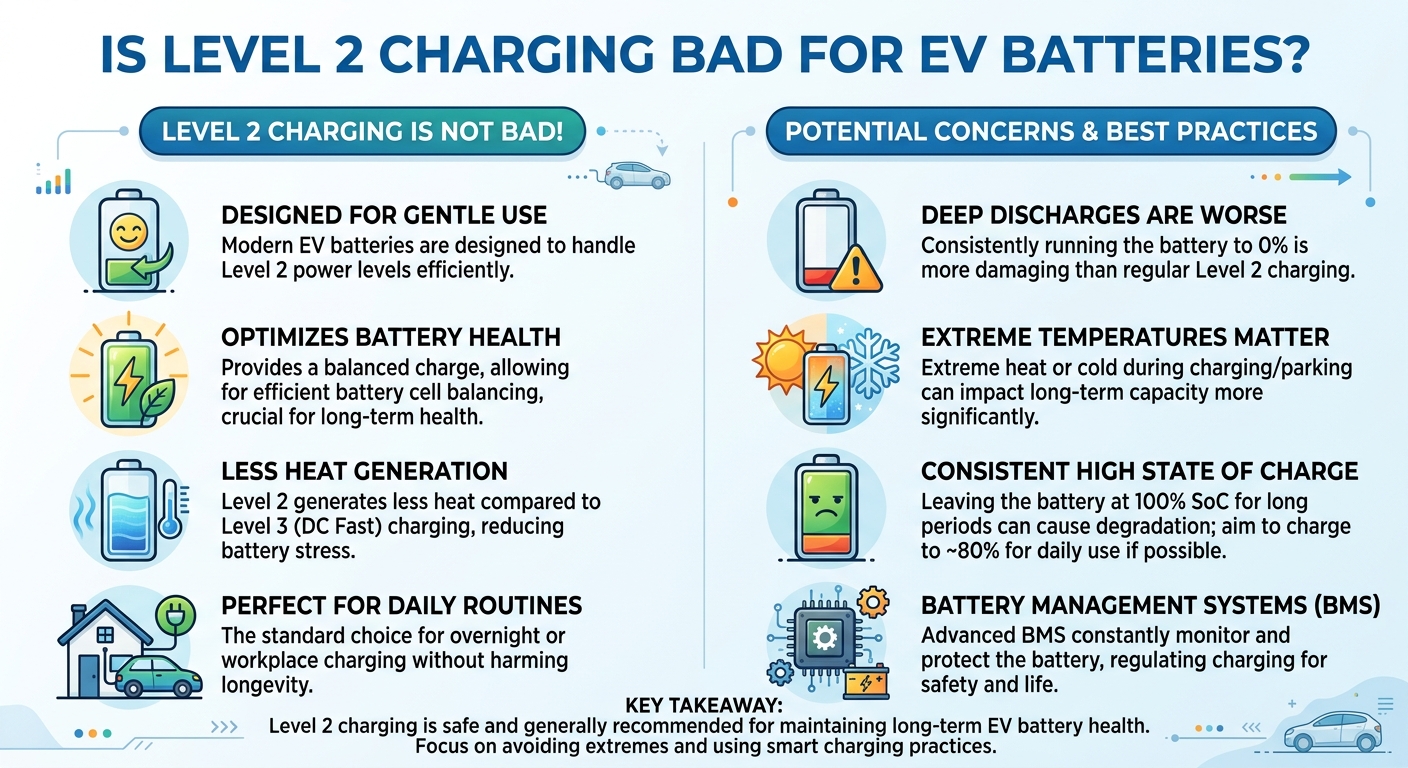
As electric vehicle (EV) adoption expands worldwide, new drivers are eager to establish safe, efficient charging habits at home and in public. Delivering 20 to 44 miles of driving range per hour over a high-voltage 240-volt single-phase supply, home Level 2 wallboxes represent the single most popular way to keep battery electric vehicles (BEVs) replenished overnight. However, as prospective EV owners read about lithium-ion degradation, heat generation, and fast-charging warnings, a fundamental technical question arises: Is Level 2 charging bad for EV batteries?
The short answer is: no, Level 2 charging is not bad for EV batteries—in fact, it is widely considered the absolute optimal charging method for daily use, striking the perfect balance between charging speed, low heat generation, and long-term battery health.
Unlike commercial Direct Current Fast Chargers (DCFC) that push high power outputs into the vehicle, Level 2 Alternating Current (AC) charging operates well within the safe thermal limits of modern battery systems.
For complete hardware reviews, installer guides, and panel load calculators, visit EV Charger Advisor.
1. Why Level 2 AC Charging Is the “Sweet Spot” for Battery Health
To understand why Level 2 charging is optimal for lithium-ion battery health, it helps to compare how power is transferred and converted inside the vehicle:
A. Controlled Power Transfer & Low Heat Generation
Level 2 chargers supply 240-Volt Alternating Current (AC) at rates ranging from 3.7 kW to 11.5 kW (16A to 48A). The vehicle’s onboard charger converts this AC power to Direct Current (DC) power before feeding it into the battery pack. Because the power flow is moderate, heat buildup inside the battery cells remains minimal, eliminating the severe thermal stress caused by high-power DC fast charging (50 kW to 350 kW).
B. Seamless Thermal Management Integration
Modern electric vehicles feature active liquid cooling loops managed by an intelligent Battery Management System (BMS). Because a Level 2 wallbox delivers steady AC power over several hours, the BMS can maintain cell temperatures within the ideal 25°C to 35°C (77°F to 95°F) window using negligible energy, preserving internal cathode and anode chemistry.
C. Preserving Onboard Battery Capacity
Large-scale fleet studies (such as data analyzed by Geotab across thousands of EVs) consistently show that vehicles relying primarily on AC Level 2 charging for daily commuting experience minimal long-term capacity loss—retaining over 80% to 90% of original capacity even after 8 to 10 years of ownership.
To learn more about how charger power levels and wire sizes compare, check out our guide on EV charging types.
2. Real Drivers of EV Battery Degradation (What ACTUALLY Harms Batteries)
If Level 2 charging is safe, what factors actually accelerate lithium-ion battery wear? EV battery health is primarily impacted by three operational conditions:
-
Frequent DC Fast Charging under High Heat: Continuously subjecting battery cells to high-current DC fast chargers (100+ kW) without thermal cooldown periods generates intense localized heat, accelerating electrolyte breakdown.
-
Sitting at Extreme States of Charge (SoC): Leaving your vehicle parked at 100% full charge or near 0% empty for days at a time subjects cell chemistry to high mechanical voltage stress.
-
Extreme Weather Driving without Pre-Conditioning: Operating or fast-charging a frozen battery below freezing temperatures ($0^\circ\text{C} / 32^\circ\text{F}$) risks lithium plating on the anode unless the battery is pre-heated.
To explore Wi-Fi-enabled smart wallboxes engineered with off-peak schedule timers, read our guide on smart chargers.
Step-by-Step Mathematical Example: Thermal Power & Current Density Comparison
Let us perform a technical energy transfer comparison between a 48-Amp Level 2 Charger ($11.52\text{ kW}$ output) and a 150 kW DC Fast Charger charging an 80 kWh Battery Pack on a single-phase $240\text{V}$ system.
Given Parameters:
-
Battery Pack Capacity ($E_{\text{pack}}$): $80 \text{ kWh}$
-
Level 2 Charger Output ($P_{\text{L2}}$): $11.52 \text{ kW} \quad (240\text{V} \times 48\text{A})$
-
DC Fast Charger Output ($P_{\text{DCFC}}$): $150.00 \text{ kW}$
Calculation 1: C-Rate Calculation for Level 2 Charging
The “C-Rate” measures charging power relative to battery pack capacity. Lower C-rates indicate low chemical and thermal stress:
Calculation 2: C-Rate Calculation for DC Fast Charging
Calculation 3: Relative Thermal Power Factor Difference
Result Breakdown: Level 2 charging operates at a gentle 0.144 C-Rate, subjecting the battery to 13 times less chemical current stress per minute than a 150 kW fast charger, guaranteeing virtually zero heat-induced degradation.
Comparison Table: Level 1 vs. Level 2 vs. DC Fast Charging Impact
| Charging Type | Electrical Input | Power Output | C-Rate Stress Level | Impact on Battery Degradation |
| Level 1 Trickle | 120V AC (12A) | 1.4 kW | ~0.017 C | Negligible (Very low heat) |
| Level 2 Wallbox | 240V AC (16A–48A) | 3.7 kW – 11.5 kW | ~0.05 C to 0.15 C | Optimal (Ideal for daily health) |
| DC Fast Charging | 400V–800V DC | 50 kW – 350 kW | ~0.75 C to 4.0 C | Moderate to High (Requires thermal management) |
Summary & Key Takeaways
-
Not Bad at All: Level 2 charging is not bad for EV batteries; it is the safest and most efficient method for daily overnight charging.
-
Minimal Heat Generation: Operating at a low C-rate (0.05C to 0.15C), Level 2 charging keeps battery cell temperatures low and stable.
-
Preserves Battery Warranties: Using a home Level 2 wallbox protects long-term battery pack capacity, ensuring your car retains high resale value and full manufacturer warranty standing.
-
Follow the 80% Rule: For optimal battery health, pair your Level 2 wallbox with daily charging limits capped between 20% and 80% State of Charge.













Leave a Reply