
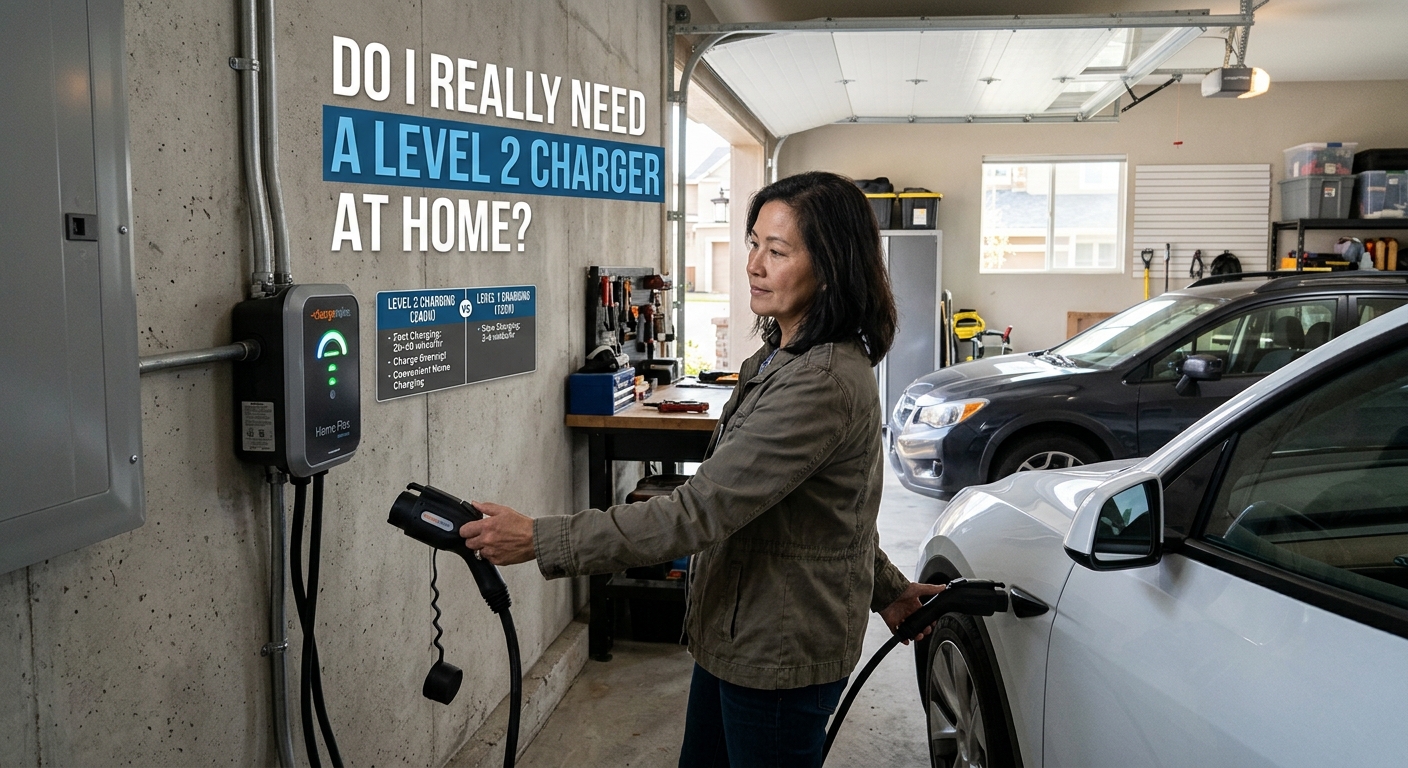
Transitioning to an electric vehicle (EV) brings instant savings on routine fuel costs, silent operation, and zero local tailpipe emissions. Delivering 20 to 44 miles of driving range per hour over a high-voltage 240-volt single-phase branch circuit, setting up a dedicated home Level 2 wallbox transforms daily battery replenishment into an effortless overnight routine. However, as prospective EV owners evaluate equipment costs and potential electrical panel upgrades, a primary practical question arises: Do I really need a Level 2 charger at home?
The short answer is: no, you do not strictly need a Level 2 charger if your daily commute is under 30 to 40 miles, you own a plug-in hybrid (PHEV), and your vehicle can sit parked for 12+ hours overnight; however, a Level 2 charger is practically essential for full battery electric vehicles (BEVs), longer commutes, cold winter climates, and multi-EV households.
Relying solely on a standard Level 1 wall outlet (120V) works for light drivers, but stepping up to a dedicated Level 2 wallbox provides the charging speed, energy efficiency, and operational buffer needed for modern EV ownership.
For complete hardware reviews, installer guides, and panel load calculators, visit EV Charger Advisor.
1. Level 1 vs. Level 2: Real-World Performance Breakdown
Understanding whether you need an upgraded wallbox depends on comparing how fast each system restores range:
A. Level 1 Trickle Charging (120V / 12A Standard Outlet)
-
Charging Speed: Restores 3 to 5 miles of range per hour ($1.2\text{ kW} – 1.4\text{ kW}$ output).
-
Overnight Recovery (10 Hours): Adds 30 to 50 miles of range.
-
Best Suited For: Drivers with daily commutes under 30 miles, plug-in hybrids (PHEVs) with small battery packs (10–18 kWh), or secondary vehicles that remain parked for long stretches.
-
Drawback: Takes 40 to 60+ hours to fully recharge a depleted 60–80 kWh BEV battery.
B. Level 2 Dedicated Charging (240V / 32A to 48A Wallbox)
-
Charging Speed: Restores 25 to 44 miles of range per hour ($7.4\text{ kW} – 11.5\text{ kW}$ output).
-
Overnight Recovery (10 Hours): Adds 250 to 400+ miles (Fully replenishes any passenger BEV).
-
Best Suited For: Daily commutes exceeding 40 miles, larger electric trucks/SUVs, cold weather conditions, and drivers taking advantage of short off-peak utility pricing windows.
To learn more about how charger power levels and wire sizes compare, check out our guide on EV charging types.
2. Four Key Factors That Demand a Level 2 Charger
Beyond daily mileage, four electro-technical realities make Level 2 charging necessary for most drivers:
-
Winter Range Losses & Thermal Pre-Conditioning: Cold ambient temperatures drop battery efficiency by 20% to 35%. A Level 1 charger consumes most of its 1.4 kW output simply warming cold battery cells, leaving almost no power to add range. Level 2 provides the thermal headroom needed to heat the cabin and pack while simultaneously charging.
-
Optimizing Off-Peak Utility Tariffs: Time-of-Use (TOU) electricity plans offer cheap rates during narrow 4-to-5-hour overnight windows. A Level 1 charger cannot pull enough power during a 4-hour window to cover a commute, whereas a Level 2 wallbox dumps 30 to 45 kWh into the car before peak rates resume.
-
Higher System Energy Efficiency: Level 1 charging forces vehicle onboard cooling systems and computers to stay powered on for 30–40 hours, wasting significant energy as thermal overhead. Level 2 compresses charging into 4–6 hours, operating at ~90% efficiency and reducing standby power losses.
-
Buffer for Unexpected Errands: If you return home with a low battery at 5 PM and need to head back out at 7 PM, Level 1 adds only 6 to 8 miles of range. A 48A Level 2 wallbox restores 50 to 80 miles in those same 2 hours.
To explore Wi-Fi-enabled smart wallboxes engineered with off-peak schedule timers, read our guide on smart chargers.
Step-by-Step Mathematical Example: The “Commute Deficit” Math
Let us calculate why a 65-mile daily commute creates an unrecoverable “charging deficit” when relying exclusively on Level 1 charging over a standard 5-day workweek.
Given Parameters:
-
Daily Commute Distance: $65 \text{ miles / day}$
-
Overnight Level 1 Charge Window: $11 \text{ hours / night}$
-
Level 1 Replenishment Rate: $3.5 \text{ miles of range / hour}$
-
Starting Battery Range (Monday Morning): $250 \text{ miles (100\% SoC)}$
Calculation 1: Daily Replenishment vs. Daily Consumption
Calculation 2: Cumulative Range Remaining by Friday Evening
Result Breakdown: By Friday night, the driver has lost 132.5 miles of range despite plugging in for 11 hours every single night. In contrast, a 7.4 kW Level 2 charger completely eliminates this deficit in just 2.5 hours overnight, proving why high-mileage drivers require Level 2 hardware.
Comparison Table: Do You Need Level 2? Self-Assessment Guide
| Driver Scenario | Commute / Usage Profile | Recommended Charger Type | Key Reason |
| Light Urban Commuter | Under $30 \text{ miles / day}$ | Level 1 (120V Outlet) | 10–12 hrs overnight recovers full range easily |
| Plug-in Hybrid Owner (PHEV) | Small 10–18 kWh battery | Level 1 (120V Outlet) | Recharges small battery in 5 to 7 hours |
| Standard Daily Commuter | $40 – 70 \text{ miles / day}$ | Level 2 (240V Wallbox) | Prevents cumulative range deficits |
| Cold Climate / Multi-EV Home | Severe winters / 2+ EVs | Level 2 (240V Wallbox) | Supports pre-conditioning & quick vehicle swaps |
Summary & Key Takeaways
-
Level 1 Works for Short Drives: If you drive under 30 miles daily and can plug in for 12 hours, a standard 120V wall outlet is sufficient.
-
Level 2 Prevents Range Deficits: Driving 40+ miles daily on Level 1 causes a gradual loss of battery charge over the workweek.
-
Essential for Cold Climates & TOU Rates: Level 2 provides necessary thermal power for winter pre-conditioning and captures cheap off-peak electricity rates.
-
Future-Proofs Your Home: Installing a 240V Level 2 circuit increases property appeal and ensures readiness for future battery electric vehicles.













Leave a Reply