
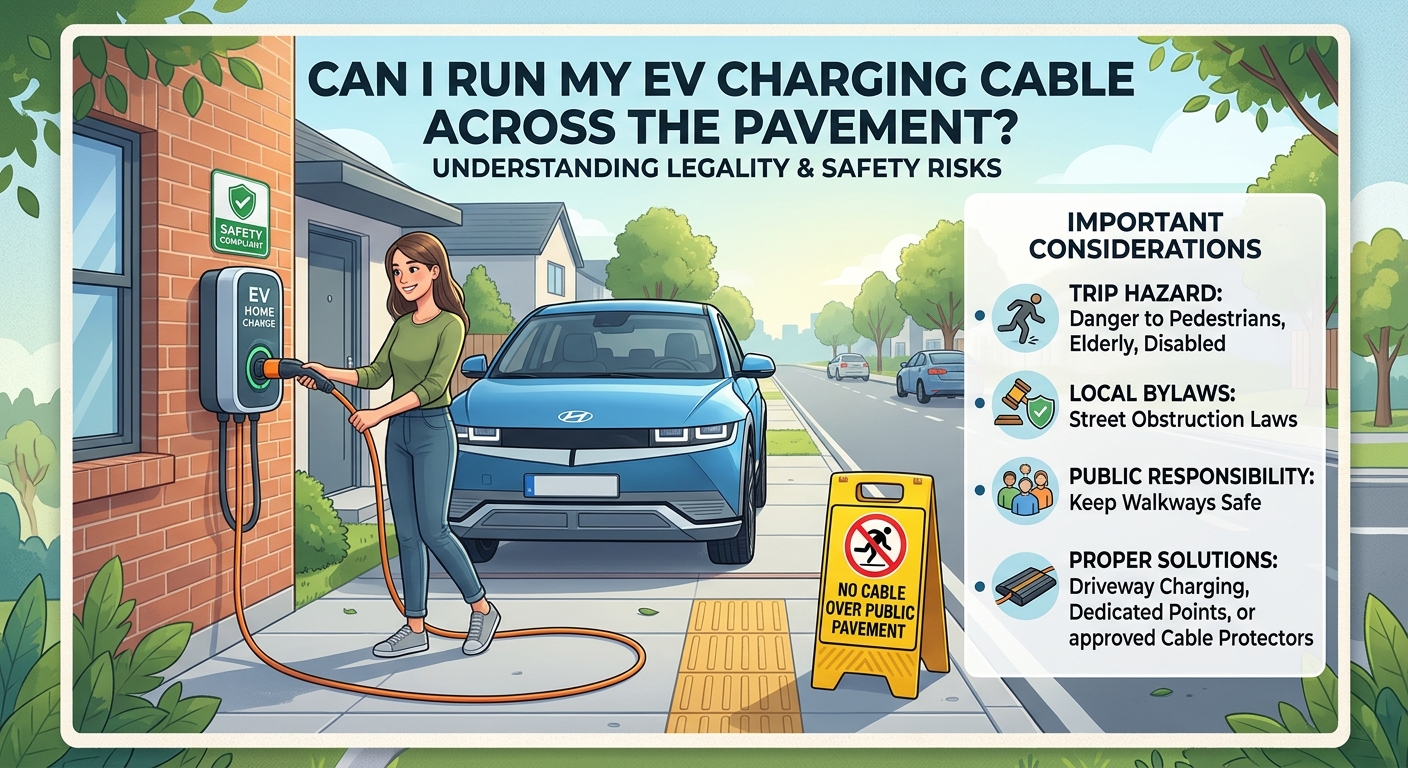
Transitioning to an electric vehicle (EV) offers massive daily fuel savings, whisper-quiet performance, and zero local tailpipe emissions. Delivering 20 to 44 miles of driving range per hour over a high-voltage 240-volt single-phase branch circuit, setting up a home Level 2 wallbox is the primary choice for EV drivers. However, for residents living in terraced townhouses, row homes, or city flats without private driveways, a primary practical question arises: Can I run my EV charging cable across the pavement?
The short answer is: no, you cannot legally run a loose EV charging cable across a public pavement (sidewalk) in the UK without explicit permission from your local highway authority, and using temporary rubber ramps or mat covers is generally prohibited or heavily restricted.
Trailing unshielded cables across a public right-of-way creates severe trip hazards, violates highway safety legislation, exposes the vehicle owner to complete public personal injury liability, and can lead to immediate council enforcement fines.
For complete hardware reviews, installer guides, and panel load calculators, visit EV Charger Advisor.
1. Legal Framework: Highways Act 1980 & Public Liability Risks
Running a charging cable across a public footpath intersects directly with highway safety legislation:
A. Section 161 & 178 of the UK Highways Act 1980
Under UK law, placing any wire, cable, pipe, or obstruction across a public highway or footpath without a statutory license issued by the local highway authority is illegal. Highways officers have the legal authority to remove unapproved cables immediately and issue enforcement notices or fines to property owners.
B. Public Personal Injury Liability
If a pedestrian, elderly citizen, visually impaired person, or wheelchair user trips over a cable or rubber ramp running across a public footpath, the vehicle owner is held personally liable for injuries and financial damages. Standard home insurance policies frequently exclude coverage for unauthorized incidents occurring on public land.
C. Why Cable Protectors & Rubber Mats Are Often Rejected
While temporary rubber cable ramps protect the cord from physical damage, many local councils prohibit them on public pavements because:
-
The ramp itself creates a raised edge or steep bump, introducing a secondary trip hazard.
-
Ramps can obstruct wheelchair wheels, mobility scooters, and child pushchairs.
To learn more about how charger power levels and wire sizes compare, check out our guide on EV charging types.
2. Legal & Council-Approved Alternatives for On-Street EV Drivers
Urban EV owners without driveways can utilize four council-approved charging alternatives:
-
Flush Cross-Pavement Cable Gullies: Local highway authorities increasingly grant permits for installing narrow aluminum or rubber channels recessed flush into the pavement stones. The cable sits securely inside the slot, allowing pedestrians and wheelchairs to cross completely unobstructed while you charge from your home electricity meter.
-
Retractable Overhead Charging Arms: Wall-mounted overhead gantries extend a retractable arm 8 to 10 feet ($2.4\text{ m} – 3.0\text{ m}$) above the sidewalk, suspending the cable safely overhead so it drops down directly at the car’s charging port without touching the footpath.
-
Municipal Lamp Post Chargers: Many local councils retrofit public streetlights with integrated Level 2 AC sockets ($3.7\text{ kW} – 7.4\text{ kW}$), allowing street-parked EVs to plug in using standard Mode 3 cables.
-
Workplace & Public Fast Chargers: Utilizing workplace charging stations or visiting public 50 kW to 350 kW DC fast charging hubs for a quick 30-minute top-up session easily covers weekly commuting requirements.
To explore Wi-Fi-enabled smart wallboxes engineered with off-peak schedule timers, read our guide on smart chargers.
Step-by-Step Mathematical Example: Flush Cable Channel Voltage Drop Math
Let us calculate the percentage voltage drop ($\Delta V$) for a council-approved 32-Amp Level 2 charging setup ($240\text{V}$ single-phase supply) running 70 feet ($21.33\text{ m}$) from a hallway panel, through a flush pavement gully, to a car at the curb using #8 AWG Copper Wire ($R = 0.000778 \Omega/\text{ft}$).
Given Parameters:
-
Continuous Current Draw ($I$): $32 \text{ Amps}$
-
Nominal Line Voltage ($V$): $240 \text{ Volts}$
-
One-Way Cable Distance ($L$): $70 \text{ feet}$
-
Conductor Resistance ($R_{\text{wire}}$): $0.000778 \Omega \text{ per foot}$
Calculation 1: Voltage Drop ($\Delta V$) Math
For a single-phase $240\text{V}$ circuit ($2 \times L = 140\text{ ft}$ total conductor path):
Calculation 2: Percentage Voltage Drop (%)
Result Breakdown: A 1.45% voltage drop stays well below the 3% maximum NEC/BS 7671 threshold limit, proving that a 70-foot circuit routed through an approved pavement gully operates safely, efficiently, and legally.
Comparison Table: On-Street Cable Crossing Options
| Cable Crossing Approach | Legality / Permitting | Trip Hazard Risk | Primary Benefit / Risk |
| Loose Cable Across Footpath | PROHIBITED (Highways Act) | Extreme | High risk of injury claims & council fines |
| Temporary Rubber Ramp | Generally Rejected by Councils | Moderate to High | Creates raised edge on sidewalk |
| Flush Pavement Channel | Approved (With council permit) | Zero (Flush surface) | Uses cheap residential off-peak tariffs |
| Overhead Retractable Arm | Approved (With wall clearance) | Zero (Cable overhead) | Suspends cable high above pedestrians |
Summary & Key Takeaways
-
Do Not Trailing Loose Cables: Running an unshielded EV cable across a public pavement is illegal without explicit council permits and creates severe trip liabilities.
-
Rubber Ramps Are Not Fully Legal: Temporary rubber mats or ramps are frequently rejected by local highway authorities because they create secondary raised trip hazards.
-
Apply for a Flush Gully Permit: Contact your local council to install a flush cross-pavement cable channel so you can charge legally at residential home electricity rates.
-
Use Municipal & Public Networks: If pavement channels are not available in your area, rely on municipal lamp post chargers, workplace stations, or weekly DC fast charging.













Leave a Reply