
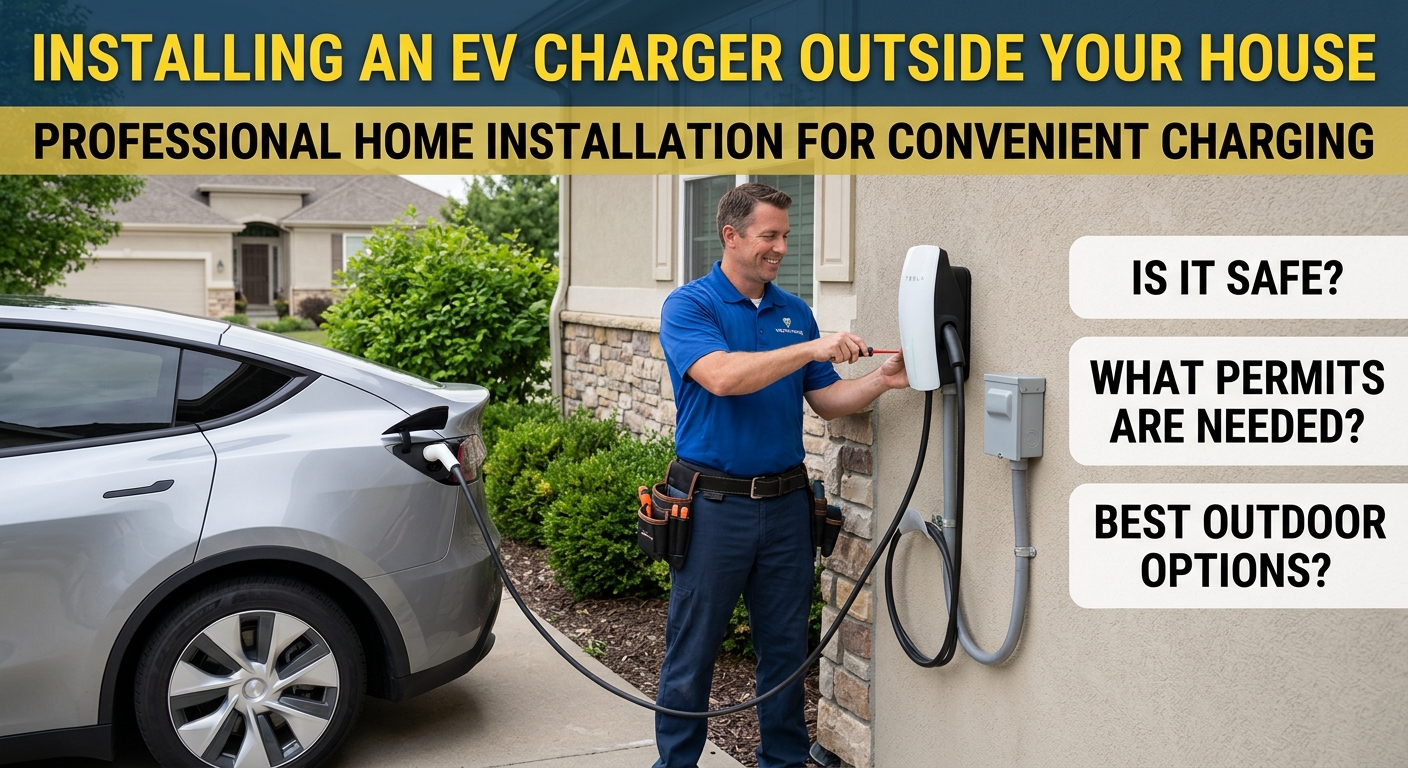
Upgrading to an electric vehicle (EV) delivers immediate savings on daily running costs, whisper-quiet performance, and zero local tailpipe emissions. Delivering 20 to 44 miles of driving range per hour over a dedicated high-voltage 240-volt single-phase branch circuit, installing a home Level 2 wallbox transforms daily vehicle charging into an effortless overnight habit. However, for homeowners without a garage, or those who use their garage for workshop storage or routinely park in a private driveway, a fundamental practical question arises: Can you install an EV charger on the outside of your house?
The short answer is: yes, you can safely install an EV charger on the outside of your house, provided you select an outdoor-rated weatherproof wallbox (NEMA 3R, NEMA 4, or IP65/IP66 rated) and follow National Electrical Code (NEC Article 625) exterior mounting rules.
Exterior installations are extremely common, durable, and fully engineered to withstand heavy driving rain, snow, freezing temperatures, dust storms, and direct solar exposure without compromising electrical safety or performance.
For complete hardware reviews, installer guides, and panel load calculators, visit EV Charger Advisor.
1. Key Requirements for Exterior EV Charger Installations
To ensure your outdoor charging setup operates reliably for years, your installation must satisfy three core requirements:
A. Mandatory Weatherproof Enclosure Ratings (NEMA & IP Standards)
Never install an indoor-only wallbox outside. Exterior units must feature certified protective enclosures:
-
NEMA 3R: Protects against falling rain, sleet, ice formation, and external ice buildup.
-
NEMA 4 / 4X: Provides complete protection against windblown dust, rain, splashing water, hose-directed water, and corrosion.
-
IP65 / IP66 (International Standard): Guarantees dust-tight protection and resistance against powerful high-pressure water jets from any direction.
B. Mandatory Outdoor Mounting Heights (NEC 625.102 / 625.30)
Under NEC Article 625, mounting height requirements differ between indoor garages and outdoor exteriors:
-
Indoor Garage Rule: Minimum 18 inches ($450\text{ mm}$) above floor level.
-
Outdoor Exterior Rule: The bottom of the wallbox coupling/control unit must be mounted at least 24 inches ($600\text{ mm}$) above finished grade to prevent water splash-back, standing puddles, and snow accumulation.
-
Recommended Height: Mounting at 40 to 48 inches ($1.0\text{ m} – 1.2\text{ m}$) provides ergonomic plug access and keeps heavy charging leads neatly elevated.
C. Hardwired Installation vs. Outdoor Receptacle
While outdoor-rated NEMA 14-50 receptacles with in-use weatherproof bubble covers exist, direct hardwiring is strongly recommended for exterior wallboxes. Hardwiring eliminates socket corrosion, prevents water infiltration at plug connection points, reduces GFCI nuisance tripping, and supports high-output 48-Amp ($11.52\text{ kW}$) charging.
To learn more about how charger power levels and wire sizes compare, check out our guide on EV charging types.
2. Outdoor Protection & Cable Management
Installing hardware outside requires addressing physical durability and security:
-
Holster & Cable Protection: Always wrap cables around a dedicated wall-mounted holster or hook. Leaving heavy cables coiled on dirt, gravel, or wet concrete causes jacket degradation and risks vehicular run-over damage.
-
Access Security & Anti-Theft: To prevent unauthorized neighbors or passersby from drawing electricity on your account, select a smart wallbox equipped with RFID card activation, mobile app access locking, or a physical key lock.
-
Sunlight & UV Shielding: Prolonged exposure to intense ultraviolet (UV) radiation can degrade plastic housings over time. Mounting the charger under a small protective roof overhang, carport, or shade cover extends the hardware’s lifespan.
To explore Wi-Fi-enabled smart wallboxes engineered with app locking and weatherproof protection, read our guide on smart chargers.
Step-by-Step Mathematical Example: Exterior Conduit Circuit & Voltage Drop Math
Let us calculate the percentage voltage drop ($\Delta V$) for a 32-Amp Level 2 outdoor charger ($240\text{V}$ single-phase supply) running 65 feet ($19.81\text{ m}$) from a main electrical panel, through exterior PVC conduit along an outside wall to a driveway mounting spot using #8 AWG Copper Wire ($R = 0.000778 \Omega/\text{ft}$).
Given Parameters:
-
Continuous Current Draw ($I$): $32 \text{ Amps}$
-
Nominal Supply Voltage ($V$): $240 \text{ Volts}$
-
One-Way Cable Path ($L$): $65 \text{ feet}$
-
Conductor Resistance ($R_{\text{wire}}$): $0.000778 \Omega \text{ per foot}$
Calculation 1: Voltage Drop ($\Delta V$) Math
For a single-phase $240\text{V}$ circuit ($2 \times L = 130\text{ ft}$ total conductor path):
Calculation 2: Percentage Voltage Drop (%)
Result Breakdown: A 1.35% voltage drop stays well below the 3% maximum NEC threshold limit, confirming that a 65-foot exterior cable run using #8 AWG copper wire operates safely, efficiently, and with minimal heat loss.
Comparison Table: Outdoor Enclosure Ratings & Features
| Enclosure Rating | Rain & Snow Resistance | Dust & Jet-Water Protection | Recommended Use Case |
| NEMA 3R | Good (Falling rain/ice) | Moderate | Standard sheltered exterior wall |
| NEMA 4 / 4X | Superior (Heavy storms & hose water) | High (Windblown dust & corrosion) | Uncovered driveway / Coastal areas |
| IP65 / IP66 | Superior (High-pressure water jets) | Dust-tight complete seal | Exposed outdoor posts & pedestals |
Summary & Key Takeaways
-
Yes, You Can Install Outside: You can safely install an EV charger on the exterior of your house using a NEMA 4 or IP65 weatherproof wallbox.
-
Follow Outdoor Mounting Heights: Mount the bottom of the wallbox at least 24 inches above finished grade to clear standing water, mud, and snow.
-
Hardwiring Is Recommended: Direct hardwiring into a junction box provides maximum weather protection and avoids socket wear.
-
Enable Access Locking: Use RFID cards or app locking features on outdoor wallboxes to prevent unauthorized power usage.













Leave a Reply