
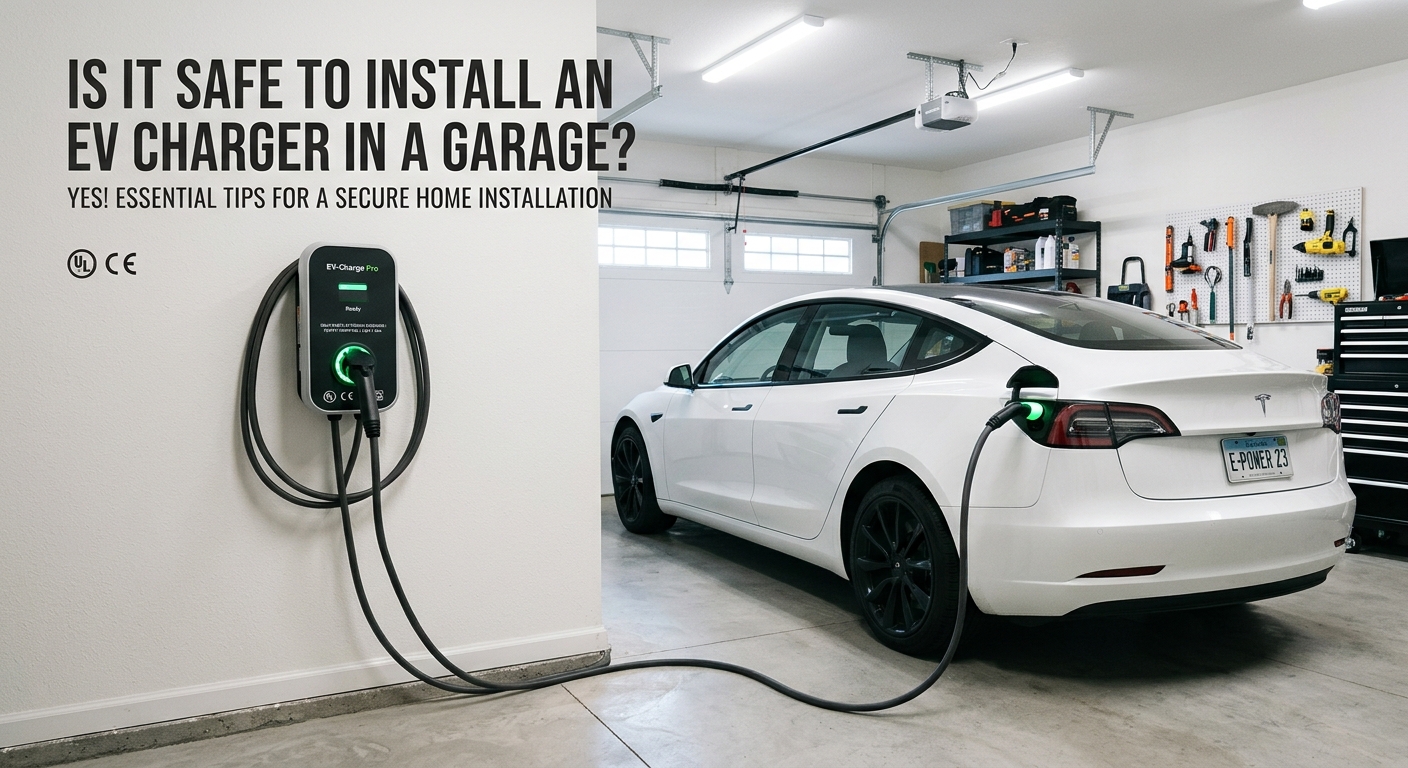
Transitioning to electric mobility offers immediate savings on fuel costs, smooth vehicle operation, and the daily luxury of waking up to a fully charged battery. Delivering 20 to 44 miles of driving range per hour over a high-voltage 240-volt single-phase branch circuit, dedicated Level 2 wallboxes turn daily vehicle charging into a simple overnight routine. However, because EV chargers operate as continuous, high-draw electrical loads indoors, homeowners frequently ask: Is it safe to install an EV charger in a garage?
The short answer is: yes, it is completely safe to install an EV charger in a garage, provided the equipment is installed by a licensed electrician, complies with National Electrical Code (NEC Article 625) standards, and incorporates built-in thermal and ground-fault protection.
In fact, an enclosed residential garage is widely considered the ideal location for a wallbox, as it shields charging hardware from rain, extreme ambient temperatures, and direct UV degradation while keeping charging cables clean and organized.
For complete hardware reviews, installer guides, and panel load calculators, visit EV Charger Advisor.
1. Four Essential Safety Standards for Garage Installations
To ensure total home and electrical safety, every garage EV charger setup must adhere to strict regulatory guidelines:
A. Proper Mounting Heights (NEC 625.102 / 625.30)
Under NEC Article 625, the mounting height of indoor charging equipment is strictly regulated to prevent electrical ignition of heavier-than-air combustible fumes (such as gasoline vapors from lawnmowers or classic cars):
-
Indoor Minimum Height: The bottom of the wallbox coupling/control unit must be mounted at least 18 inches ($450\text{ mm}$) above the garage floor level.
-
Recommended Working Height: Mounting the unit 40 to 48 inches ($1.0\text{ m} – 1.2\text{ m}$) high ensures ergonomic plug handling and keeps cables elevated off the floor.
B. Continuous Load Sizing (125% Breaker Rule)
EV chargers draw maximum rated power for several hours continuously. Under NEC 625.42, the branch circuit breaker and conductors must be sized to 125% of the charger’s rated draw (e.g., a 32A charger requires a 40A double-pole breaker; a 48A charger requires a 60A breaker) to prevent thermal degradation and false breaker trips.
C. Ground-Fault & Thermal Safety Mechanisms
Modern smart Level 2 wallboxes include built-in Charge Circuit Interrupting Devices (CCID) and automatic thermal cut-off sensors. If an internal temperature spike or earth fault is detected, the charger instantly cuts power to protect your home’s wiring.
D. Direct Hardwiring vs. Plug-in Receptacles
While plug-in chargers (NEMA 14-50 sockets) offer portability, direct hardwiring into a junction box is recommended for garage setups. Hardwiring eliminates socket wear, prevents GFCI breaker nuisance trips, and supports high-output 48-Amp ($11.52\text{ kW}$) charging speeds.
To learn more about how charger power levels and wire sizes compare, check out our guide on EV charging types.
2. Environmental & Battery Health Advantages of Garage Charging
Beyond electrical safety, charging inside an enclosed garage provides clear physical advantages:
-
Optimized Battery Thermal Management: Lithium-ion batteries degrade faster and charge slower in extreme cold or heat. A garage buffers temperature extremes, reducing energy spent on battery pre-conditioning.
-
Weather & UV Shielding: Eliminates exposure to driving rain, snow, freezing ice, and direct sunlight, extending the operational lifespan of the wallbox and flexible cable.
-
Trip Hazard Reduction: Mounting wall-mounted cable holsters inside a garage keeps heavy charging leads neatly wrapped, eliminating sidewalk trip hazards and driveway vehicular run-overs.
To explore Wi-Fi-enabled smart wallboxes engineered with integrated GFCI protection, read our guide on smart chargers.
Step-by-Step Mathematical Example: Garage Circuit Voltage Drop Math
Let us perform a safety and efficiency evaluation by calculating the voltage drop ($\Delta V$) for a 48-Amp Level 2 charger ($240\text{V}$ single-phase supply) running 45 feet ($13.71\text{ m}$) from a garage sub-panel using #6 AWG Copper Wire ($R = 0.000491 \Omega/\text{ft}$).
Given Parameters:
-
Continuous Current Draw ($I$): $48 \text{ Amps}$
-
Nominal Supply Voltage ($V$): $240 \text{ Volts}$
-
One-Way Cable Path ($L$): $45 \text{ feet}$
-
Conductor Resistance ($R_{\text{wire}}$): $0.000491 \Omega \text{ per foot}$
Calculation 1: Voltage Drop ($\Delta V$) Math
For a single-phase $240\text{V}$ circuit ($2 \times L = 90\text{ ft}$ total conductor path):
Calculation 2: Percentage Voltage Drop (%)
Result Breakdown: A 0.88% voltage drop stays well below the 3% maximum NEC threshold limit, confirming that a 45-foot garage cable run using #6 AWG copper wire operates safely, efficiently, and with minimal thermal heat generation.
Comparison Table: Garage Mounting Approaches
| Mounting Method | Electrical Connection | Maximum Output Speed | Recommended NEC Height |
| Direct Hardwired Wallbox | Dedicated junction box | 48A ($11.52\text{ kW}$) | 18″ to 48″ above floor |
| Plug-in Receptacle (NEMA 14-50) | Heavy-duty wall socket | 32A – 40A ($7.68 – 9.6\text{ kW}$) | 18″ to 48″ above floor |
| Portable Level 1 Trickle | Standard domestic outlet | 12A ($1.44\text{ kW}$) | Elevated off floor |
Summary & Key Takeaways
-
Completely Safe: Installing an EV charger in a garage is fully safe when completed by a licensed electrician following NEC Article 625.
-
Follow Height Rules: Mount the bottom of the wallbox at least 18 inches above the floor to avoid igniting combustible fumes.
-
Hardwiring Is Superior: Direct hardwiring supports faster 48A charging speeds and eliminates wall socket wear and GFCI tripping.
-
Protects Charger & Battery: Garage charging shields hardware from outdoor weather while keeping battery temperatures stable for faster charging.













Leave a Reply