
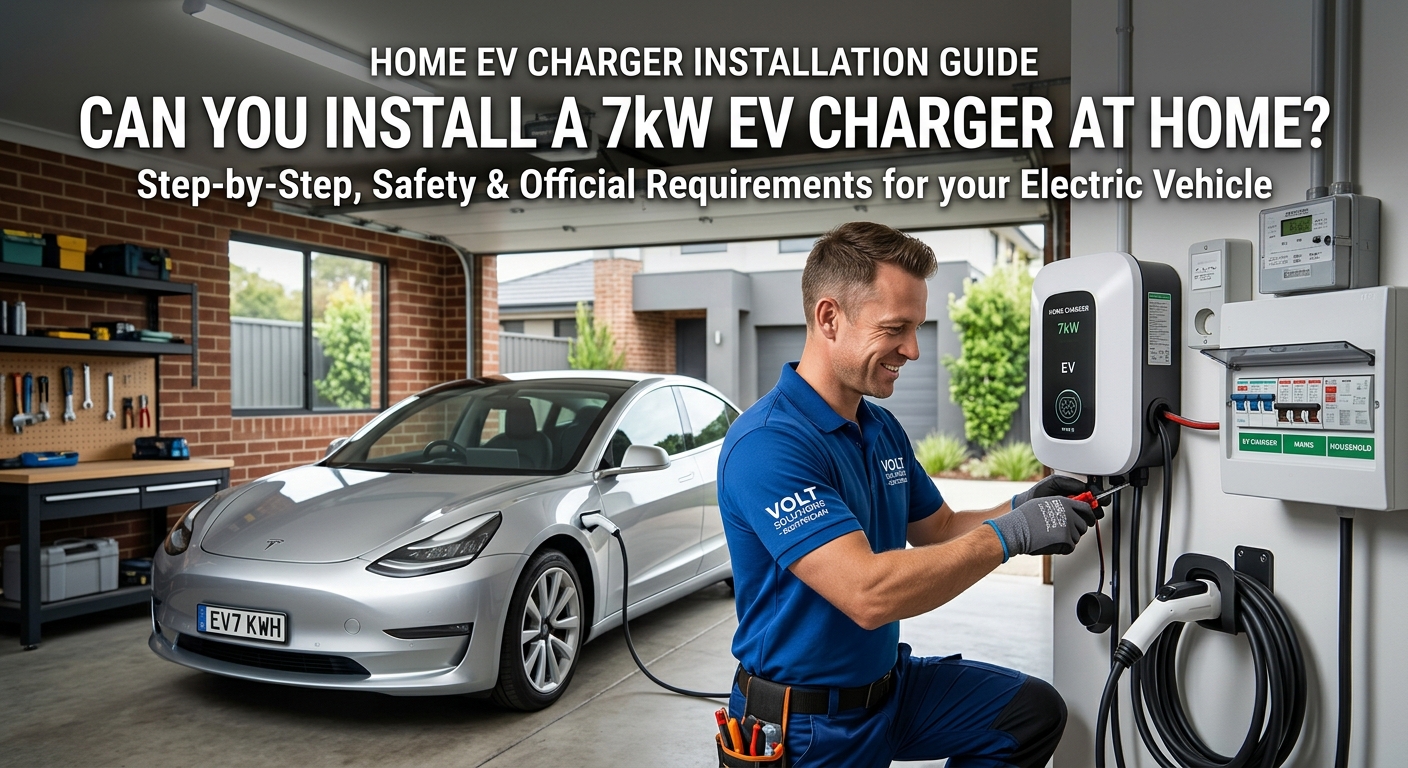
Switching to an electric vehicle (EV) offers impressive fuel savings, quiet performance, and the daily comfort of waking up with a fully replenished battery. Operating on a standard residential 230V/240V single-phase power supply, a 7kW Level 2 home charger is widely considered the sweet spot for residential charging. Restoring 25 to 30 miles of driving range per hour, setting up a 7kW wallbox allows EV owners to recharge a depleted battery comfortably overnight. However, as homeowners review installation options, a primary question arises: Can you install a 7kW EV charger at home?
The short answer is: yes, most homes can install a 7kW Level 2 EV charger, provided the property has a single-phase electricity connection, a dedicated 32-Amp or 40-Amp double-pole circuit breaker, and adequate main panel load capacity.
Installing a 7kW unit strikes an ideal balance between rapid overnight charging speeds and manageable home electrical demands, making it fully compatible with standard residential utility infrastructure.
For complete hardware reviews, installer guides, and panel load calculators, visit EV Charger Advisor.
1. Technical Requirements for Installing a 7kW Home Charger
To successfully support a 7kW Level 2 wallbox, your home’s electrical setup must satisfy three fundamental technical criteria:
A. Single-Phase 230V/240V Supply Connection
A 7kW charger operates by drawing a continuous 32 Amps of current across a single-phase 230V/240V electrical connection ($230\text{V} \times 32\text{A} \approx 7.36\text{ kW}$). Most modern single-family detached homes, townhouses, and villas have single-phase or three-phase utility connections capable of delivering this supply.
B. Dedicated Circuit Breaker Sizing (125% Continuous Rule)
Under National Electrical Code (NEC Article 625) standards, EV chargers are classified as continuous loads. Circuit breakers and conductors must be sized to 125% of the charger’s continuous draw:
-
Charger Draw: 32 Amps continuous.
-
Required Breaker Rating: $32\text{A} \times 1.25 = \mathbf{40 \text{ Amps}}$ (Double-pole breaker).
-
Conductor Wire Gauge: Requires heavy-gauge #8 AWG or #6 AWG copper wiring to handle continuous thermal heat safely.
C. Main Electrical Panel Thermal Capacity
A licensed electrician will conduct a load calculation on your main breaker board:
-
200A Main Panels: Easily support a 40A dedicated EV circuit alongside central air conditioning, electric water heaters, and heavy home appliances.
-
100A Main Panels: Can still support a 7kW charger in many cases, but if household peak load is high, installing a Smart Energy Management System (EVEMS) or Dynamic Load Management (DLM) device allows the charger to automatically throttle during peak kitchen or HVAC usage without triggering the main breaker.
To learn more about how charger power levels and wire sizes compare, check out our guide on EV charging types.
2. Why 7kW Is the Ideal Standard for Homeowners
Compared to smaller portable units or higher-output commercial stations, a 7kW wallbox delivers key practical advantages:
-
Perfect Overnight Charging Window: A typical 60 kWh battery electric vehicle (BEV) recharges from 10% to 80% in approximately 6 to 7 hours, fitting comfortably into overnight off-peak utility windows.
-
Maximizes Cheap Utility Tariffs: Capturing cheap electricity during 4-to-5-hour overnight time-of-use (TOU) windows yields maximum fuel cost savings.
-
Avoids Heavy Three-Phase Utility Upgrades: Higher-output chargers (such as 11kW or 22kW units) require three-phase power supplies, which often demand expensive utility grid transformer upgrades that are unnecessary for standard daily driving needs.
To explore Wi-Fi-enabled smart wallboxes engineered with off-peak schedule timers, read our guide on smart chargers.
Step-by-Step Mathematical Example: Overnight Charging Math for a 7.4kW Setup
Let us calculate the exact charge time and range replenishment for an EV with a 64 kWh battery pack using a 7.4kW single-phase charger ($230\text{V} / 32\text{A}$) operating at 90% net efficiency.
Given Parameters:
-
Usable Battery Capacity: $64 \text{ kWh}$
-
Target Charge Window: $10\% \text{ to } 90\% \text{ State of Charge (SoC)} \rightarrow 80\% \text{ net charge needed}$
-
Energy to Deliver: $64 \text{ kWh} \times 0.80 = \mathbf{51.2 \text{ kWh}}$
-
Charger Usable Output: $7.4 \text{ kW} \times 0.90 \text{ efficiency} = \mathbf{6.66 \text{ kW net}}$
-
Vehicle Driving Efficiency: $3.5 \text{ Miles per kWh}$
Calculation 1: Total Charge Time Required
Calculation 2: Total Added Driving Range
Result Breakdown: A 7.4kW home wallbox safely restores 179.2 miles of driving range in under 7.7 hours overnight, proving that a standard 7kW setup easily satisfies daily driving requirements without needing complex utility transformer modifications.
Comparison Table: 7kW Home Charger vs. Alternative Setup Options
| Charger Option | Supply Circuit Requirements | Added Range per Hour | 10% to 80% Charge Time (60 kWh EV) |
| Standard 120V Socket (Level 1) | 15A / 120V Single-Phase | $3 – 5 \text{ miles/hr}$ | $30 – 40 \text{ Hours}$ |
| 3.7kW Portable Charger | 16A / 230V Single-Phase | $10 – 12 \text{ miles/hr}$ | $14 – 16 \text{ Hours}$ |
| 7.4kW Home Wallbox (Level 2) | 32A / 230V Single-Phase (40A Breaker) | $25 – 30 \text{ miles/hr}$ | $6 – 8 \text{ Hours}$ |
| 11kW Commercial Wallbox | 16A / 400V Three-Phase | $40 – 45 \text{ miles/hr}$ | $4 – 5 \text{ Hours}$ |
Summary & Key Takeaways
-
Yes, You Can Install One: Most residential homes can support a 7kW Level 2 charger using standard single-phase 230V/240V electricity.
-
Requires a 40A Dedicated Breaker: Following the NEC 125% continuous duty rule, a 32A/7kW charger requires a dedicated 40-Amp circuit breaker and #8 or #6 AWG copper wire.
-
Ideal for Overnight Charging: A 7kW charger restores 175+ miles of range in under 8 hours, making it the most cost-effective solution for daily commuting.
-
Avoids Three-Phase Upgrades: 7kW chargers provide rapid Level 2 speeds without forcing property owners to pay for expensive three-phase utility grid upgrades.













Leave a Reply