
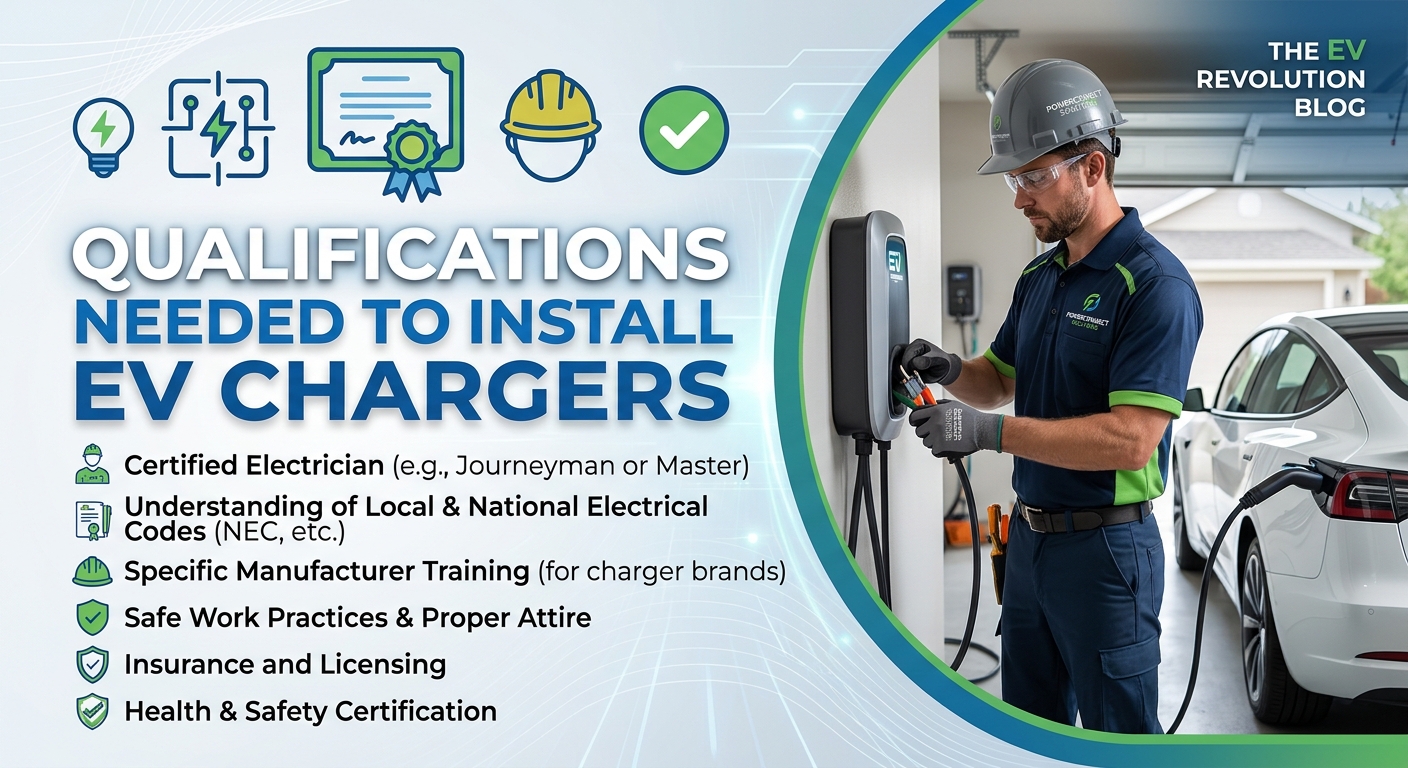
Transitioning to electric mobility is driving massive global demand for high-power residential and commercial charging infrastructure. Delivering 20 to 44 miles of driving range per hour over a high-voltage 240-volt single-phase or 400-volt three-phase supply, dedicated Level 2 wallboxes operate as high-draw continuous electrical loads. Because these systems draw maximum rated power for hours at a time, homeowners and commercial site managers frequently ask: What qualifications do you need to install EV chargers?
The short answer is: to legally and safely install EV chargers, an installer requires a foundation of core electrical trade qualifications (Licensed Journeyman/Master Electrician or City & Guilds level certification), specialized EV supply equipment (EVSE) installation awards, and relevant industry/governmental scheme registration.
Attempting uncertified or DIY installations violates National Electrical Code (NEC Article 625) standards, invalidates vehicle and wallbox warranties, and creates severe electrocution, ground-fault, and electrical fire hazards.
For complete hardware reviews, installer guides, and panel load calculators, visit EV Charger Advisor.
1. The Three Essential Qualification Layers
Becoming a qualified EV charger installer involves three distinct levels of technical certification:
A. Core Electrical Trade Credentials
Before undertaking specialized EV training, an installer must hold recognized trade licenses certifying complete mastery of electrical theory, wiring standards, circuit protection, and grounding systems:
-
North America: Licensed Journeyman or Master Electrician credential (completion of 4–5 year apprenticeship program, 8,000+ practical hours, and state trade board licensing).
-
United Kingdom / International: NVQ Level 3 in Electrical Installation, City & Guilds 2365 / 2357, and 18th Edition IET Wiring Regulations (BS 7671) certification.
B. Specialized EVSE Technical Installation Training
Generic electrical knowledge is insufficient for EV hardware due to unique continuous-load profiles, open-PEN conductor fault protection, dynamic load balancing protocols, and smart grid communications:
-
North America: EVITP (Electric Vehicle Infrastructure Training Program) certification, covering site load management, ADA accessibility, and NEC 625 compliance.
-
United Kingdom / Europe: City & Guilds 2921-31 (Design and Installation of Domestic and Small Commercial Electric Vehicle Charging Installations) or C&G 2919.
C. Government & Professional Scheme Registration
To sign off on building control permits, issue safety compliance certificates, and allow clients to claim state/utility rebates, installers must hold professional registration:
-
North America: State Licensed Electrical Contractor credentials, bonded and insured with local municipal permit-issuing authority.
-
United Kingdom / Europe: Registration with competent person schemes such as NICEIC, NAPIT, or ELECSA, alongside OZEV (Office for Zero Emission Vehicles) authorization.
To learn more about how charger power levels and wire sizes compare, check out our guide on EV charging types.
2. Why Specialized EV Qualifications Are Mandatory
EV chargers represent unique electrical loads compared to standard household appliances:
-
100% Continuous Duty Load Requirement: Under NEC 625.42, EV chargers are classified as continuous loads. Electricians must calculate circuit breakers at 125% of the charger’s maximum rated draw (e.g., a 32A charger requires a 40A breaker; a 48A charger requires a 60A breaker).
-
Advanced Earth Fault & Ground Protection: Installers must understand CCID (Charge Circuit Interrupting Device) operation, PEN conductor failure protection (BS 7671 Rule 722), and Type A vs. Type B Residual Current Devices (RCDs) to prevent lethal casing shocks.
-
Smart Grid & Load Management Protocols: Modern commercial and multi-family installations require configuring OCPP (Open Charge Point Protocol) software and dynamic load management (DLM) sensors to prevent central transformer overloads.
To explore Wi-Fi-enabled smart wallboxes engineered with integrated GFCI/RCD protections, read our guide on smart chargers.
Step-by-Step Mathematical Example: Certified Continuous Circuit Sizing Math
Let us perform a continuous load sizing calculation that a qualified electrician must execute under NEC Article 625 for a 48-Amp Level 2 EV Charger ($240\text{V}$ single-phase supply).
Given Parameters:
-
Charger Continuous Rating ($I_{\text{continuous}}$): $48 \text{ Amps}$
-
NEC Continuous Duty Safety Factor: $125\% \quad (1.25)$
-
Supply Line Voltage ($V$): $240 \text{ Volts}$
Calculation 1: Minimum Circuit Breaker Amperage Rating
Calculation 2: Continuous Usable Power Output ($P$)
Calculation 3: Minimum Copper Conductor Gauge Selection
Under NEC Table 310.16 (75°C terminal rating):
-
#8 AWG Copper Wire = 50A Max $\rightarrow$ INSUFFICIENT
-
#6 AWG Copper Wire = 65A Ampacity $\rightarrow$ REQUIRED (Satisfies 60A breaker requirement)
Result Breakdown: A qualified installer correctly identifies that a 48A charger requires a 60A double-pole circuit breaker and #6 AWG copper conductors, delivering a safe, code-compliant 11.52 kW of continuous charging power.
Comparison Table: Qualifications Framework by Region
| Qualification Tier | North America (US / Canada) | United Kingdom / Europe |
| Core License | Licensed Journeyman / Master Electrician | NVQ Level 3 + 18th Edition (BS 7671) |
| Specialized EVSE Certification | EVITP (EV Infrastructure Training Program) | City & Guilds 2921-31 / 2919 |
| Industry Registration | State Electrical Contractor Board | NICEIC / NAPIT / Competent Person Scheme |
| Government Grant License | State / Utility Approved Contractor | OZEV Authorized Installer |
Summary & Key Takeaways
-
Three Qualifications Required: Installing EV chargers safely requires a core electrician license, specialized EVSE technical certification (like EVITP or City & Guilds 2921-31), and industry scheme registration.
-
Understands Continuous Duty Rules: Certified installers properly apply the 125% NEC continuous load factor to size circuit breakers and heavy copper conductors correctly.
-
Ensures Code & Warranty Compliance: Qualified sign-off guarantees compliance with building control permits, satisfies utility rebate criteria, and maintains hardware warranties.
-
Protects Property & Safety: Certified setup prevents thermal socket degradation, neutral fault shocks, and main service panel overloads.













Leave a Reply