
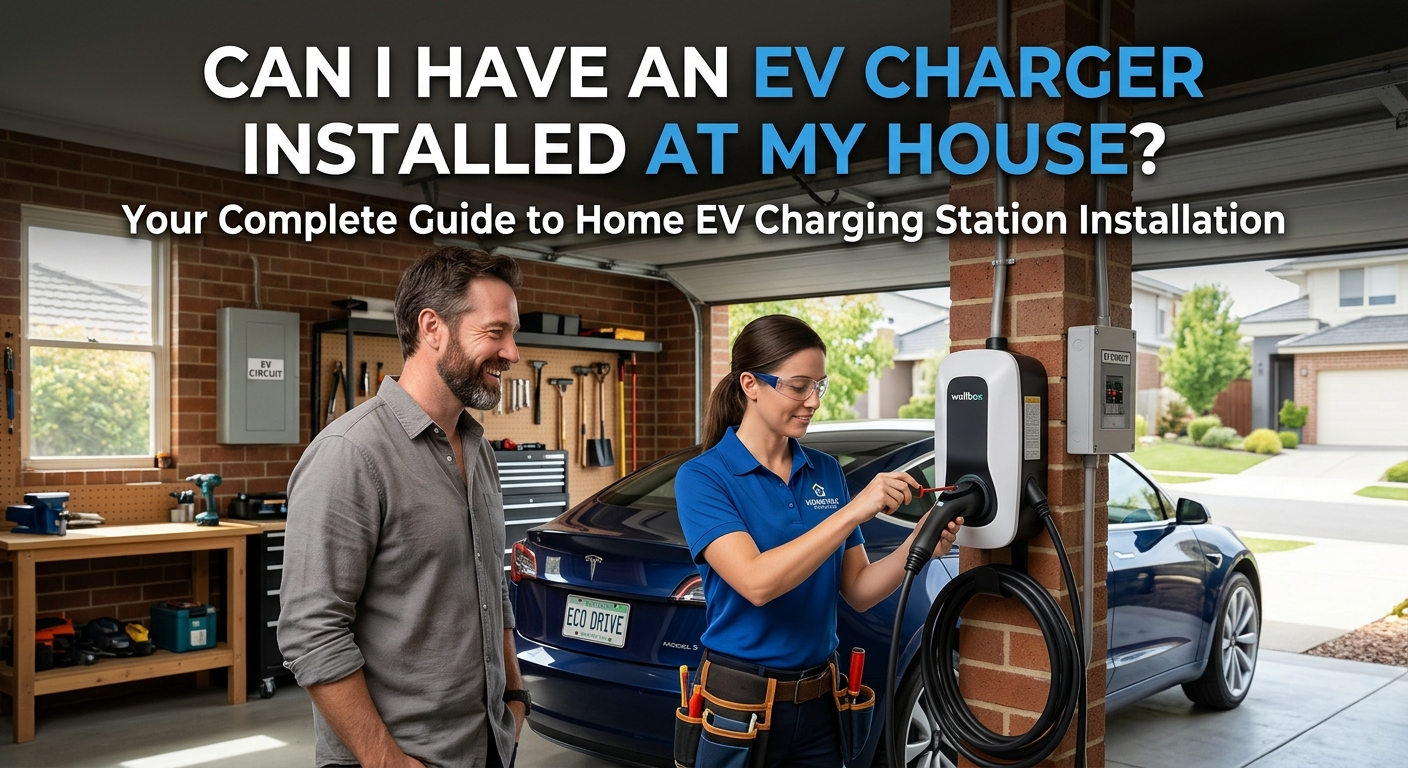
Switching to an electric vehicle (EV) is one of the best ways to reduce long-term transportation costs, eliminate daily gas station trips, and enjoy the convenience of waking up every morning with a fully replenished battery. Delivering 20 to 44 miles of driving range per hour over a high-voltage 240-volt single-phase supply, setting up a home Level 2 wallbox transforms daily vehicle charging into a simple overnight routine. However, as new or prospective EV owners evaluate their properties, a primary question arises: Can I have an EV charger installed at my house?
The short answer is: yes, you can have an EV charger installed at your house, provided your home has sufficient electrical panel capacity, a dedicated parking spot (inside a garage or along a private driveway), and adheres to National Electrical Code (NEC Article 625) standards.
Whether you own a single-family house, a townhouse, or a property with an outdoor parking pad, evaluating your home’s electrical service limits and mounting locations ensures a smooth, code-compliant, and cost-effective installation.
For complete hardware reviews, installer guides, and panel load calculators, visit EV Charger Advisor.
1. Three Critical Requirements for Home EV Charger Installation
Before scheduling a licensed electrical contractor, verify that your home satisfies three foundational elements:
A. Main Electrical Panel Capacity (Amperage Load Analysis)
A dedicated Level 2 wallbox typically demands a continuous load of 32 to 48 Amps on a dedicated 240V double-pole circuit breaker:
-
200-Amp Main Service Panel: Standard in most modern homes, a 200A panel easily supports a 40A or 50A EV charger alongside central air conditioning, electric dryers, and kitchen appliances without requiring an upgrade.
-
100-Amp Main Service Panel: Common in older homes, a 100A panel may require a load calculation by an electrician. If thermal capacity is constrained, you can either install a Smart Energy Management System (EVEMS) to balance load dynamically or upgrade your main panel to 200A.
B. Dedicated Parking Bay & Vehicle Charge Port Reach
You need an off-street parking space—such as a private garage, carport, or dedicated driveway—within reach of the wallbox cable. Under standard electrical codes, flexible EV charging cables are limited to 25 feet ($7.5\text{ m}$) maximum length.
C. Circuit Wiring & Hardwiring Preferences
Installers route heavy-gauge copper conductors (#8 AWG for 32A or #6 AWG for 48A chargers) directly from your breaker board to the wallbox. Direct hardwiring into the electrical system is widely recommended over plug-in receptacles, as it eliminates socket wear, prevents GFCI nuisance tripping, and supports higher charging speeds.
To learn more about how charger power levels and wire sizes compare, check out our guide on EV charging types.
2. Mandatory NEC Code Requirements for Residential Placement
Under NEC Article 625, specific safety rules govern where and how high a wallbox must be mounted:
-
NEC Minimum Mounting Heights (NEC 625.102 / 625.30):
-
Indoor Garages: The bottom of the wallbox coupling/control unit must be mounted between 18 inches ($450\text{ mm}$) and 4 feet ($1.2\text{ m}$) above floor level to avoid igniting heavier-than-air combustible vapors.
-
Outdoor Driveways: The bottom of the wallbox coupling/control unit must be mounted between 24 inches ($600\text{ mm}$) and 4 feet ($1.2\text{ m}$) above finished grade to protect hardware from standing water, splash-back, and snow.
-
-
Weatherproof Enclosure Ratings: Outdoor installations require wallboxes certified with NEMA 3R, NEMA 4, or IP65 weatherproofing to withstand driving rain, snow, and extreme weather.
To explore Wi-Fi-enabled smart wallboxes engineered with durable housings, read our guide on smart chargers.
Step-by-Step Mathematical Example: Circuit Voltage Drop Calculation
To evaluate the efficiency of an installation, let us compute the voltage drop ($\Delta V$) for a 48-Amp Level 2 charger ($240\text{V}$ single-phase supply) running 60 feet ($18.28\text{ m}$) from the main panel to a garage wall using #6 AWG Copper Wire ($R = 0.000491 \Omega/\text{ft}$).
Given Parameters:
-
Continuous Current Draw ($I$): $48 \text{ Amps}$
-
Line Voltage ($V$): $240 \text{ Volts}$
-
One-Way Cable Run ($L$): $60 \text{ feet}$
-
Conductor Resistance ($R_{\text{wire}}$): $0.000491 \Omega \text{ per foot}$
Calculation 1: Voltage Drop ($\Delta V$) Math
For a single-phase $240\text{V}$ circuit ($2 \times L = 120\text{ ft}$ total conductor path):
Calculation 2: Percentage Voltage Drop (%)
Result Breakdown: A 1.18% voltage drop stays well below the 3% maximum NEC threshold limit, confirming that a 60-foot cable run using #6 AWG copper conductors operates safely, efficiently, and with minimal heat dissipation.
Comparison Table: Home EV Charger Installation Options
| Installation Approach | Circuit Breaker Rating | Added Driving Range per Hour | Average Installation Complexity |
| Standard Wall Socket (Level 1) | 15A / 20A (120V) | $3 – 5 \text{ miles/hr}$ | Zero ($0 upfront setup) |
| Hardwired Level 2 (32A Output) | 40A (240V) | $20 – 30 \text{ miles/hr}$ | Low to Moderate |
| Hardwired Level 2 (48A Output) | 60A (240V) | $35 – 44 \text{ miles/hr}$ | Moderate (Requires #6 AWG wire) |
| Panel Upgrade + Level 2 | 200A Service Upgrade | $25 – 44 \text{ miles/hr}$ | High (Requires utility coordination) |
Summary & Key Takeaways
-
Yes, You Can Install One: You can install an EV charger at your house if you have dedicated off-street parking and sufficient electrical capacity.
-
Check Your Panel Capacity: Homes with 200A panels can easily support Level 2 chargers. Homes with 100A panels may use smart load management devices to avoid a full service replacement.
-
Direct Hardwiring Is Superior: Hardwiring directly into a dedicated circuit breaker increases safety, performance, and charging speed.
-
Follow Height & Safety Codes: Mount wallboxes at least 18 inches high in garages and 24 inches high outdoors per NEC Article 625 rules.













Leave a Reply