
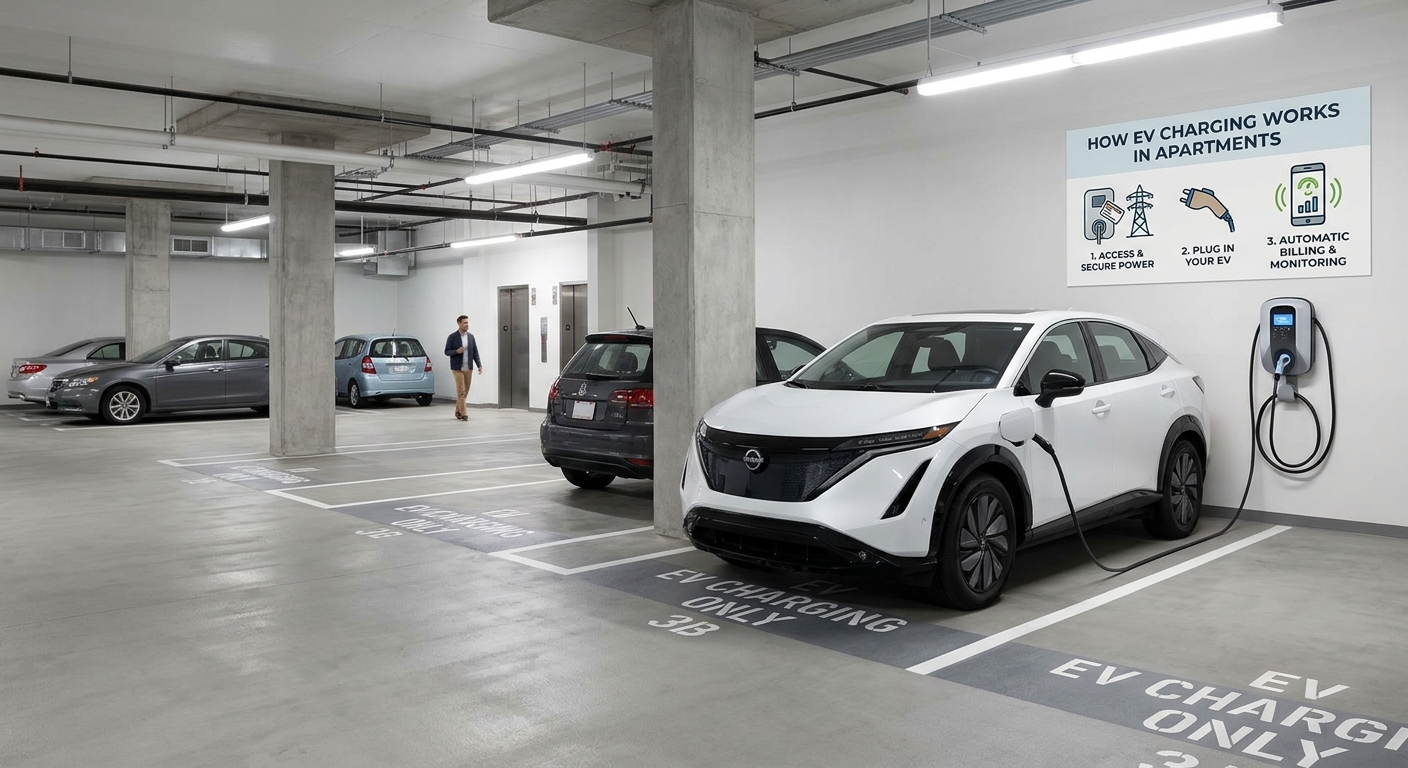
As electric vehicles (EVs) become increasingly mainstream across urban centers, multi-family residential complexes and apartment buildings face rising demand for reliable charging options. Delivering 20 to 44 miles of driving range per hour over a high-voltage 240-volt single-phase branch circuit, Level 2 AC wallboxes represent the optimal balance of charging speed and infrastructure cost. However, for residents living in apartment towers or multi-family blocks, understanding the mechanics of shared power distribution leads to a common question: How does EV charging work in apartments?
The short answer is: EV charging in apartments typically uses smart Level 2 AC chargers installed in assigned parking bays or shared visitor spots, powered by dedicated building sub-panels and managed via intelligent energy management and automated billing software.
Unlike standalone single-family homes with direct access to a private utility meter, multi-tenant properties rely on centralized load balancing, access control mechanisms, and sub-metering infrastructure to ensure total electrical safety under the National Electrical Code (NEC Article 625).
For complete hardware reviews, installer guides, and panel load calculators, visit EV Charger Advisor.
1. The Three Core Hardware & Wiring Architectures
Apartment EV charging infrastructure relies on three main technical setups:
A. Direct Meter Feed (Individual Unit Connection)
In low-rise buildings or properties where parking spaces sit adjacent to the main electrical room, heavy-gauge copper wiring (#8 or #6 AWG) routes directly from the individual resident’s utility meter to their assigned parking bay.
-
Billing Method: Electricity costs appear directly on the resident’s existing monthly utility bill.
-
Limitation: Cable run distance limits and physical panel space restrict this method to a small number of units.
B. Common Service Panel + Smart Sub-Metering
Chargers connect to a centralized multi-family electrical sub-panel located in the garage. Each charger incorporates an embedded revenue-grade meter or RFID reader.
-
Billing Method: Software platforms track kilowatt-hour (kWh) usage per user and automatically bill the tenant’s credit card or re-route funds to the building management system.
C. Shared Community Charging Bays
Instead of installing chargers in every private space, property owners set up dedicated visitor or community charging stalls. Residents park, scan an RFID card or mobile app, charge for 2 to 4 hours, and then move their vehicle to allow neighbors access.
To learn more about how charger power levels and wire sizes compare, check out our guide on EV charging types.
2. Dynamic Load Management (DLM): Preventing Panel Overload
The primary challenge in apartment EV charging is main service panel capacity. If 20 tenants plug in 48-Amp Level 2 chargers simultaneously, total power demand ($20 \times 11.5\text{ kW} = 230\text{ kW}$) would overload the building’s main transformer.
Modern apartment installations solve this using Dynamic Load Management (DLM):
-
Real-Time Amperage Throttling: Smart wallboxes communicate via Wi-Fi, Ethernet, or Cellular OCPP (Open Charge Point Protocol) to measure real-time building electrical draw.
-
Automatic Power Sharing: During peak hours (e.g., 6 PM to 10 PM), the DLM system automatically throttles each wallbox to 16A or 24A. During off-peak night hours (12 AM to 6 AM), power scales back up to 32A or 48A, ensuring every vehicle is fully charged by morning without triggering panel breakers.
To explore Wi-Fi-enabled smart wallboxes engineered with OCPP compatibility, read our guide on smart chargers.
Step-by-Step Mathematical Example: DLM Power Sharing in Apartment Garages
Let us perform a power distribution calculation for a multi-family garage sub-panel with a 100-Amp maximum continuous capacity limit ($240\text{V}$ single-phase supply = $24\text{ kW}$ max continuous power) serving 6 active Level 2 charging stations.
Given Parameters:
-
Available Panel Continuous Capacity: $100 \text{ Amps}$ ($24,000 \text{ Watts}$)
-
Number of Active EVs Plugged In: $6 \text{ Vehicles}$
-
Maximum Individual Charger Rating: $32 \text{ Amps}$ ($7.68 \text{ kW}$)
Calculation 1: Total Power Demand Without Load Management
Calculation 2: Equal Dynamic Load Distribution ($100\text{A}$ Panel)
Calculation 3: Added Overnight Driving Range (8-Hour Dwell Time)
Assuming an EV efficiency of 3.3 miles per kWh:
Result Breakdown: Even when 6 vehicles share a constrained 100-Amp sub-panel simultaneously, Dynamic Load Management safely delivers 105.6 miles of driving range to each car during an 8-hour overnight session.
Comparison Table: Apartment EV Charging Architecture
| Architecture Strategy | Power Allocation | Billing Method | Primary Advantage |
| Direct Meter Feed | Fixed per unit ($32\text{A} – 48\text{A}$) | Directly on personal utility bill | Simple billing, zero software fees |
| Sub-Panel + DLM | Dynamic auto-sharing | App / RFID automated billing | Prevents expensive transformer upgrades |
| Shared Visitor Bays | Fixed high power ($32\text{A} – 48\text{A}$) | Pay-per-use mobile app | Low initial hardware count |
Summary & Key Takeaways
-
Uses Smart Level 2 AC Chargers: Apartment charging typically relies on 240V Level 2 wallboxes installed in assigned bays or shared spaces.
-
Dynamic Load Management Prevents Overloads: DLM software automatically balances available panel capacity across multiple active chargers without tripping breakers.
-
Automated Sub-Metering & Billing: Networked chargers use RFID cards or mobile apps to track individual kWh consumption and charge users accurately.
-
Delivers Full Overnight Charge: Even under shared power settings, tenants receive 100+ miles of range during overnight plug-in sessions.













Leave a Reply