
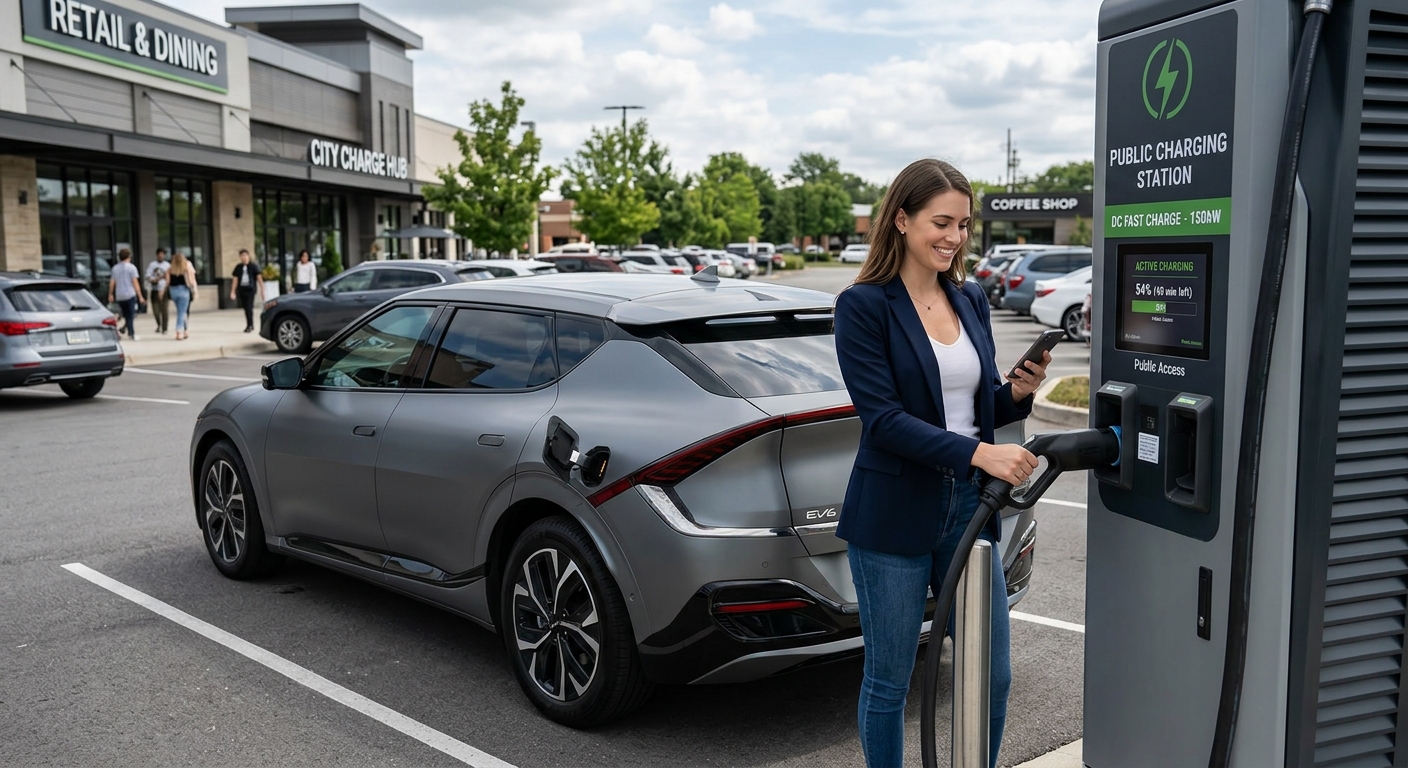
witching to an electric vehicle (EV) promises instant fuel savings, quiet operation, and zero daily tailpipe emissions. When paired with a dedicated home Level 2 wallbox, owners enjoy the ultimate convenience of waking up every morning with a fully replenished battery. However, for drivers living in high-rise apartments, rented properties, or urban homes without off-street parking, a crucial question arises: Is an EV worth it without a home charger?
The short answer is: for most drivers, an EV is generally not worth it without a home charger, as relying exclusively on public charging networks eliminates the primary cost savings, time convenience, and battery health benefits of EV ownership.
While owning an EV without home charging is technically possible through workplace charging or public DC fast networks, it turns the seamless “charge-while-you-sleep” experience into an inconvenient chore—often costing as much per mile as driving a fuel-efficient hybrid.
For complete hardware reviews, installer guides, and panel load calculators, visit EV Charger Advisor.
1. Why EV Ownership Changes Without Home Charging
Relying entirely on public charging infrastructure fundamentally shifts the daily EV experience across three main pillars:
A. Financial Cost Escalation (Public Tariffs vs. Home Rates)
The largest economic advantage of an EV comes from low residential off-peak electricity rates. Public DC fast charging operators charge significant service markups to cover expensive high-voltage equipment, maintenance, and commercial demand charges.
-
Global/US Reality: Public fast chargers cost $0.40 to $0.65+ per kWh—nearly 3x to 4x the cost of home charging.
-
Pakistani Market Reality: Residential home charging costs approximately Rs 35–65 per kWh, whereas public fast chargers range from Rs 110 to 150 per kWh. At public rates, running costs approach those of an economical petrol hybrid.
B. Time Loss & Queue Stress
Instead of spending 10 seconds plugging in at home before bed, drivers without home charging must actively schedule charging stops. Spending 30 to 50 minutes waiting at a fast charger—or dealing with broken public stations and busy queues—reintroduces “gas station behavior” and charging anxiety.
C. Accelerated Battery Degradation
Frequent, exclusive reliance on public DC fast chargers subjects lithium-ion cells to elevated internal heat and mechanical stress. Over time, exclusive fast charging can accelerate capacity loss compared to gentle AC Level 2 charging at home.
To learn more about how charger power levels and wire sizes compare, check out our guide on EV charging types.
2. When an EV Can Work Without Home Charging
Despite the drawbacks, owning an EV without a private home charger can still be viable under four specific scenarios:
-
Free or Low-Cost Workplace Charging: If your employer offers dedicated Level 2 ($7.4\text{ kW}$) chargers at your office, your vehicle recharges while you work, effectively replacing home charging.
-
Short Commutes (Low Annual Mileage): If you drive under 15 to 20 miles per day, a single 30-minute fast-charging session every 2 to 3 weeks is sufficient.
-
Abundant Walking-Distance Public AC Chargers: If you live directly adjacent to a public parking lot with low-cost Level 2 charging, you can leave your vehicle parked overnight or during errands.
-
Temporary Level 1 Socket Access: If you lack a wallbox but can plug a 10A trickle charger into a standard wall socket overnight, you can restore 40 to 50 miles of daily range without any hardware installation costs.
To explore Wi-Fi-enabled smart wallboxes engineered with mobile app control, read our guide on smart chargers.
Step-by-Step Mathematical Example: Home Charging vs. Public Fast Charging Costs
Let us perform a financial comparison evaluating the annual fuel costs for an EV driving 12,000 miles (19,300 km) annually under 100% Home Charging vs. 100% Public Fast Charging.
Given Parameters:
-
Annual Commute Distance: $12,000 \text{ Miles}$
-
EV Efficiency Rating: $3.3 \text{ Miles per kWh}$ ($0.303 \text{ kWh/mile}$)
-
Total Annual Energy Consumption: $\frac{12,000}{3.3} = \mathbf{3,636.36 \text{ kWh / year}}$
-
Home Electricity Rate: $\$0.14 \text{ per kWh}$ (or ~Rs 50/kWh in Pakistan)
-
Public Fast Charging Rate: $\$0.55 \text{ per kWh}$ (or ~Rs 120/kWh in Pakistan)
Calculation 1: Annual Energy Cost for 100% Home Charging
Calculation 2: Annual Energy Cost for 100% Public Fast Charging
Result Breakdown: Relying exclusively on public fast chargers costs an extra $1,490 (or ~Rs 254,000) every year, completely wiping out the primary financial savings of driving electric compared to a fuel-efficient hybrid or petrol vehicle.
Comparison Table: EV Ownership Modes Compared
| Metric / Consideration | 100% Home Level 2 Charging | Public DC Fast Charging Only |
| Fueling Cost per Mile | Lowest ($\$0.04 – \$0.06 / \text{mile}$) | High ($\$0.15 – \$0.20 / \text{mile}$) |
| Time Spent Charging | 0 Minutes (Charges while sleeping) | 30 to 50 Minutes per session |
| Daily Convenience | Maximum (Wake up fully charged) | Low (Requires planning & queuing) |
| Battery Health Impact | Minimal (Gentle AC current) | Moderate to High (Thermal stress) |
| Ideal For | Anyone with a garage or driveway | High-mileage renters (Not recommended) |
Summary & Key Takeaways
-
Generally Not Worth It: Without home charging, an EV loses its biggest advantages: ultra-low fueling costs and overnight convenience.
-
Public Rates Eliminate Savings: Public DC fast chargers cost 3x to 4x more than home electricity rates, making running costs comparable to petrol hybrids.
-
Exceptions Exist: Owning an EV without home charging can work if you have reliable workplace charging or drive very short daily distances.
-
Try Level 1 Sockets First: If you cannot install a Level 2 wallbox, plugging into a standard 120V/230V socket overnight often provides enough range for average commutes.













Leave a Reply