
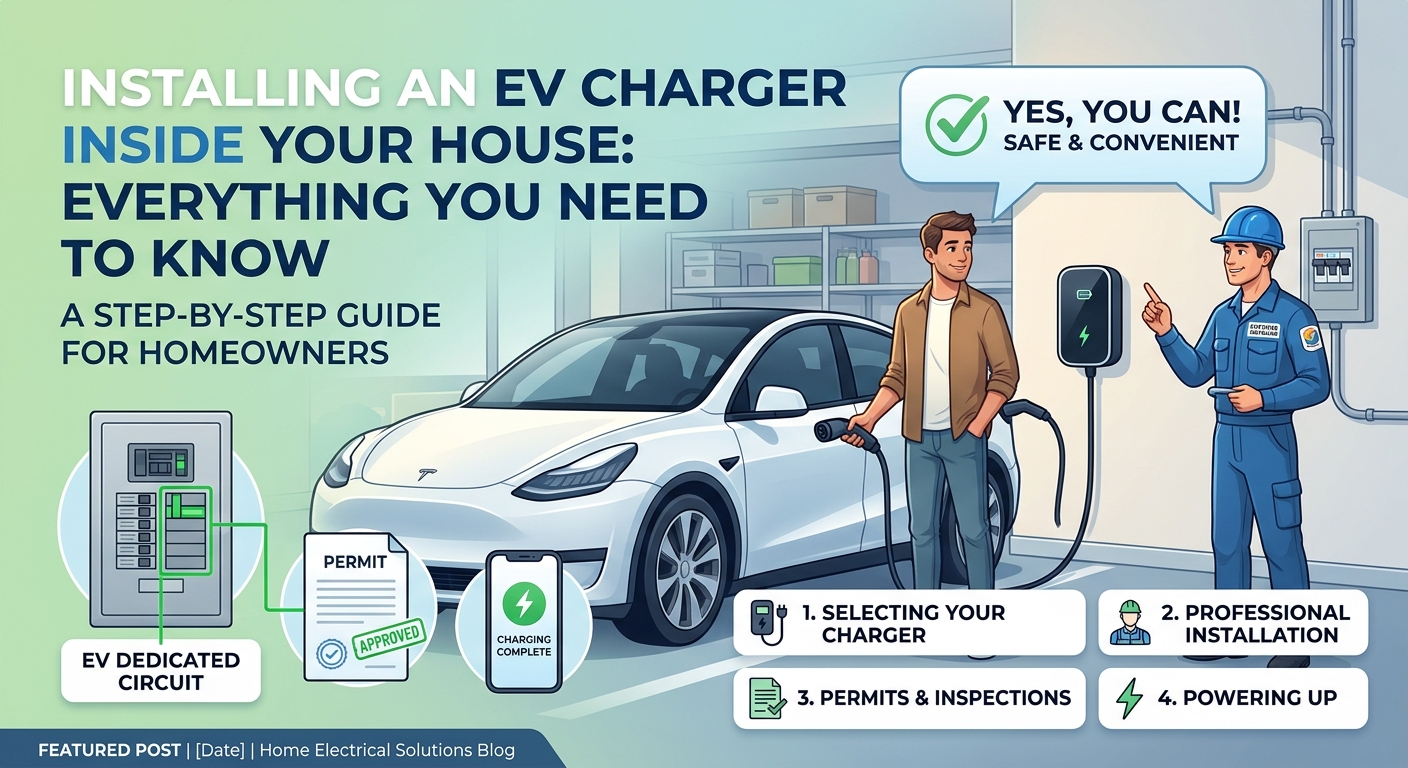
Transitioning to an electric vehicle (EV) is one of the most effective ways to lower daily commute costs while enjoying the comfort of waking up every morning with a fully replenished battery. Delivering 20 to 44 miles of driving range per hour over a high-voltage 240-volt single-phase supply, setting up a home Level 2 wallbox transforms daily battery charging into an effortless overnight routine. However, when evaluating installation locations, homeowners often ask: Can I install an EV charger inside my house?
The short answer is: yes, you can install an EV charger inside your house—most commonly inside an attached garage, workshop, or dedicated utility room—provided the installation adheres strictly to National Electrical Code (NEC Article 625) standards, proper ventilation guidelines, and structural safety rules.
Installing a charger indoors protects sensitive hardware from harsh weather conditions, prevents cable degradation from extreme freeze-thaw cycles, and keeps charging equipment secure from vandalism or unauthorized outdoor access.
For complete hardware reviews, installer guides, and panel load calculators, visit EV Charger Advisor.
1. Key Indoor Installation Requirements & NEC Standards
While mounting a wallbox inside an attached garage or indoor utility bay is standard practice, several critical electrical and fire safety codes must be met:
A. NEC Minimum Mounting Heights (NEC 625.102 / 625.30)
-
Indoor Height Limits: In an enclosed garage or indoor space, the bottom of the wallbox coupling or control unit must be mounted between 18 inches ($450\text{ mm}$) and 4 feet ($1.2\text{ m}$) above floor level.
-
Vapor Safety Clearance: Elevating the charger at least 18 inches off the ground prevents electric arcs or switching contacts from igniting heavier-than-air combustible vapors (such as gasoline fumes, lawnmower fuel, or paint thinners stored on garage floors).
B. Enclosure Environmental Protection (NEMA / IP Ratings)
-
Indoor Enclosures: Indoor wallboxes require at least a NEMA 1 or NEMA 2 rating (dust protection).
-
Cross-Use Capability: Most modern wallboxes carry NEMA 3R, NEMA 4, or IP65 ratings, meaning they are fully sealed against moisture, dust, and washdowns, making them exceptionally durable inside dusty garage environments.
C. Ventilation Requirements for Standard Modern EVs
-
Zero Ventilation Needed for Modern EVs: Modern production electric vehicles utilize sealed, solid-state or liquid-cooled lithium-ion battery packs. They release zero hazardous gases during normal AC charging, meaning no special mechanical ventilation or exhaust fans are required inside your garage.
-
Older Lead-Acid Systems: Mechanical ventilation is legally required under NEC 625 only if charging legacy open-flooded lead-acid battery systems that off-gas hydrogen during charge cycles.
To learn more about how charger power levels and wire sizes compare, check out our guide on EV charging types.
2. Best Practices for Indoor EV Charger Placement
To ensure seamless daily operation and avoid safety hazards inside your garage or home, keep these four setup rules in mind:
-
Mount Close to the Main Breaker Panel: Positioning the wallbox adjacent to or on the same wall as your main distribution panel minimizes long conduit runs, lowering copper conductor expenses and reducing circuit line resistance.
-
Align with Your Vehicle’s Charge Port: Standard charging cables are limited to 25 feet ($7.5\text{ m}$) maximum length per NEC code. Ensure the cable easily reaches your car’s charging inlet whether you park nose-in or back into the garage.
-
Avoid Running Cables Through Doors or Drywall: Under NEC 625.50, flexible EV supply cables must never be routed through walls, floor penetrations, ceiling drywalls, or doorways, as pinched cables present severe insulation fire risks.
-
Use Hardwired Connections: Direct-hardwiring the wallbox into a double-pole circuit breaker eliminates heavy-duty 14-50 plug receptacles, preventing socket contact wear and nuisance tripping.
To explore Wi-Fi-enabled smart wallboxes engineered for indoor mounting, read our guide on smart chargers.
Step-by-Step Mathematical Example: Circuit Voltage Drop on Indoor Wiring Runs
When placing a high-power indoor wallbox (such as a hardwired 48-Amp Level 2 charger on a 60A breaker) inside a garage located 50 feet ($15.24\text{ m}$) from the main electrical panel, selecting the correct conductor size limits voltage drop ($\Delta V$) and prevents heat buildup.
Let us evaluate the voltage drop using #6 AWG Copper Wire ($R = 0.000491 \Omega/\text{ft}$) on a 240V single-phase supply.
Given Parameters:
-
Continuous Current Draw ($I$): $48 \text{ Amps}$
-
Nominal Line Voltage ($V$): $240 \text{ Volts}$
-
One-Way Cable Distance ($L$): $50 \text{ feet}$
-
Conductor Resistance ($R_{\text{wire}}$): $0.000491 \Omega \text{ per foot}$
Calculation 1: Voltage Drop ($\Delta V$) Math
For a single-phase $240\text{V}$ circuit ($2 \times L = 100\text{ ft}$ total conductor path):
Calculation 2: Percentage Voltage Drop (%)
Result Breakdown: A 0.98% voltage drop stays well below the 3% maximum NEC threshold limit, confirming that a 50-foot indoor cable run using #6 AWG copper conductors operates safely, efficiently, and with minimal heat generation.
Comparison Table: Indoor Garage vs. Outdoor EV Charger Installation
| Setup Metric | Indoor Garage Installation | Outdoor Exterior Installation |
| Minimum Mounting Height | 18 Inches ($450\text{ mm}$) above floor | 24 Inches ($600\text{ mm}$) above grade |
| Weather & Environmental Protection | Protected from rain, snow, UV | Requires NEMA 3R, NEMA 4, or IP65 |
| Enclosure Rating Required | NEMA 1, NEMA 2, or NEMA 3R | NEMA 3R or NEMA 4 Watertight |
| Cable Lifespan & Wear | Longest lifespan (Shielded from climate) | Moderate (Exposed to temperature shifts) |
| Vandalism & Security Risk | Zero Risk (Secured indoors) | Moderate (Requires locking app/pedestal) |
Summary & Key Takeaways
-
100% Safe & Standard: Installing an EV charger inside your house or attached garage is fully legal, safe, and code-compliant under NEC Article 625.
-
Observe Mounting Height Rules: Mount indoor wallboxes at least 18 inches above floor level to avoid igniting heavier-than-air combustible vapors.
-
No Special Ventilation Needed: Modern lithium-ion EVs release zero toxic fumes during charging, eliminating the need for garage exhaust fans.
-
Never Pass Cables Through Drywall: Always ensure charging cables remain inside the room where the charger is installed and never trail through doors or drywall penetrations.













Leave a Reply