
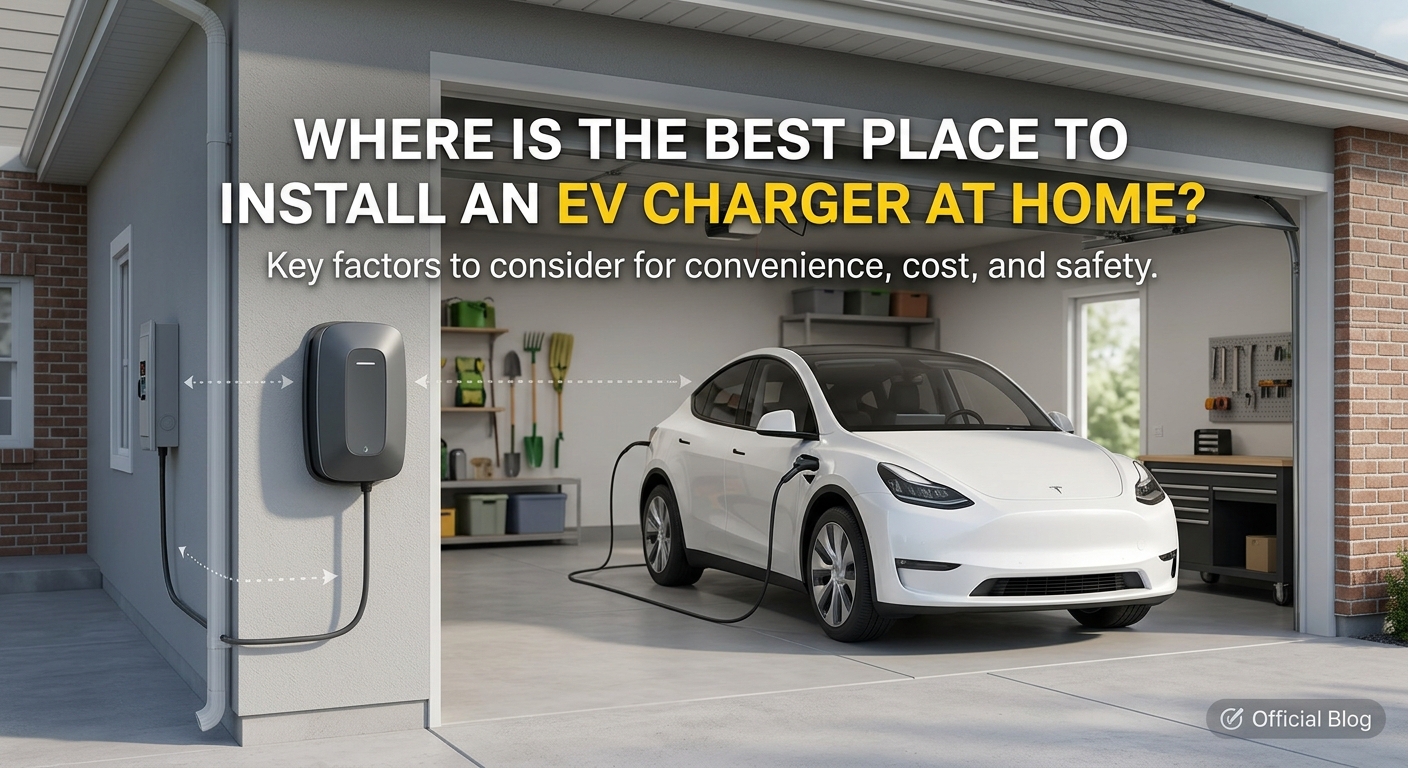
Transitioning to an electric vehicle (EV) is one of the most effective ways to slash monthly transportation costs while enjoying the comfort of waking up every morning with a fully replenished battery. Delivering 20 to 44 miles of driving range per hour over a high-voltage 240-volt single-phase branch circuit, installing a dedicated Level 2 home wallbox is the industry gold standard. However, when evaluating garage layouts, driveway configurations, and electrical panel routing, homeowners frequently ask: Where is the best place to install an EV charger at home?
The short answer is: the best place to install an EV charger is inside an enclosed garage or on an exterior wall right next to your primary parking spot, positioned as close as possible to your main electrical service panel.
Selecting a location that combines vehicle port reach, short conduit paths, and strict National Electrical Code (NEC Article 625) mounting compliance ensures low turnkey installation expenses, high operating efficiency, and long-term convenience.
For complete hardware reviews, installer guides, and panel load calculators, visit EV Charger Advisor.
1. Four Primary Criteria for Optimal Charger Placement
Selecting the exact mounting spot for your wallbox involves evaluating four practical factors:
A. Proximity to the Main Electrical Panel
Every foot of heavy-gauge copper wiring (#8 or #6 AWG) and protective conduit added to an installation increases material costs and electrical line resistance ($R$). Mounting the wallbox on the wall directly adjacent to or behind your main circuit breaker panel minimizes copper cable requirements, keeping electrician labor and material expenses low.
B. Vehicle Charge Port Location
Different EV manufacturers place charge ports in different locations:
-
Rear Drivers Side / Front Passenger Side: Tesla, Rivian, Lucid
-
Front Grille / Nose: Nissan Leaf, Kia Niro EV
-
Front Drivers Side: Porsche Taycan, Audi e-tron
-
Rear Passenger Side: Hyundai Ioniq 5, Kia EV6
Mount your charger so the standard 18-to-25-foot cable easily reaches your vehicle’s charge port whether you park nose-in or back into your space, without stretching across walking paths.
C. Indoor Garage vs. Outdoor Driveway
-
Indoor Garage: Shields equipment from weather extremes, prolongs rubber cable life, and keeps charging in a dry, temperature-controlled environment.
-
Outdoor Driveway / Exterior Wall: Essential if you lack garage parking. Requires an outdoor-rated wallbox (NEMA 3R, NEMA 4, or IP65) direct-hardwired into weatherproof conduit.
D. Multi-EV Flexibility
If your household owns or plans to add a second electric vehicle, mount the wallbox on a central wall between two garage bays or on an exterior wall pillar between two driveway spaces. Choosing a charger with dynamic load-sharing features allows two units to share a single branch circuit safely.
To learn more about how charger power levels and wire sizes compare, check out our guide on EV charging types.
2. Mandatory NEC Code Requirements for Charger Placement
Under NEC Article 625, specific safety rules govern where and how high a wallbox must be mounted:
-
NEC Minimum Mounting Heights (NEC 625.102 / 625.30):
-
Indoor Garages: The bottom of the wallbox coupling/control unit must be mounted between 18 inches ($450\text{ mm}$) and 4 feet ($1.2\text{ m}$) above floor level to avoid heavier-than-air combustible vapors.
-
Outdoor Driveways: The bottom of the wallbox coupling/control unit must be mounted between 24 inches ($600\text{ mm}$) and 4 feet ($1.2\text{ m}$) above finished grade to prevent water splash-back, flooding, and snow buildup.
-
-
Maximum Cable Length Limits: Standard EV cables are limited to 25 feet ($7.5\text{ m}$) max length per code standards unless paired with an approved cable retractor system.
-
Avoid Cable Trip Hazards: Cables must never run across public footpaths, doorways, or high-traffic walkways.
To explore Wi-Fi-enabled smart wallboxes engineered with durable housings, read our guide on smart chargers.
Step-by-Step Mathematical Example: Wiring Distance & Voltage Drop Optimization
To illustrate why placing your charger close to the electrical panel matters, let us compare two installation locations for a 48-Amp Level 2 charger ($240\text{V}$ single-phase supply): Location A (Short 15-foot run) vs. Location B (Long 90-foot run across the home) using #6 AWG Copper Wire ($R = 0.000491 \Omega/\text{ft}$).
Given Parameters:
-
Continuous Current Draw ($I$): $48 \text{ Amps}$
-
Line Voltage ($V$): $240 \text{ Volts}$
-
Location A Distance ($L_A$): $15 \text{ feet}$
-
Location B Distance ($L_B$): $90 \text{ feet}$
-
Conductor Resistance ($R_{\text{wire}}$): $0.000491 \Omega \text{ per foot}$
Calculation 1: Location A Voltage Drop ($\Delta V_A$) — Short Run (15 ft)
Calculation 2: Location B Voltage Drop ($\Delta V_B$) — Long Run (90 ft)
Result Breakdown: Placing the charger at Location A (15 ft) reduces line voltage drop down to 0.29%, saves hundreds of dollars in heavy copper cable expenses, and keeps branch circuit line heat dissipation to a minimum compared to Location B.
Comparison Table: Home EV Charger Mounting Locations
| Location Option | Primary Advantages | Placement Requirements | Best Suited For |
| Indoor Garage Wall | Shielded from weather, maximum cable life | Mount 18″ to 48″ off floor | Indoor parking spaces |
| Exterior House Wall | Direct driveway access, short wire runs | Mount 24″ to 48″ off grade | Open driveway parking |
| Central Shared Wall | Reaches two parking bays easily | Central position between bays | Multi-EV households |
| Driveway Pedestal | Independent post placement away from house | Trenching & underground PVC | Detached parking pads |
Summary & Key Takeaways
-
Park First, Plan Second: Position your charger inside your garage or on an exterior wall right next to your primary parking spot so the cable comfortably reaches your car’s charge port.
-
Minimize Distance to Main Panel: Mounting close to your circuit panel cuts wiring installation costs and reduces circuit voltage drop.
-
Observe NEC Height Rules: Mount indoor wallboxes at least 18 inches above floor level, and outdoor wallboxes at least 24 inches above ground level.
-
Hardwire Outdoor Installations: Always direct-hardwire outdoor chargers into weatherproof conduit to ensure long-term durability.













Leave a Reply