
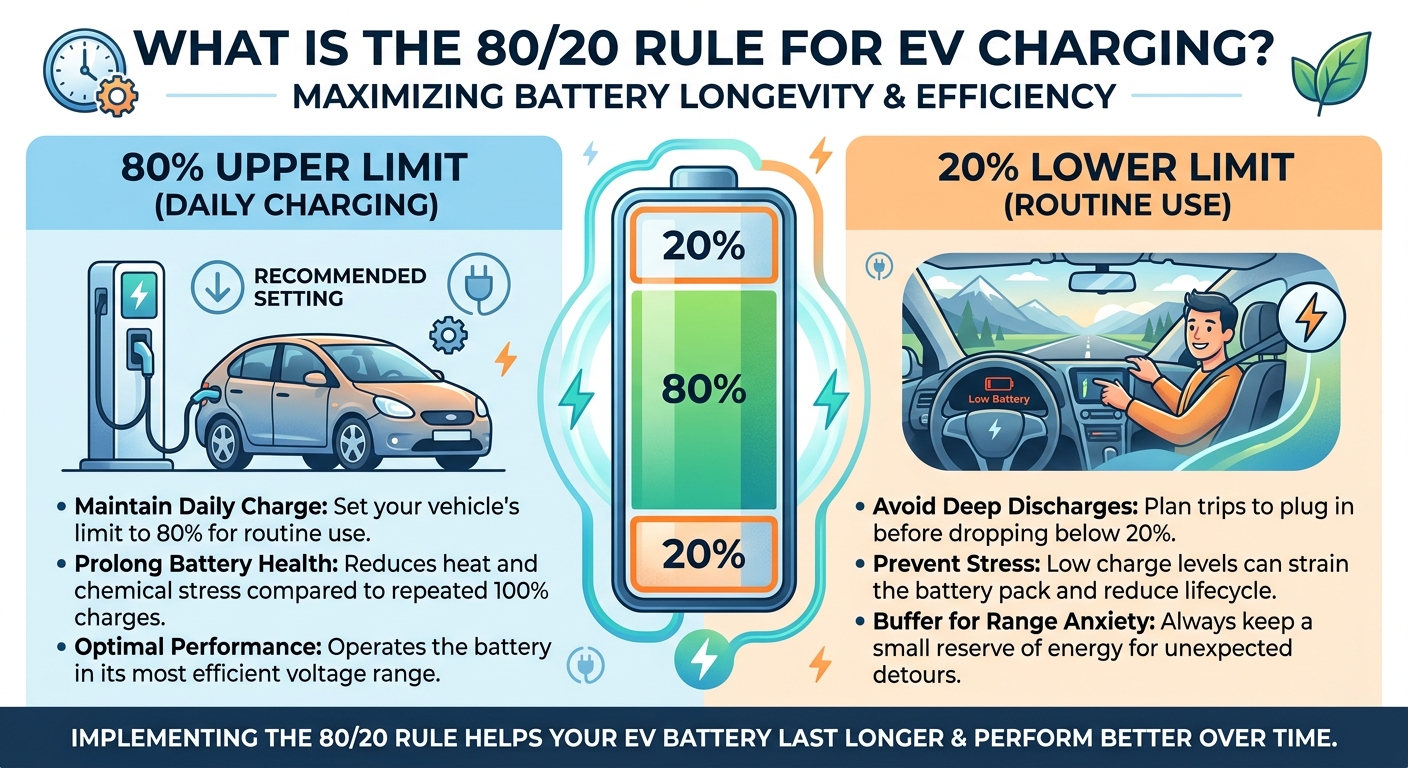
Upgrading to an electric vehicle (EV) unlocks exceptional torque, quiet acceleration, and significant long-term savings over petrol or diesel. Operating on a standard single-phase Level 2 branch circuit, a home wallbox restores 20 to 44 miles of driving range per hour, making overnight home charging seamless. However, as new owners explore battery management settings inside vehicle apps, they frequently encounter an important recommendation: What is the 80/20 rule for EV charging?
The short answer is: the 80/20 rule (or 20/80 rule) for EV charging is an operational battery maintenance guideline that advises keeping your lithium-ion battery’s state of charge (SoC) between 20% and 80% for daily driving.
By avoiding the electrochemically stressful extremes of charging to a full 100% or draining the pack below 20% during everyday commutes, drivers significantly reduce calendar aging, electrode mechanical stress, and capacity degradation.
For complete hardware reviews, installer guides, and panel load calculators, visit EV Charger Advisor.
1. Electrochemistry: Why the 80/20 Rule Protects Batteries
Lithium-ion battery packs operate through the reversible movement of lithium ions between a nickel-based (NMC/NCA) cathode and a graphite anode. The 80/20 window operates as the optimal “sweet spot” due to three core factors:
A. High Voltage & Cathode Oxidation (Above 80% SoC)
When an EV pack reaches 80% to 100% capacity, cell voltage increases non-linearly toward its upper threshold limit. Sustained high voltage accelerates electrolyte oxidation, thickens the Solid Electrolyte Interphase (SEI) layer on the anode, and causes structural mechanical expansion in cathode crystals. Leaving a battery parked at 100% charge—especially in warm climates—accelerates permanent capacity loss.
B. Anode Degradation & Copper Dissolution (Below 20% SoC)
Allowing an EV battery to drop below 20% toward deep discharge introduces extreme low-voltage polarization. At low states of charge, the graphite anode becomes highly delithiated, increasing internal electrical resistance and raising the risk of copper current collector dissolution, which can permanently damage battery cells.
C. Thermal Management & DC Fast Charging Taper Curves
Beyond chemical protection, the 80/20 rule optimizes public charging speed. Above 80% SoC, vehicle Battery Management Systems (BMS) intentionally taper down direct current (DC) charging speeds from high kilowatts to a slow trickle to prevent overheating and lithium plating. Charging from 80% to 100% at a public fast charger often takes as long as charging from 10% to 80%.
To learn more about how charger power levels and wire sizes compare, check out our guide on EV charging types.
2. Exceptions to the 80/20 Rule: LFP Chemistries & Long Trips
While the 80/20 rule is recommended for standard NMC and NCA battery packs, two key exceptions apply:
-
Lithium Iron Phosphate (LFP / LiFePO4) Packs: Many entry-level and modern standard-range EVs use LFP chemistry. LFP cells exhibit a remarkably flat voltage curve and exceptional thermal stability. Vehicle manufacturers explicitly recommend charging LFP-equipped cars to 100% at least once a week to calibrate the BMS energy estimator.
-
Long Road Trips: Charging to 100% prior to departing on a long highway trip is completely safe and intended. The battery is harmed primarily when sitting idle at 100% for extended days, not when the power is immediately consumed while driving.
To explore Wi-Fi-enabled smart wallboxes that let you set custom 80% charge limits, read our guide on smart chargers.
Step-by-Step Mathematical Example: Usable Daily Range vs. Full Capacity
Let us calculate the available daily range, battery energy window, and charging time under the 80/20 rule for a 75 kWh EV battery pack using a 7.4 kW Level 2 Home Charger (32A / 230V single-phase).
Given Parameters:
-
Total Battery Capacity: $75 \text{ kWh}$
-
Upper Limit (80% SoC): $0.80 \times 75\text{ kWh} = \mathbf{60 \text{ kWh}}$
-
Lower Limit (20% SoC): $0.20 \times 75\text{ kWh} = \mathbf{15 \text{ kWh}}$
-
Vehicle Driving Efficiency: $3.5 \text{ Miles per kWh}$ ($0.285 \text{ kWh/mile}$)
-
Home Charger Output: $7.4 \text{ kW}$ (with $90\%$ AC-to-DC onboard charging efficiency = $6.66\text{ kW}$ usable)
Calculation 1: Usable Energy Window (80/20 Rule)
Calculation 2: Available Daily Driving Range
Calculation 3: Overnight Recharge Time (from 20% up to 80%)
Result Breakdown: Operating strictly within the 80/20 safety window on a 75 kWh battery yields 157.5 miles of daily driving range, which far exceeds average commuting needs while requiring under 6.75 hours of overnight Level 2 home charging.
Comparison Table: Battery Degradation Factors & Best Practices
| Operating State | Electrochemical Impact | Recommended Frequency |
| 0% to 20% SoC | Anode delamination, risk of copper dissolution | Emergency use only; recharge promptly |
| 20% to 80% SoC | Optimal voltage balance, minimal SEI growth | Daily commuting & regular routine |
| 80% to 100% SoC | Elevated cell voltage, increased chemical heat | Road trips / LFP pack calibration |
| Overnight Idle at 100% | Accelerates calendar capacity loss | Avoid leaving sat for extended days |
Summary & Key Takeaways
-
Protect Your Battery: The 80/20 rule keeps lithium-ion battery state of charge between 20% and 80% to maximize health and longevity.
-
Minimizes Chemical Stress: Staying within 20–80% prevents high-voltage cathode degradation and deep-discharge anode stress.
-
Automate via App Settings: Set an 80% charge ceiling inside your EV’s onboard menu or smart charger app for daily home charging.
-
Charge to 100% When Needed: It is completely fine to charge to 100% before starting a long highway trip or to maintain LFP battery packs.













Leave a Reply