
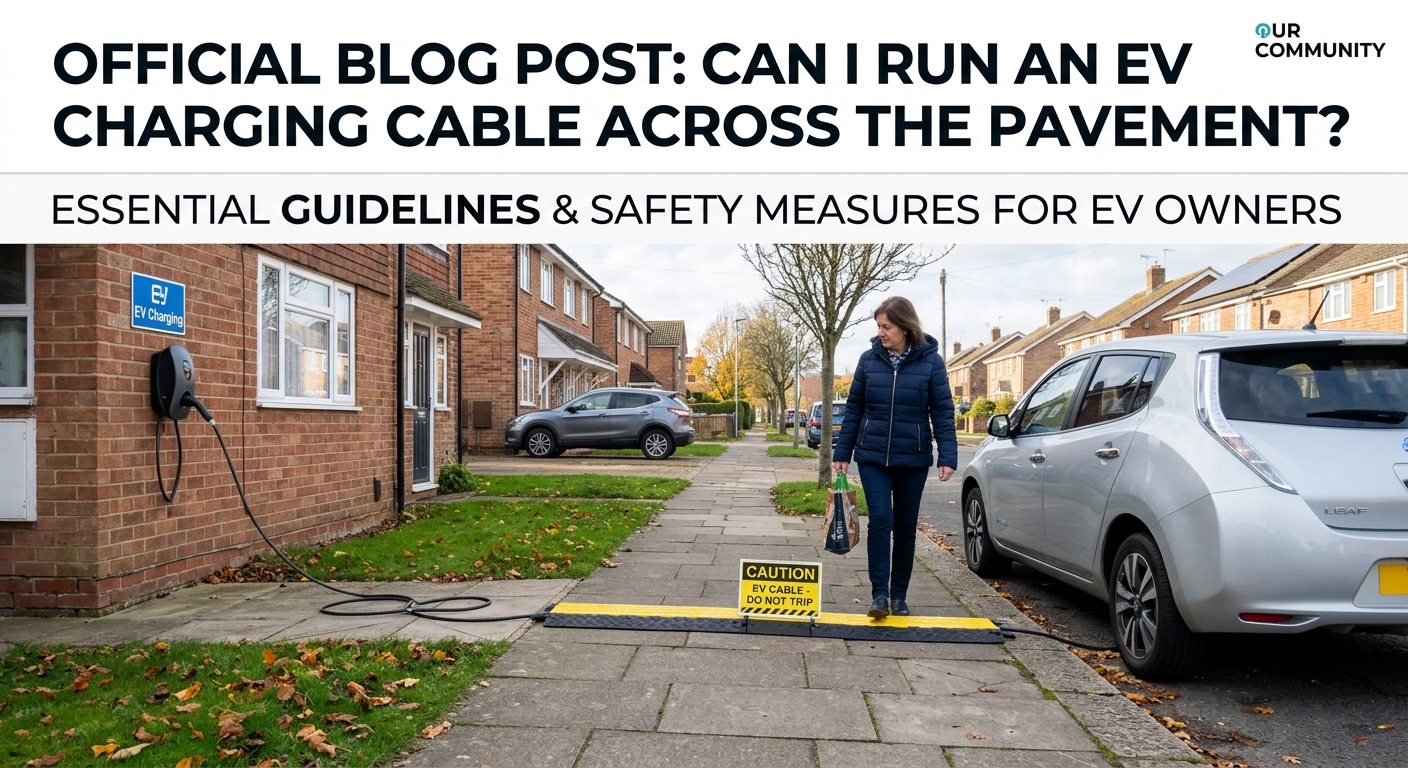
As electric vehicle (EV) adoption accelerates globally, home charging remains the most convenient and cost-effective way to power daily driving. Delivering 20 to 44 miles of range per hour over a high-voltage 240-volt circuit, setting up a home Level 2 wallbox enables drivers to wake up every morning with a fully replenished battery. However, for EV owners living in terraced homes, townhouses, or urban properties without off-street driveways, a fundamental question arises: Can I run an EV charging cable across the pavement?
The short answer is: no, you generally cannot trail a loose EV charging cable across a public pavement (sidewalk). Doing so creates a serious tripping hazard and is illegal under highways legislation and local municipal bylaws in most jurisdictions.
While trailing loose wires across public footpaths can result in severe legal liability or municipal fines, emerging cross-pavement gully technologies and approved overhead cable arms allow non-driveway households to access low-cost home electricity rates safely and legally.
For complete hardware reviews, installer guides, and panel load calculators, visit EV Charger Advisor.
1. Why Trailing Loose Cables Across Public Pavements Is Prohibited
Running a cable across a sidewalk—even when covered by a rubber cable mat or ramp—violates several core safety and legal regulations:
A. Serious Pedestrian Trip Hazard & Public Liability
A loose charging cable lying on a public walkway creates a hazard for pedestrians, particularly visually impaired individuals, elderly residents, parents with pushchairs, and wheelchair users. If a pedestrian trips over your cable, you face full civil liability for personal injury claims and medical damages.
B. Highways Act Violations & Municipal Fines
In the UK, running a cable across a public highway or footpath breaches Section 162 of the Highways Act 1980 (and similar obstruction/hazard laws across North American and European municipalities). Highway authorities have the legal power to remove unauthorized cables immediately, issue enforcement notices, and levy financial penalties against property owners.
C. Electrical Cable Wear & Insulation Damage
Pedestrian foot traffic, bicycle tires, and weather exposure cause rapid wear on flexible EV cable jackets. Damaged outer insulation exposed to rain or standing puddles introduces significant electrical shock risks.
To learn more about how charger power levels and wire sizes compare, check out our guide on EV charging types.
2. Safe & Approved Alternatives for Non-Driveway Charging
If you park on the street in front of your house, four legal infrastructure solutions allow you to charge safely without trailing loose wires:
1. Installed Cross-Pavement Gullies / Cable Channels
A narrow, shallow channel is cut into the pavement, and a heavy-duty rubber or metal gully (such as Kerbo Charge or Gul-e) is fitted completely flush with the sidewalk surface. When charging, you insert your cable into the recessed, locking channel so it sits flush below foot level, presenting zero trip hazard.
-
Requirement: Must be installed by an authorized contractor with a street works permit from your local council or highway authority.
2. Overhead Charging Arms / Retractors
Mounted high on an exterior wall or front garden post, an overhead arm extends out over the sidewalk at a safe height (typically above 8 to 10 feet / $2.5 – 3\text{m}$ clearance) and drops the charging connector down directly beside your vehicle’s port.
3. Front Garden Conversion (Dropped Kerbs)
If you have a front lawn or patio with sufficient space, you can apply to pave the area with permeable materials and request a dropped kerb from your local council to establish a legal off-street driveway bay.
4. Municipal Lamp Post & On-Street Chargers
Many municipal councils are actively retrofitting public street lamp columns with 3.5 kW–7 kW charging points, providing safe overnight charging without running cables from private homes.
To explore smart wallboxes engineered with app-locking features for outdoor street use, read our guide on smart chargers.
Step-by-Step Mathematical Example: Pavement Gully vs. Public Fast Charging Economics
Let us calculate the financial savings and payback duration of installing a $1,400 (£1,100) pavement gully system versus relying exclusively on commercial public DC fast chargers for 12,000 miles of annual driving.
Given Parameters:
-
Annual Commute Distance: $12,000 \text{ Miles}$
-
EV Driving Efficiency: $3.3 \text{ Miles per kWh}$ ($0.303 \text{ kWh/mile}$)
-
Public Rapid Charging Tariff: $\$0.75 \text{ per kWh}$
-
Overnight Off-Peak Home Electricity Rate: $\$0.12 \text{ per kWh}$
-
Turnkey Gully & Wallbox Installation Cost: $\$1,400$
Calculation 1: Total Annual Energy Required
Calculation 2: Annual Refueling Costs
Calculation 3: Investment Payback Period Math
Result Breakdown: Utilizing an approved cross-pavement gully system to access low overnight home tariffs yields $2,290 in annual fuel savings, completely paying off total equipment and permit expenses in under 8 months.
Comparison Table: Pavement Cable Management Solutions
| Charging Method | Trip Hazard Level | Council Approval Required? | Legal Liability Protection |
| Trailing Loose Cable | Severe (High Risk) | No (Prohibited / Illegal) | Zero (Full Personal Liability) |
| Cable Plastic Mat / Ramp | Moderate (Still an Obstruction) | Rarely Approved | Low (May still violate bylaws) |
| Flush Pavement Gully | Zero (Flush with sidewalk) | Yes (Street Works License) | High (Fully Compliant) |
| Overhead Cable Arm | Zero (Suspended overhead) | Yes (Airspace License) | High (Fully Compliant) |
Summary & Key Takeaways
-
Loose Cables Are Prohibited: You cannot legally or safely trail a loose EV charging cable across a public pavement or sidewalk.
-
High Trip Hazard Liability: Loose wires create tripping dangers for pedestrians, exposing property owners to council fines and legal injury claims.
-
Use Approved Flush Gullies: Install an approved cross-pavement cable channel with local council permission to run your charging line flush beneath the pavement surface.
-
Fast Financial Payback: Accessing home off-peak electricity rates via a pavement gully saves over $2,200 annually compared to public rapid fast chargers.













Leave a Reply