
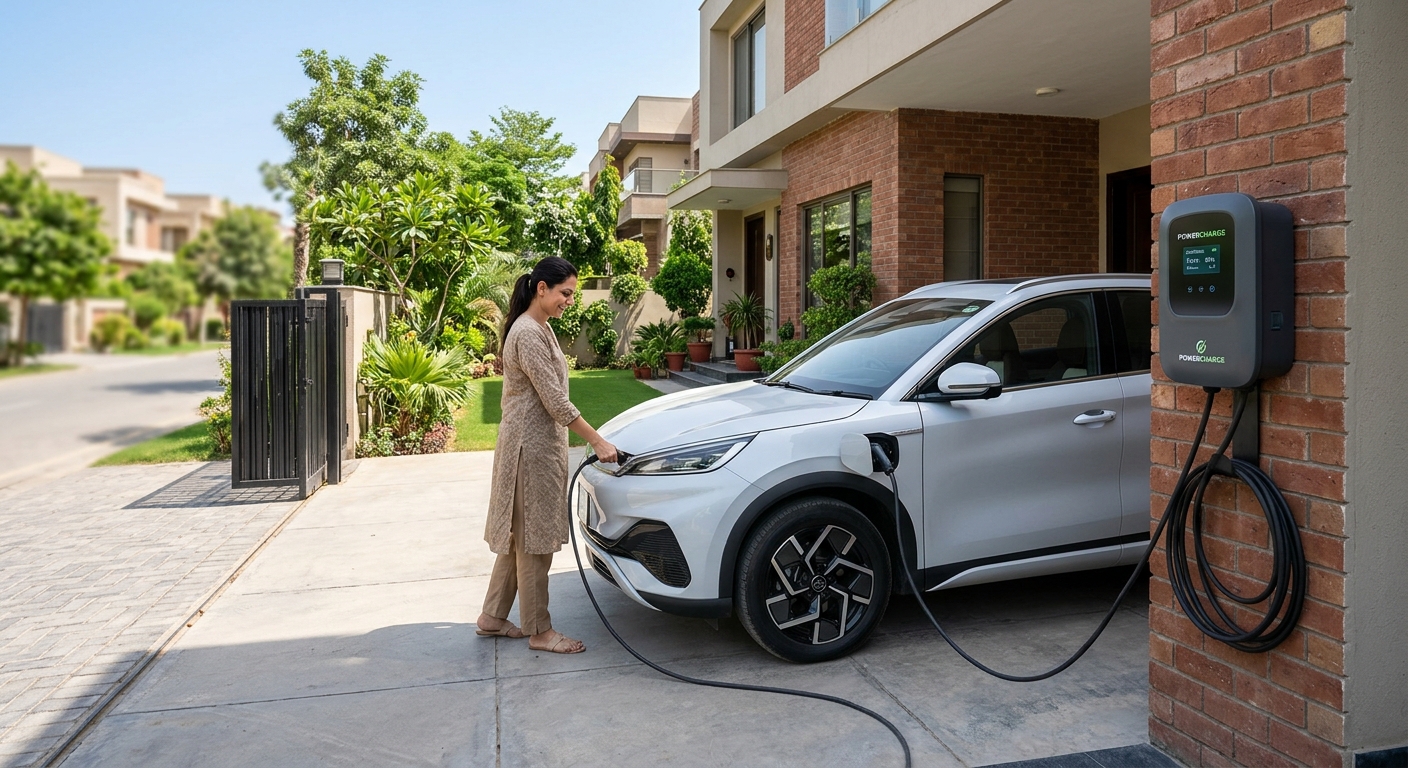
As electric vehicles (EVs) become increasingly popular around the globe, home charging remains the most convenient, cost-effective way to power your daily drive. Delivering 20 to 44 miles of range per hour on a dedicated 240-volt Level 2 circuit, home chargers eliminate the need for frequent trips to public charging stations. However, for homes without an enclosed garage, or for multi-vehicle households with crowded garage bays, drivers often wonder: Can you charge an EV in the driveway?
The short answer is: yes, you can charge an electric vehicle in your driveway safely and legally. Certified Level 2 wallboxes are specifically engineered with weatherproof enclosures to operate reliably in outdoor environments.
Whether you mount a wallbox on an exterior house wall or install a free-standing pedestal post next to your driveway, outdoor home charging is fully compliant with the National Electrical Code (NEC Article 625) and international electrical standards.
For complete hardware reviews, installer guides, and panel load calculators, visit EV Charger Advisor.
1. Core Infrastructure & Hardware Setup for Driveway Charging
Charging an electric car in an open driveway requires selecting hardware designed for outdoor weather exposure and establishing a clean wiring path:
A. Weatherproof Enclosure Ratings (NEMA 3R, NEMA 4 & IP65)
Outdoor EV chargers must be rated to protect sensitive internal electronics from water and dust ingress:
-
NEMA 3R / NEMA 4 Ratings: North American standards guaranteeing protection against windblown rain, sleet, snow, ice formation, and direct water exposure.
-
IP65 / IP66 Ratings: International ingress protection standards certifying that the wallbox is completely dust-tight and resistant to water jets.
B. Hardwired Connection vs. Outdoor Plugs
While indoor garage installations frequently use plug-in NEMA 14-50 receptacles, outdoor driveway chargers should preferably be direct-hardwired. Hardwiring seals high-voltage electrical connections inside the weatherproof wallbox housing, eliminating moisture breakdown at plug outlets and preventing GFCI nuisance tripping during heavy downpours.
C. Exterior Wall Mount vs. Driveway Pedestal
-
Exterior Wall Mounting: If your driveway runs alongside your home or detached garage, mounting the charger on an exterior wall is the most economical setup, requiring minimal conduit routing.
-
Driveway Pedestal Post: If you park further away from the house wall, an electrician can run underground feeder cables inside Schedule 80 PVC conduit and mount the wallbox on a free-standing, weather-sealed metal post adjacent to your parking space.
To learn more about how charger power levels and wire sizes compare, check out our guide on EV charging types.
2. Important NEC Rules & Safety Best Practices
To ensure total electrical safety when charging outdoors in your driveway, observe key NEC Article 625 code guidelines:
-
Mandatory Mounting Height (NEC 625.102 / 625.30): The bottom of an outdoor EV wallbox or control coupling must be mounted at least 24 inches ($600\text{ mm}$) above finished ground level. This prevents splash-back water ingress, ground moisture damage, and snow accumulation.
-
Automated Safety Handshake: The charging handle does not carry live high-voltage current while hanging on the wall. Under SAE J1772 and NACS (SAE J3400) standards, high-voltage electricity flows only after a low-voltage digital control pilot signal confirms a dry, fully seated latch inside the car’s charge port.
-
Cable Management & Holstering: Always store the charging handle in its downward-angled holster when not in use. Leaving the handle on wet asphalt can allow dirt, water, or ice to collect inside the terminal contact pins.
To explore Wi-Fi-enabled smart wallboxes engineered with durable housings, read our guide on smart chargers.
Step-by-Step Mathematical Example: Voltage Drop on Driveway Conduit Runs
When placing an EV charger on a driveway pedestal at a distance from the main electrical breaker panel, long wiring runs introduce electrical line resistance ($R$). Under NEC recommendations, total branch circuit voltage drop ($\Delta V$) should stay below 3% to ensure maximum charging efficiency and prevent thermal overheating.
Let us evaluate the voltage drop for a hardwired 48-Amp continuous Level 2 charger ($240\text{V}$ single-phase supply) running 85 feet ($25.9\text{ m}$) to a driveway pedestal using #6 AWG Copper Wire ($R = 0.000491 \Omega/\text{ft}$).
Given Parameters:
-
Continuous Current Draw ($I$): $48 \text{ Amps}$
-
Line Voltage ($V$): $240 \text{ Volts}$
-
One-Way Cable Distance ($L$): $85 \text{ feet}$
-
Conductor Resistance ($R_{\text{wire}}$): $0.000491 \Omega \text{ per foot}$
Calculation 1: Voltage Drop ($\Delta V$) Math
For a single-phase $240\text{V}$ circuit ($2 \times L = 170\text{ ft}$ total conductor path):
Calculation 2: Percentage Voltage Drop (%)
Result Breakdown: A 1.67% voltage drop stays safely well below the 3% maximum NEC threshold limit, confirming that an 85-foot outdoor cable run using #6 AWG copper wire operates safely and efficiently during long overnight charging sessions in your driveway.
Comparison Table: Driveway Charging Installation Options
| Feature / Metric | Exterior Wall Mount | Driveway Pedestal Post |
| Primary Placement | Outer house / Garage wall | Free-standing near parking pad |
| Installation Complexity | Low to Moderate | Moderate to High (Requires trenching) |
| Minimum Mounting Height | 24 Inches ($600\text{ mm}$) above grade | 24 Inches ($600\text{ mm}$) above grade |
| Enclosure Rating Needed | NEMA 3R, NEMA 4, or IP65 | NEMA 4 or NEMA 4X |
| Recommended Connection | Direct Hardwired | Direct Hardwired (Underground PVC) |
Summary & Key Takeaways
-
100% Safe & Practical: Charging an EV in your driveway is completely safe when using certified outdoor-rated equipment (NEMA 3R or NEMA 4).
-
Mount 24 Inches High: Always observe NEC rules by mounting outdoor units at least 24 inches off the ground to prevent moisture damage and water splash.
-
Hardwiring Is Superior Outdoors: Direct hardwiring into weatherproof conduit eliminates socket degradation and prevents breaker trips during rainstorms.
-
Dock the Handle: Always return the charging handle to its holster after use to keep water, dust, and debris out of the terminal pins.













Leave a Reply