
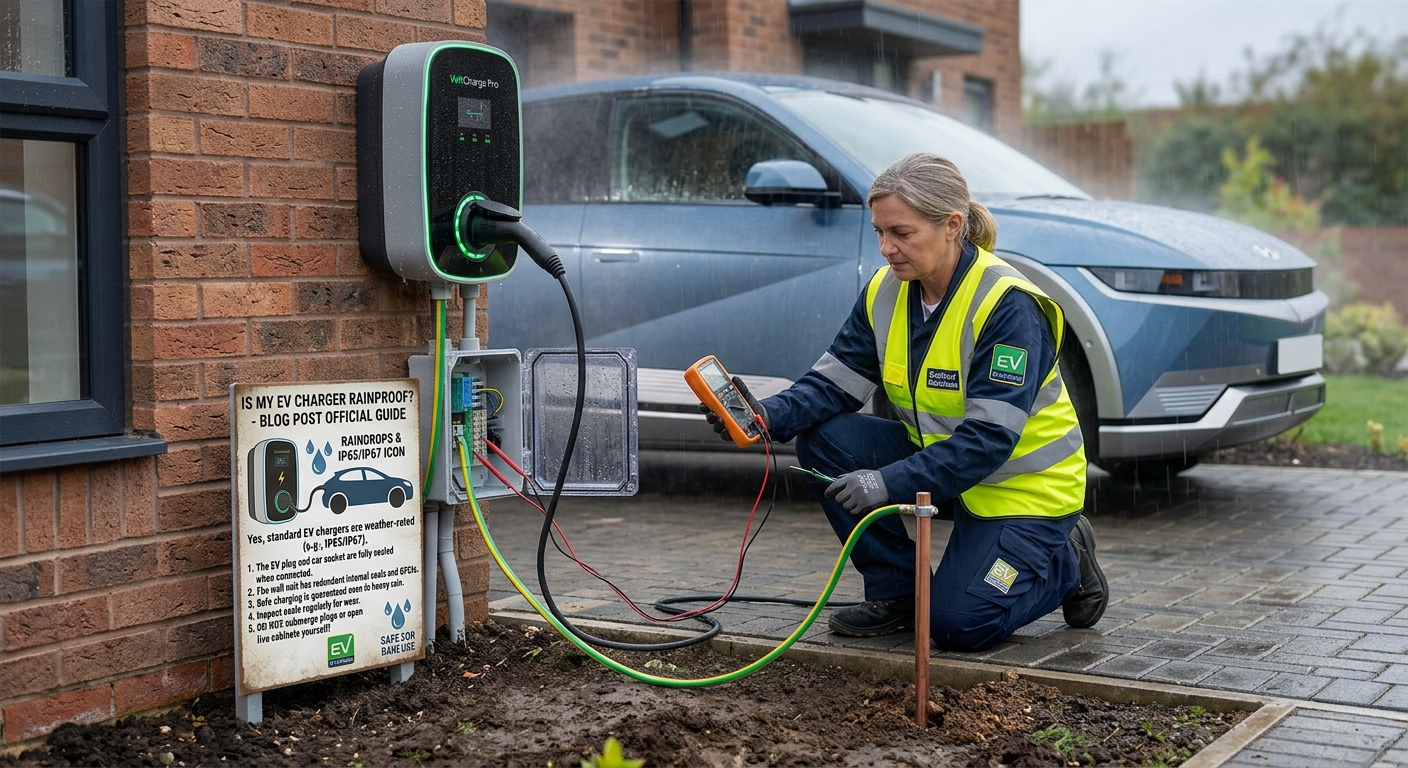
Switching to an electric vehicle (EV) brings low fueling costs and the convenience of waking up every morning with a fully charged battery. Delivering anywhere from 20 to 44 miles of driving range per hour over a high-voltage 240-volt branch circuit, a Level 2 wallbox is the gold standard for residential charging. However, for drivers who park in open driveways, carports, or outdoor parking spaces, a common question arises during severe storms: Can I leave my EV charger out in the rain?
The short answer is: yes, you can leave a fixed, professionally installed EV wallbox or a properly managed portable EV charger out in the rain because they are engineered to be completely weatherproof, water-resistant, and electrical-shock safe.
Modern electric vehicle charging infrastructure incorporates multi-layered physical seals, automated software handshakes, and ground-fault protection, ensuring that charging in heavy rainstorms or leaving your hardware mounted outdoors is entirely safe.
For complete hardware reviews, installer guides, and panel load calculators, visit EV Charger Advisor.
1. How Outdoor EV Chargers Safely Resist Water & Rain
Plugging a high-voltage line into an electric car during torrential rainfall might seem dangerous, but advanced electrical engineering keeps the process completely secure:
A. Weatherproof Enclosure Ratings (NEMA 3R / NEMA 4 & IP65+)
Fixed outdoor wallboxes are housed in sealed, impact-resistant enclosures designed specifically to prevent water intrusion:
-
NEMA 3R / NEMA 4 Ratings: North American standards certifying protection against windblown rain, sleet, snow, ice formation, and direct water jets.
-
IP65 / IP67 Ingress Ratings: International standards certifying that internal high-voltage electronics are dust-tight and protected against hose-directed water jets or short-term water immersion.
B. The Automated Digital Safety Handshake (Control Pilot)
The charging handle and cable do not carry live high-voltage power while resting on the wall or when being held in your hand. Under SAE J1772 and NACS (SAE J3400) standards, high-voltage alternating current flows only after a low-voltage digital signal (control pilot pin) verifies a sealed, dry, and fully latched mechanical connection inside the vehicle’s charge port.
C. Ground Fault Circuit Interruption (GFCI / CCID Protection)
Per NEC Article 625 regulations, outdoor chargers feature built-in Charge Circuit Interrupting Devices (CCID). If moisture enters a damaged terminal or a current imbalance occurs, the system cuts off electricity in milliseconds—far faster than human reaction times.
To learn more about how charger power levels and wire sizes compare, check out our guide on EV charging types.
2. Best Practices for Leaving EV Chargers Outdoors in the Rain
To maintain your charging hardware and prevent long-term environmental wear, observe these four basic habits:
-
Always Holster the Charging Handle: Never leave the charging nozzle lying face-up on wet ground or puddles. Always dock the handle inside its downward-facing holster to prevent rain and debris from clogging the pin contacts.
-
Hardwire Fixed Outdoor Wallboxes: Direct hardwiring into a weatherproof junction box eliminates plug/socket contact degradation and prevents GFCI nuisance tripping during heavy downpours.
-
Keep Portable Chargers Off the Ground: If using a portable Level 1 or Level 2 charger outdoors, ensure the control box (the brick unit) is mounted off the wet ground and plugged into an in-use weatherproof outlet cover (NEMA 3R/4).
-
Inspect Cable Jacket Integrity: Regularly check the rubber cable jacket for cracks, tears, or cuts caused by accidental run-overs, which can compromise weather protection.
To explore Wi-Fi-enabled smart wallboxes built with weather-resistant housings, read our guide on smart chargers.
Step-by-Step Mathematical Example: Circuit Thermal Loss on Outdoor Runs
When placing a fixed EV wallbox outdoors at a distance from the main breaker panel (e.g., across a 70-foot driveway run), long cable runs introduce small electrical line resistance ($R$). Under NEC guidelines, circuit voltage drop ($\Delta V$) should stay under 3% to prevent heat generation in wet conduit environments.
Let us evaluate the voltage drop for a 40-Amp continuous Level 2 charger ($240\text{V}$ single-phase supply) running 70 feet ($21.33\text{ m}$) using #6 AWG Copper Conductors ($R = 0.000491 \Omega/\text{ft}$).
Given Parameters:
-
Continuous Charging Draw ($I$): $40 \text{ Amps}$
-
Line Voltage ($V$): $240 \text{ Volts}$
-
One-Way Distance ($L$): $70 \text{ feet}$
-
Conductor Resistance ($R_{\text{wire}}$): $0.000491 \Omega \text{ per foot}$
Calculation 1: Voltage Drop ($\Delta V$) Math
For a single-phase $240\text{V}$ circuit ($2 \times L = 140\text{ ft}$ total conductor path):
Calculation 2: Percentage Voltage Drop (%)
Result Breakdown: A 1.14% voltage drop stays well below the 3% maximum threshold limit, confirming that a 70-foot outdoor cable run using #6 AWG copper wire operates safely and efficiently during severe weather conditions.
Comparison Table: Outdoor Ingress Protection (IP) & NEMA Ratings
| Protection Level | Environmental Capabilities | Safe for Outdoor Rain? |
| Indoor Rated | Basic dust cover / zero moisture seal | No (Garage Use Only) |
| IP54 | Splash-proof & dust protected | Moderate rain (Carport recommended) |
| NEMA 3R / IP65 | Heavy rain, sleet & water jet protected | Yes (Standard Outdoor Wallbox) |
| NEMA 4 / IP67 | Heavy storms, ice & temporary submersion | Yes (Extreme Weather Protection) |
Summary & Key Takeaways
-
Fully Safe Out in the Rain: Professionally installed fixed EV wallboxes and properly docked portable chargers are engineered to handle continuous rain exposure safely.
-
No Live Power Until Latched: High-voltage electricity is energized only after a sealed, dry digital handshake is established between the charger and the vehicle.
-
Dock the Handle: Always keep the connector handle secured inside its downward-angled holster to prevent water from entering the contact pins.
-
Hardwiring Is Superior Outdoors: Direct hardwiring into weatherproof conduit eliminates socket moisture issues and prevents breaker trips during heavy storms.













Leave a Reply