
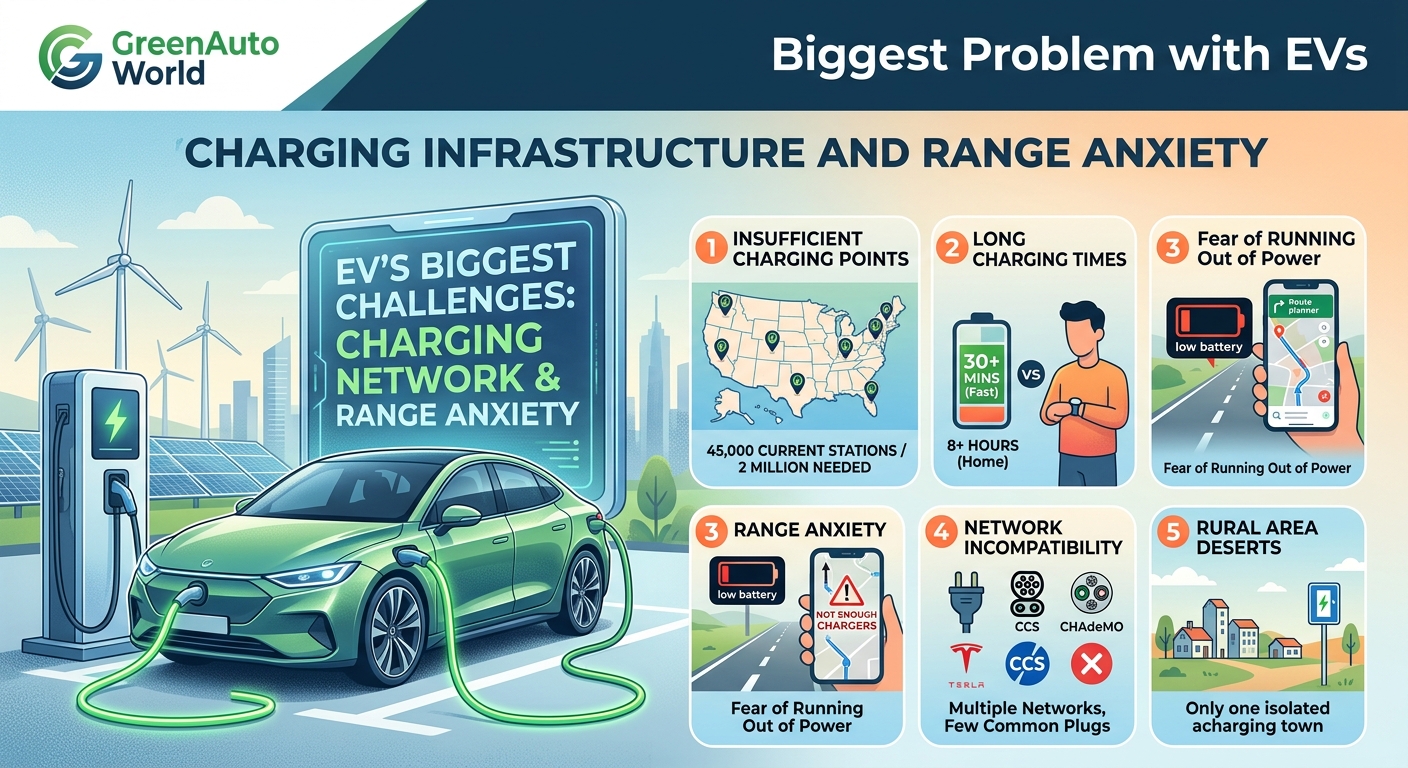
Electric vehicles (EVs) have transformed from a niche automotive category into the fastest-growing segment of global transportation. Offering lightning-fast torque, zero tailpipe emissions, silent operation, and drastically lower fueling costs, modern battery electric vehicles (BEVs) are redefining personal mobility. However, as prospective buyers evaluate switching away from internal combustion engine (ICE) vehicles, consumers frequently ask: What is the biggest problem with EVs?
The short answer is: the biggest problem with EVs is a combination of limited public charging infrastructure and range anxiety—the fear that the battery will run out of power before reaching a destination or finding a functional charging station.
While battery chemistry, upfront purchase pricing, and winter driving range degradation remain notable hurdles, solving the charging availability and dwell-time gap is the single most critical challenge facing mass adoption.
For complete home charger reviews, installer guides, and panel load calculators, visit EV Charger Advisor.
1. Analyzing the Core Challenges Facing EV Owners
To understand why range anxiety and infrastructure bottlenecks persist, we must examine the primary pain points reported by daily drivers:
A. Range Anxiety & Public Charger Reliability
Unlike petrol stations located on nearly every corner with a 3-minute refuel time, public direct current (DC) fast-charging networks are often sparse in rural corridors, overcrowded in urban centers, and plagued by broken or out-of-order stalls. This uncertainty creates range anxiety, forcing drivers to meticulously plan road trips around charging stops.
B. Upfront Vehicle Purchase Price vs. Total Cost of Ownership
While lifetime fueling and maintenance costs for an EV are significantly lower than a gas car, the initial sticker price remains higher due to the cost of raw battery materials (lithium, cobalt, and nickel). Although federal tax credits and state incentives help close this gap, upfront affordability remains a barrier for budget-conscious buyers.
C. Cold Weather Range Loss & Battery Degradation
Lithium-ion battery cells rely on electrochemical reactions that slow down in sub-freezing temperatures. Cabin heating also draws immense battery energy, causing a 15% to 30% reduction in driving range during harsh winter months. Additionally, frequent rapid DC fast charging and high ambient heat gradually accelerate long-term battery capacity degradation.
To learn more about how home chargers mitigate public charging headaches, check out our guide on EV charging types.
Step-by-Step Mathematical Example: Home Charging vs. Public Charging Economics
The most effective way to eliminate range anxiety and high public charging costs is installing a Level 2 home charger. Let us calculate the financial and time comparison between relying on expensive public DC fast chargers versus convenient overnight home charging for an annual commute of 15,000 miles.
Given Parameters:
-
Annual Driving Distance: $15,000 \text{ Miles}$
-
Average EV Efficiency: $3.3 \text{ Miles per kWh}$ ($0.303 \text{ kWh/mile}$)
-
Public DC Fast Charging Rate: $\$0.45 \text{ per kWh}$
-
Home Off-Peak Electricity Rate: $\$0.14 \text{ per kWh}$
Calculation 1: Annual Energy Demand
Calculation 2: Annual Fuel Cost (Public DC Fast Charging Only)
Calculation 3: Annual Fuel Cost (Home Level 2 Charging Only)
Result Breakdown: Relying entirely on public fast chargers diminishes the financial advantage of driving electric. Installing a home Level 2 charger reduces annual refueling expenses by $1,409, entirely eliminating daily range anxiety by waking up to a “full tank” every single morning.
To explore Wi-Fi-enabled smart wallboxes that optimize off-peak home charging rates, read our guide on smart chargers.
Comparison Table: EV Ownership Pain Points & Practical Solutions
| Major EV Problem | Primary Cause | Effective Solution / Mitigation |
| Range Anxiety | Sparse public chargers & long refill times | Install a home Level 2 wallbox (Wake up full) |
| Public Charger Unreliability | Broken hardware & lack of maintenance | Utilize reliable networks (Tesla Supercharger / NACS) |
| High Upfront Vehicle Cost | Expensive battery raw materials | Claim tax credits, buy used, or lease |
| Winter Range Drop | Cabin heating loads & cold chemistry | Pre-condition battery and cabin while plugged in |
Summary & Key Takeaways
-
Infrastructure Is the Bottleneck: Limited public charging availability and range anxiety remain the most prominent hurdles for widespread EV adoption.
-
Home Charging Solves Range Anxiety: Installing a dedicated Level 2 wallbox ensures you never rely on public stations for daily commuting.
-
Total Cost Wins Long-Term: Although upfront sticker prices are higher, lower maintenance and home electricity rates deliver massive long-term savings.
-
The Industry Is Adapting: The transition to NACS (SAE J3400) connector standardization and massive federal investments in charging infrastructure are actively resolving these pain points.













Leave a Reply