
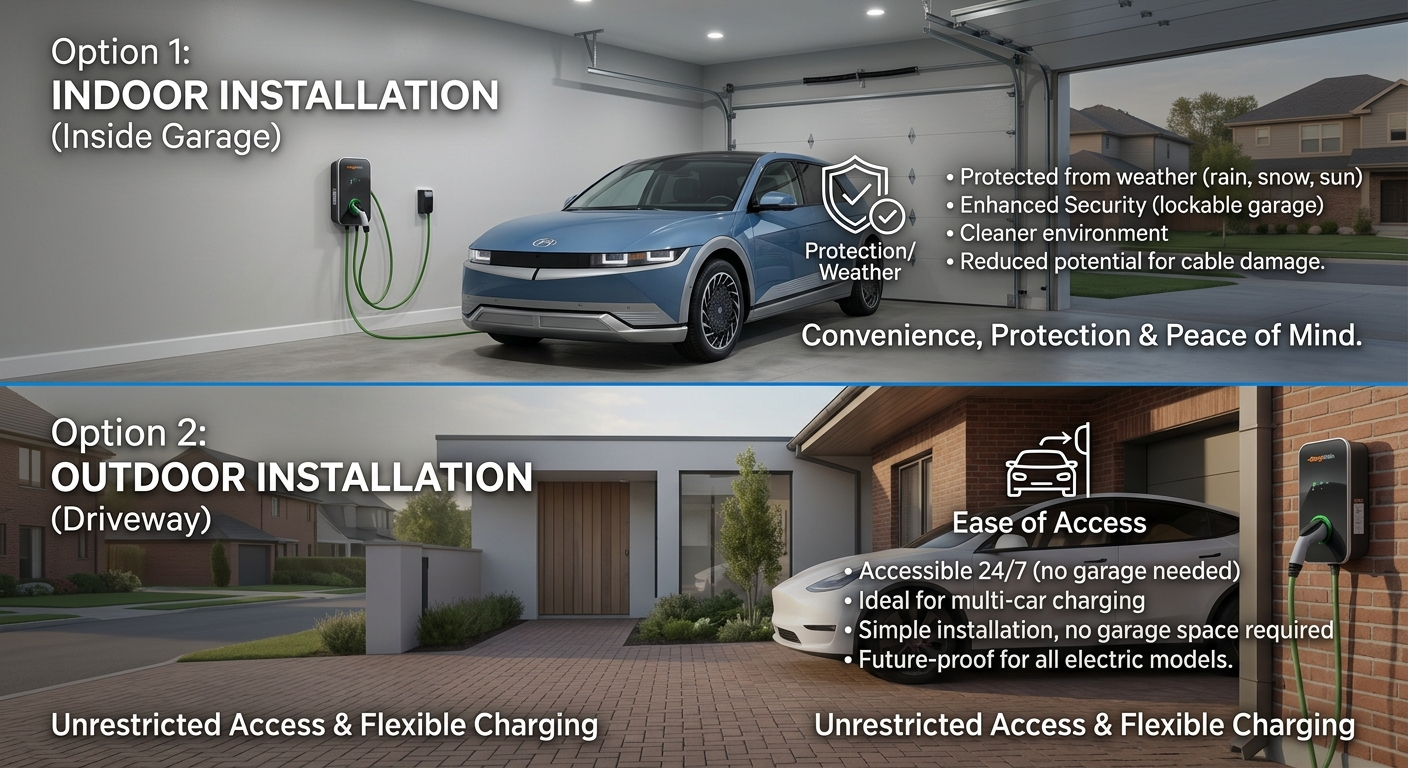
When setting up a Level 2 home electric vehicle (EV) charger, deciding where to physically mount your wallbox is one of the most practical decisions in your installation plan. Operating on a 240-volt single-phase branch circuit, a Level 2 charger restores 20 to 44 miles of driving range per hour, making overnight home charging effortless. However, as drivers map out parking logistics, cable paths, and electrical panel proximity, a fundamental question arises: Is it better to install an EV charger inside the garage or outside?
The short answer is: installing an EV charger inside the garage is generally better and more common if you park your vehicle indoors, though an outdoor setup is ideal if you primarily park in the driveway or operate a multi-vehicle household.
Both indoor and outdoor installations are fully safe and National Electrical Code (NEC Article 625) compliant, provided the equipment meets appropriate weatherproof enclosure standards (NEMA 3R/4) and satisfies minimum mounting height rules.
For complete hardware reviews, installer guides, and panel load calculators, visit EV Charger Advisor.
1. Indoor Garage vs. Outdoor Driveway: Key Operational Differences
Choosing between an indoor garage setup and an outdoor installation comes down to your daily parking routines, space availability, and weather protection priorities:
A. Indoor Garage Installations — The Standard Choice for Covered Parking
-
Equipment Longevity: Mounting the wallbox indoors shields sensitive power electronics, Wi-Fi modules, and cable rubber jackets from direct UV sunlight, freezing ice, and heavy downpours.
-
Daily Ergonomics: Handling the charging cable and plug inside a clean, dry garage is far more comfortable during extreme heat waves, winter snow, or heavy rainstorms.
-
Vandalism & Access Control: Indoor placement eliminates unauthorized plug access, cable theft, or tampering risks completely without needing locked holsters or mobile app locks.
B. Outdoor Driveway & Carport Setups — Maximum Convenience for Open Parking
-
Driveway Accessibility: Essential for homes without a garage or properties where garages are utilized for storage rather than vehicle parking.
-
Multi-EV Flexibility: Mounting an outdoor charger on an exterior wall between garage doors or on a central pedestal allows flexible cable reach regardless of where charging ports are located (e.g., front fender vs. rear quarter panel).
-
Hardwiring Advantage: Direct hardwiring into a weatherproof junction box creates a seamless, durable installation that resists moisture intrusion better than outdoor plug sockets.
To learn more about how charger power levels and wire sizes compare, check out our guide on EV charging types.
2. Mandatory NEC Safety Rules: Indoor vs. Outdoor Mounting
Under NEC Article 625, specific safety standards govern where and how high an EV wallbox must be installed depending on its physical environment:
-
NEC Minimum Mounting Heights (NEC 625.102 / 625.30):
-
Indoor Garages: The bottom of the wallbox coupling/control unit must be mounted at least 18 inches ($450\text{ mm}$) above the floor to avoid heavier-than-air combustible vapors.
-
Outdoor Driveways: The wallbox coupling/control unit must be mounted at least 24 inches ($600\text{ mm}$) above grade to prevent ground water splashing, snow accumulation, and moisture damage.
-
-
Enclosure Standards: Outdoor wallboxes must feature NEMA 3R, NEMA 4, or IP65+ ingress protection ratings to withstand windblown dust, driving rain, and ice formation.
To explore Wi-Fi-enabled smart wallboxes engineered with durable housings, read our guide on smart chargers.
Step-by-Step Mathematical Example: Voltage Drop on Outdoor Conduit Runs
When placing an EV charger on an outdoor wall or detached carport at a distance from the main electrical breaker panel, long wiring runs introduce electrical line resistance ($R$). Under NEC recommendations, branch circuit voltage drop ($\Delta V$) should stay below 3% to ensure maximum charging efficiency.
Let us evaluate the voltage drop for a hardwired 48-Amp continuous Level 2 charger ($240\text{V}$ single-phase supply) installed on an outdoor pedestal 85 feet ($25.9\text{ m}$) away from the main panel using #6 AWG Copper Wire ($R = 0.000491 \Omega/\text{ft}$).
Given Parameters:
-
Continuous Current ($I$): $48 \text{ Amps}$
-
Supply Voltage ($V$): $240 \text{ Volts}$
-
One-Way Distance ($L$): $85 \text{ feet}$
-
Conductor Resistance ($R_{\text{wire}}$): $0.000491 \Omega \text{ per foot}$
Calculation 1: Voltage Drop ($\Delta V$) Math
For a single-phase $240\text{V}$ circuit ($2 \times L = 170\text{ ft}$ total conductor path):
Calculation 2: Percentage Voltage Drop (%)
Result Breakdown: A 1.67% voltage drop stays safely well under the 3% maximum NEC threshold limit, confirming that an 85-foot outdoor wiring run using #6 AWG copper conductors delivers full charging performance without excessive heat generation.
Comparison Table: Indoor vs. Outdoor EV Charger Installation
| Metric / Consideration | Indoor Garage Installation | Outdoor Driveway Installation |
| Primary Suitability | Indoor parking / Covered garage | Driveway parking / No garage |
| Weather Impact | Shielded from sun, rain & snow | Exposed (Requires NEMA 3R/4 rating) |
| NEC Mounting Height | Minimum 18 Inches above floor | Minimum 24 Inches above grade |
| Recommended Connection | Hardwired or Plug-in NEMA 14-50 | Direct Hardwired into Junction Box |
| Tampering / Security | Fully enclosed & secure | Requires lockable holster or app lock |
Summary & Key Takeaways
-
Garage Setup Is Preferred for Indoor Parking: Installing inside the garage provides the best weather protection, cable longevity, and charging comfort.
-
Outdoor Setup Is Best for Driveways: Mounting outdoors works exceptionally well for drivers who park outside or require flexible cable reach for multiple vehicles.
-
Verify Enclosure Ratings Outdoors: Always confirm your outdoor wallbox is certified for NEMA 3R, NEMA 4, or IP65 weatherproofing.
-
Follow NEC Mounting Rules: Maintain a minimum height of 18 inches above floor level indoors and 24 inches above ground level outdoors.













Leave a Reply