
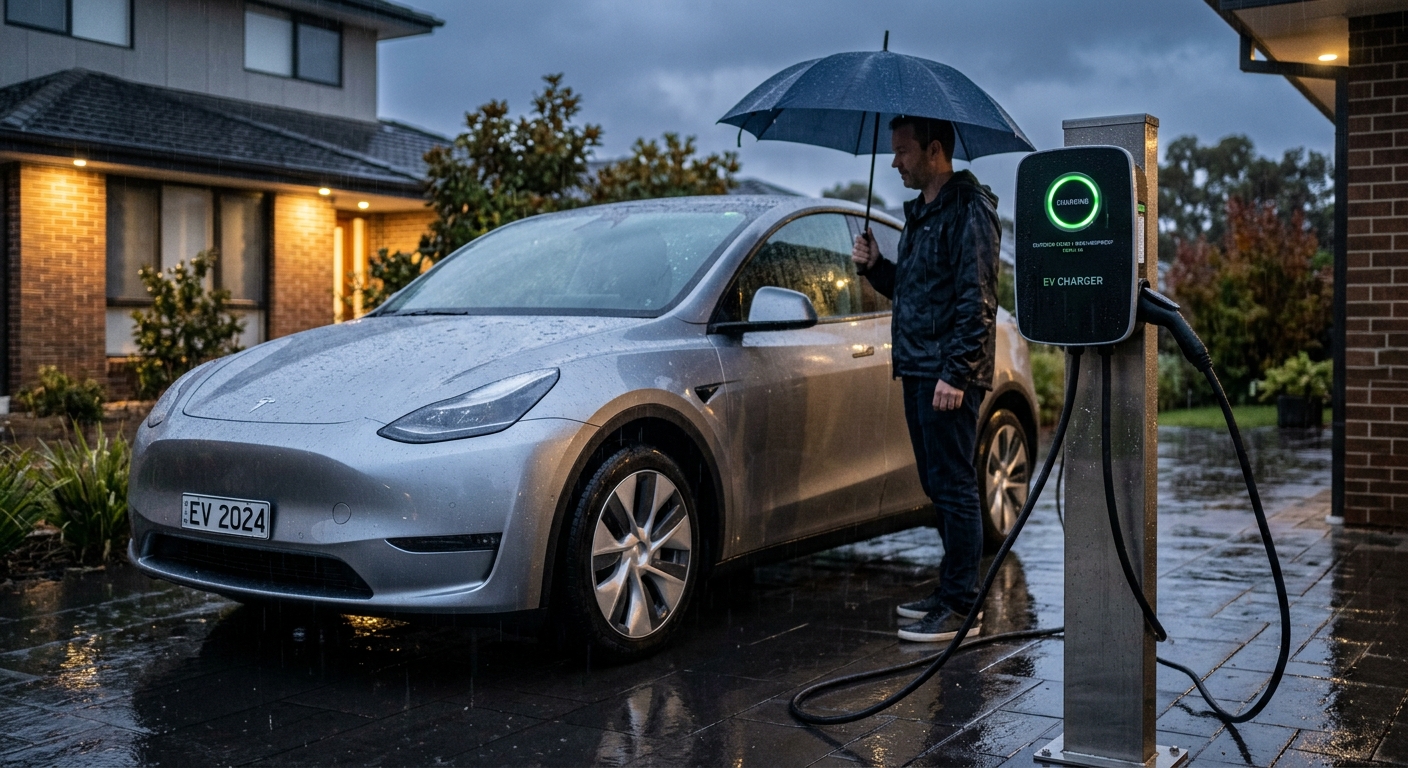
Installing an outdoor Level 2 electric vehicle (EV) charger on a driveway wall, carport, or dedicated mounting pedestal gives drivers the freedom to charge without needing an enclosed garage. Operating on a 240-volt single-phase branch circuit, an outdoor wallbox restores 20 to 44 miles of range per hour while your vehicle is parked overnight. However, as heavy downpours, snowstorms, and high humidity approach, new EV owners frequently ask: Can I leave my EV charger outside in the rain?
The short answer is: yes, you can leave a certified EV charger outside in the rain because outdoor-rated wallboxes (certified to NEMA 3R, NEMA 4, or IP65+ standards) are specifically engineered to be weatherproof, fully sealed, and safe from water exposure.
Electric vehicle charging infrastructure is designed from the ground up with multi-layered electrical safety, automated software safety handshakes, and ground fault protection, ensuring that plugging in during a heavy rainstorm is completely safe.
For complete hardware reviews, installer guides, and panel load calculators, visit EV Charger Advisor.
1. How Outdoor EV Chargers Safely Handle Rain & Water Exposure
Plugging a high-voltage cable into a car during a rainstorm might seem counterintuitive, but several engineering layers protect both the user and the vehicle:
A. Weatherproof Enclosure Ratings (NEMA 3R / NEMA 4 & IP65)
Outdoor EV wallboxes are housed in sealed, corrosion-resistant enclosures.
-
NEMA 3R / NEMA 4 Ratings: North American standards guaranteeing protection against windblown rain, sleet, snow, ice formation, and water jets.
-
IP65 / IP67 Ingress Ratings: International standards certifying that internal electronics are totally dust-tight and protected against powerful water jets or short-term water submersion.
B. The Digital Safety Handshake (Pilot Pin Signal)
The charging handle and cable do not carry live electrical current while hanging on the wall or when initially held in your hand. Under SAE J1772 and NACS (SAE J3400) standards, the wallbox uses a low-voltage digital signal (control pilot pin) to verify that the connector is fully seated and latched inside the vehicle’s charging port. High-voltage power flows only after a watertight seal is established.
C. Ground Fault Circuit Interruption (GFCI / PEN Fault Protection)
Per NEC Article 625 regulations, outdoor chargers include integrated CCID (Charge Circuit Interrupting Device) sensors. If water penetrates a damaged terminal or a current imbalance occurs, the system cuts off power within milliseconds—far faster than a human reaction time.
To learn more about how charger power levels and wire sizes compare, check out our guide on EV charging types.
2. Best Practices for Outdoor Rain Protection
While outdoor wallboxes are built to withstand severe weather, following these four maintenance habits preserves your charger’s longevity:
-
Always Dock the Handle in the Holster: Never leave the charging nozzle laying face-up in dirt or standing puddles on the ground. Store the handle inside its downward-facing holster to prevent rain, leaves, and dirt from clogging the terminal pins.
-
Hardwire Outdoor Installations: Direct hardwiring into a weatherproof junction box is superior to outdoor plug-in (NEMA 14-50) outlets. Hardwiring eliminates moisture degradation at wall sockets and avoids GFCI nuisance tripping.
-
Inspect Cable Insulation Periodically: Check your charging cable regularly for cuts, cracks, or outer jacket fraying caused by accidental vehicle run-overs or UV wear. Damaged cables must be replaced immediately.
-
Avoid Submerged Equipment: While chargers handle falling rain effortlessly, standard wallboxes are not designed to operate fully submerged under standing floodwaters.
To explore Wi-Fi-enabled smart wallboxes built with weather-resistant housings, read our guide on smart chargers.
Step-by-Step Mathematical Example: Circuit Thermal Loss in Outdoor Cable Runs
When placing an EV charger outdoors at a distance from the main electrical panel (e.g., across a 75-foot driveway run), long cable paths encounter small resistance losses ($R$). Under NEC recommendations, circuit voltage drop ($\Delta V$) should stay under 3% to prevent heat generation in wet conduit environments.
Let us calculate the voltage drop for a 40-Amp continuous charger ($240\text{V}$ single-phase supply) running 75 feet ($22.86\text{ m}$) using #6 AWG Copper Conductors ($R = 0.000491 \Omega/\text{ft}$).
Given Parameters:
-
Continuous Current ($I$): $40 \text{ Amps}$
-
Supply Voltage ($V$): $240 \text{ Volts}$
-
One-Way Distance ($L$): $75 \text{ feet}$
-
Conductor Resistance ($R_{\text{wire}}$): $0.000491 \Omega \text{ per foot}$
Calculation 1: Voltage Drop ($\Delta V$) Math
For a single-phase $240\text{V}$ circuit ($2 \times L = 150\text{ ft}$ total conductor path):
Calculation 2: Percentage Voltage Drop (%)
Result Breakdown: A 1.23% voltage drop stays well below the 3% maximum threshold limit, confirming that a 75-foot outdoor cable run using #6 AWG copper wire operates at optimal efficiency without thermal overheating during heavy rains.
Comparison Table: Outdoor Ingress Protection (IP) & NEMA Ratings
| Protection Level | Environmental Capability | Suitable for Outdoor Rain? |
| IP54 | Splash-proof & dust protected | Moderate rain (Carport recommended) |
| NEMA 3R / IP65 | Heavy rain, sleet & water jet protected | Yes (Standard Outdoor Wallbox) |
| NEMA 4 / IP67 | Washdown, heavy storms & temporary immersion | Yes (Extreme Weather Protection) |
| Indoor Rated | Zero moisture seal | No (Garage Use Only) |
Summary & Key Takeaways
-
100% Weatherproof: Certified outdoor EV chargers (NEMA 3R, NEMA 4, or IP65+) are specifically engineered to withstand heavy rain, snow, and extreme temperatures.
-
No Power Until Latched: High-voltage electricity flows only after a dry, sealed digital handshake is established between the charger and the car.
-
Dock the Connector Handle: Always insert the connector handle into its holster when not in use to keep rain and dirt out of the pin contacts.
-
Hardwiring Is Superior: Direct hardwiring into weatherproof conduit eliminates socket moisture issues and prevents breaker trips.













Leave a Reply