
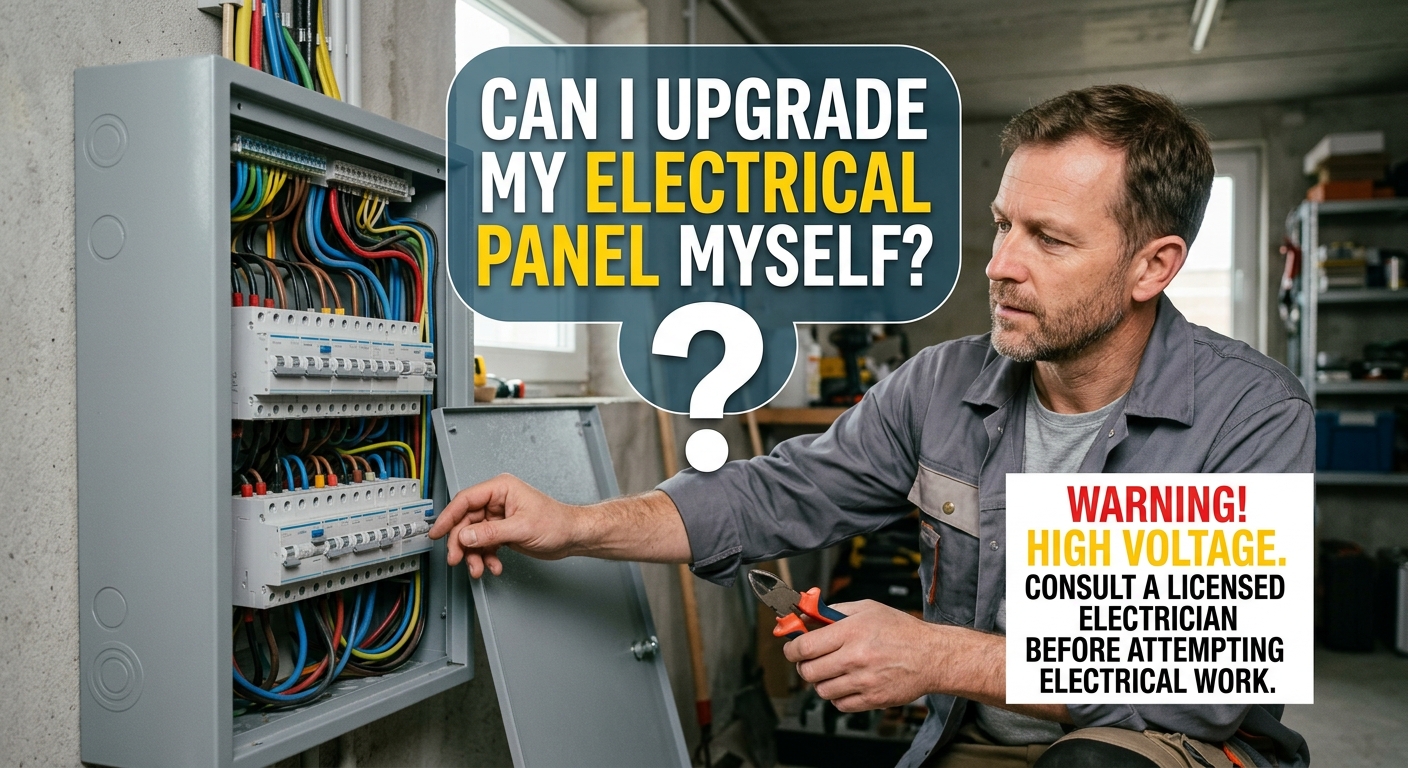
Upgrading your home’s main breaker box—whether moving from an outdated 100-amp panel to a modern 200-amp service or adding subpanels to accommodate heavy continuous loads like Level 2 EV chargers—is one of the most critical electrical improvements you can make. However, when evaluating contractor quotes and labor costs, handy homeowners frequently ask: Can I upgrade my electrical panel myself?
The short answer is: no, upgrading an electrical panel yourself is strongly discouraged, highly dangerous, and in most jurisdictions, explicitly illegal without a master electrician’s license.
Unlike running a simple 120V interior light switch, replacing a main service entrance panel requires working directly adjacent to unfused, live utility lines carrying fatal levels of electric current. Understanding the extreme safety risks, municipal permit restrictions, utility company power-down requirements, and insurance consequences explains why this job must be left to licensed professionals.
For complete panel load calculators, EV infrastructure guides, and safety standards, visit EV Charger Advisor.
1. Why DIY Main Panel Upgrades Are Dangerously High-Risk
Replacing a main circuit breaker panel is fundamentally different from standard branch circuit wiring inside your home. The core hazards stem from the physical connection to the grid:
A. Working Ahead of the Main Breaker (No Shutdown Switch)
When you turn off the main breaker inside your current panel, it de-energizes the individual branch breakers below it. However, the main service conductors coming from the utility meter remain 100% energized ($240\text{V}$ at $100\text{A} – 200\text{A}+$ continuous grid capacity). Touching these live main lugs with a tool or hand results in immediate severe arc blast, catastrophic arc flash burns, or electrocution.
B. Utility Service Disconnect & Lockout Requirements
To safely work on a main panel, utility power must be physically disconnected at the street transformer or power pole. Power companies will not disconnect service for an unlicensed homeowner. They require an approved electrical permit issued to a licensed, bonded, and insured electrical contractor before pulling the meter or scheduling a drop disconnection.
C. $I^2R$ Arc Flash & Thermal Hazard Risks
Loose terminal connections or improperly torqued lug screws on high-amperage panel feeders create extreme resistance heating ($P = I^2R$). Under continuous high-power loads (such as running an EV charger, central HVAC, or electric water heater), poorly landed cables melt busbars, destroy breaker enclosures, and trigger immediate house fires.
To learn more about how charger power levels and wire sizes compare, check out our guide on EV charging types.
Step-by-Step Mathematical Example: The Physics of Arc Flash Power
To understand why live main utility lines are fatal, let us calculate the available short-circuit power ($\text{Watts}$) generated during an accidental tool short on an energized 240V utility feeder lug with a short-circuit fault current ($I_{\text{sc}}$) of 10,000 Amps.
Given Parameters:
-
Line Voltage ($V$): $240 \text{ Volts}$
-
Utility Short-Circuit Fault Current ($I_{\text{sc}}$): $10,000 \text{ Amps}$
Calculation: Instantaneous Arc Energy Output during a Short Circuit
Result Breakdown: Accidental bridging of live utility service lines produces over 2.4 Megawatts ($2,400\text{ kW}$) of instantaneous thermal energy in a fraction of a second. This explosive arc flash reaches temperatures exceeding $35,000^\circ\text{F}$ ($19,400^\circ\text{C}$)—hotter than the surface of the sun—instantaneously vaporizing copper conductors and causing fatal burns.
To explore Wi-Fi-enabled smart wallboxes that protect home distribution systems, read our guide on smart chargers.
2. Legal, Permitting & Insurance Consequences of DIY Installations
Skipping professional installation creates major legal and financial hazards:
-
Permit Denials & City Fines: Municipal building departments require detailed NEC Article 220 load calculations, official permit applications, and post-installation inspections by a certified municipal code official. Unpermitted panel replacements risk heavy municipal fines and red-tag shutdown orders.
-
Voided Homeowners Insurance Coverage: If an unpermitted, DIY-installed main panel causes an electrical fire, insurance underwriters will investigate the municipal permit record. Claims for property damage or total loss resulting from illegal, unlicensed work are routinely denied, leaving the homeowner fully liable.
-
Home Resale Blockers: During home buyer inspections, unpermitted panel modifications or code violations (such as improper wire sizing, missing AFCI/GFCI breakers, or grounding errors) must be completely torn out and re-installed by a licensed electrician at double the cost before title transfer can close.
Comparison Table: DIY Attempt vs. Licensed Professional Panel Upgrade
| Feature / Standard | DIY Installation Attempt | Licensed Master Electrician |
| Utility Disconnect Approval | Denied by Power Company | Official Utility Power-Down Arranged |
| Municipal Permitting | Illegal in most jurisdictions | Fully Permitted & Inspected |
| Arc Flash & Electrocution Risk | Extreme / Potentially Fatal | Mitigated via PPE & Utility Disconnect |
| NEC Load Calculation & Sizing | High risk of error | Guaranteed NEC Article 220 Compliance |
| Homeowners Insurance Validity | Voided for fire claims | 100% Covered & Compliant |
Summary & Key Takeaways
-
Extremely Dangerous: Main panel service lines remain live with fatal utility power even when your main breaker is switched off.
-
Requires Utility Disconnect: Power companies will not disconnect live service drops without an approved permit issued to a licensed electrician.
-
Voids Home Insurance: Unpermitted DIY panel work invalidates homeowners insurance coverage in the event of an electrical fire.
-
Hire a Licensed Specialist: Professional electricians ensure proper NEC Article 220 load sizing, precise torque specs, ground bonding, and official municipal permit sign-offs.













Leave a Reply