
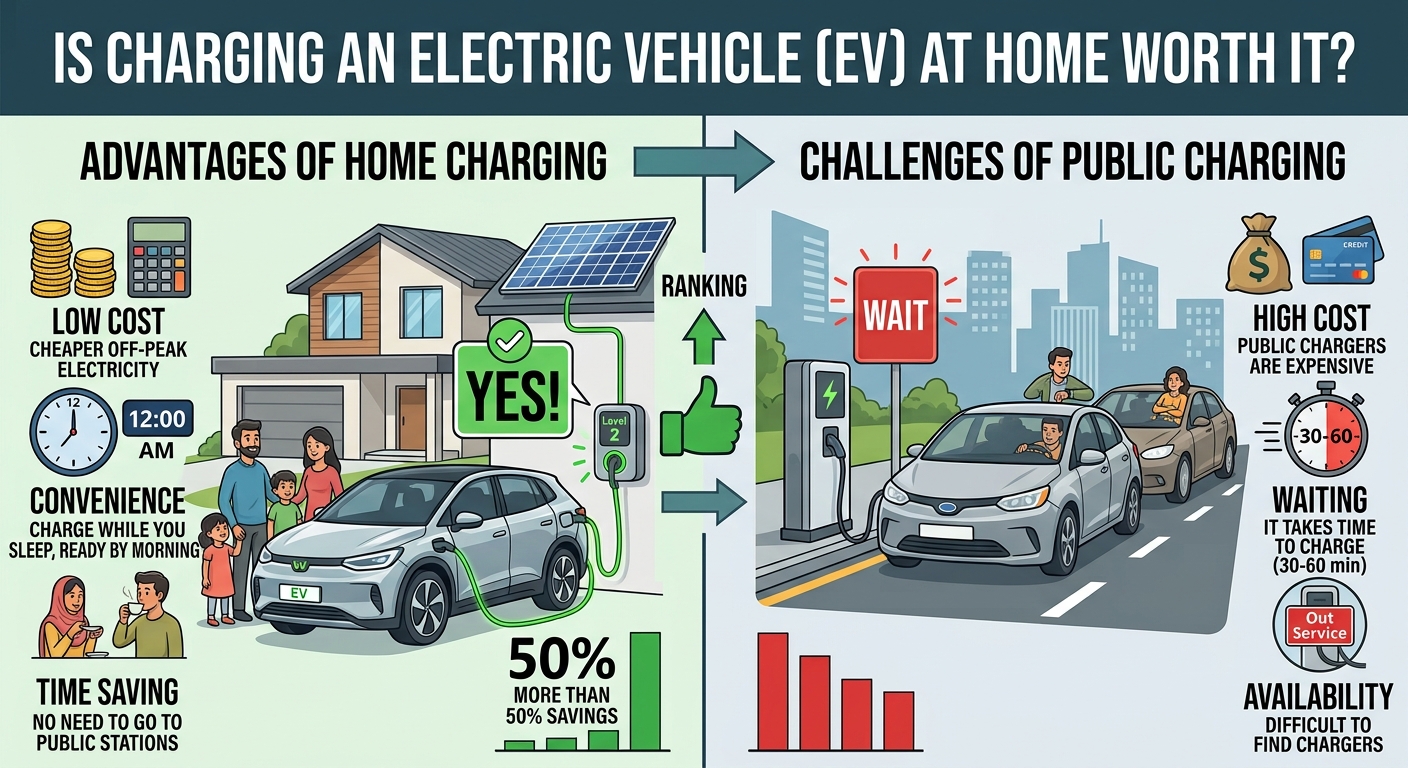
Switching from a gas-powered vehicle to an electric car promises significantly lower operating costs and a smoother driving experience. However, maximize those benefits relies on how and where you recharge your battery. While public fast-charging networks offer roadside convenience during long highway trips, new and prospective electric vehicle owners frequently ask: Is it worth charging an EV at home?
The short answer is: yes, charging an electric vehicle (EV) at home is almost always worth it for ultimate convenience and long-term cost savings, though the setup cost depends on your daily driving and local electricity rates.
In addition to eliminating trips to commercial charging stations, home charging allows you to take advantage of low residential off-peak electricity rates. This can cut your per-mile fuel costs by 50% to 80% compared to gasoline or public fast chargers.
For comprehensive hardware reviews, load calculators, and installer guides, visit EV Charger Advisor.
1. Cost Breakdown: Home Charging vs. Public Fast Charging vs. Gasoline
The financial advantage of home EV charging comes down to the price per unit of energy. Gasoline is priced per gallon, public chargers often bill per kilowatt-hour ($\text{kWh}$) at premium rates, and home electricity is billed at standard residential utility tariffs.
A. Residential Electricity Rates ($0.10 – $0.18 per kWh)
Charging at home overnight using standard or off-peak utility tariffs typically costs $0.10 to $0.18 per kWh across most regions. This means fully charging a $60\text{ kWh}$ battery pack costs roughly $6.00 to $10.80.
B. Commercial Level 3 DC Fast Charging Rates ($0.35 – $0.55 per kWh)
Public fast chargers (such as Tesla Superchargers or Electrify America) include heavy commercial demand fees and hardware maintenance markups, costing $0.35 to $0.55 per kWh. Fully recharging that same $60\text{ kWh}$ battery at a public fast charger costs $21.00 to $33.00.
C. Gasoline Fuel Costs ($3.50 – $4.50 per Gallon)
An average internal combustion engine (ICE) car achieving $30\text{ mpg}$ requires $10\text{ gallons}$ of fuel to travel $300\text{ miles}$, costing $35.00 to $45.00 per fill-up.
To learn more about how charger power levels and wire sizes compare, check out our guide on EV charging types.
Step-by-Step Mathematical Example: Annual Cost Savings & Return on Investment (ROI)
Let us perform a mathematical financial comparison for a driver commuting 12,000 miles per year in a typical EV achieving an efficiency rating of 3.3 miles per kWh ($0.303\text{ kWh per mile}$).
Given Parameters:
-
Annual Driving Distance: $12,000 \text{ Miles}$
-
EV Energy Consumption: $\frac{12,000 \text{ miles}}{3.3 \text{ miles/kWh}} = \mathbf{3,636.36 \text{ kWh per year}}$
-
Home Off-Peak Rate ($C_{\text{home}}$): $\$0.13 \text{ / kWh}$
-
Public Fast Charge Rate ($C_{\text{public}}$): $\$0.42 \text{ / kWh}$
-
Gasoline Benchmark ($30\text{ MPG}$ @ $\$3.80\text{/gal}$): $\$0.1267 \text{ / mile}$
-
Home Level 2 Hardware & Install Cost: $\$1,500$
Calculation 1: Annual Home Charging Cost
Calculation 2: Annual Public Charging Cost
Calculation 3: Annual Gasoline Vehicle Fuel Cost
Calculation 4: Payback Period / ROI on a $1,500 Level 2 Home Setup
Result Breakdown: Charging at home saves over $1,040 per year compared to driving a gas car and over $1,050 per year compared to relying on public fast chargers. The initial $1,500 Level 2 home installation pays for itself in just 17 months.
To explore Wi-Fi-enabled smart wallboxes that support automated off-peak scheduling, read our guide on smart chargers.
2. Non-Financial Benefits: Why Home Charging Is Unmatched
Beyond raw cost savings, home charging provides key lifestyle advantages:
A. Convenience: Wake Up to a “Full Tank” Every Day
Plugging in your car at night takes less than 5 seconds. You eliminate detours to gas stations or public charging plazas, starting every morning with a full battery.
B. Enhanced Battery Longevity
Frequent use of high-power Level 3 DC fast chargers subjects EV battery cells to high thermal heat loads, accelerating chemical degradation over time. Gentle overnight Level 2 AC charging ($7.6\text{ kW} – 11.5\text{ kW}$) preserves battery health and long-term capacity.
C. Maximizing Solar Panel Synergy
If your home features rooftop solar panels, charging your EV during peak solar generation hours allows you to run your vehicle on 100% clean energy.
Comparison Table: Home Charging vs. Public Charging vs. Gasoline
| Feature / Metric | Level 2 Home Charger | Commercial Public Fast Charger | Standard Gas Station |
| Fuel Cost per 100 Miles | $3.90 – $5.50 | $12.60 – $18.00 | $12.00 – $15.00 |
| Annual Fueling Cost (12k miles) | ~$470 | ~$1,520 | ~$1,520 |
| Convenience Factor | Extreme (Charge while sleeping) | Moderate (Requires 20-45 min wait) | High (5-minute stop) |
| Long-Term Battery Impact | Gentle / Optimal | Higher thermal wear | N/A |
| Upfront Setup Investment | $800 – $2,500 (One-time) | $0 | $0 |
Summary & Key Takeaways
-
Massive Financial Savings: Home EV charging cuts annual fueling expenses by 65% to 70% compared to gasoline or commercial public chargers.
-
Rapid ROI: A standard $1,500 Level 2 installation pays for itself in roughly 1.5 years through fuel savings alone.
-
Unmatched Convenience: Eliminates time spent at gas stations or public charging plazas by refueling overnight while you sleep.
-
Protects Battery Health: Low-power Level 2 AC charging minimizes cell heat stress, maximizing battery life.













Leave a Reply