
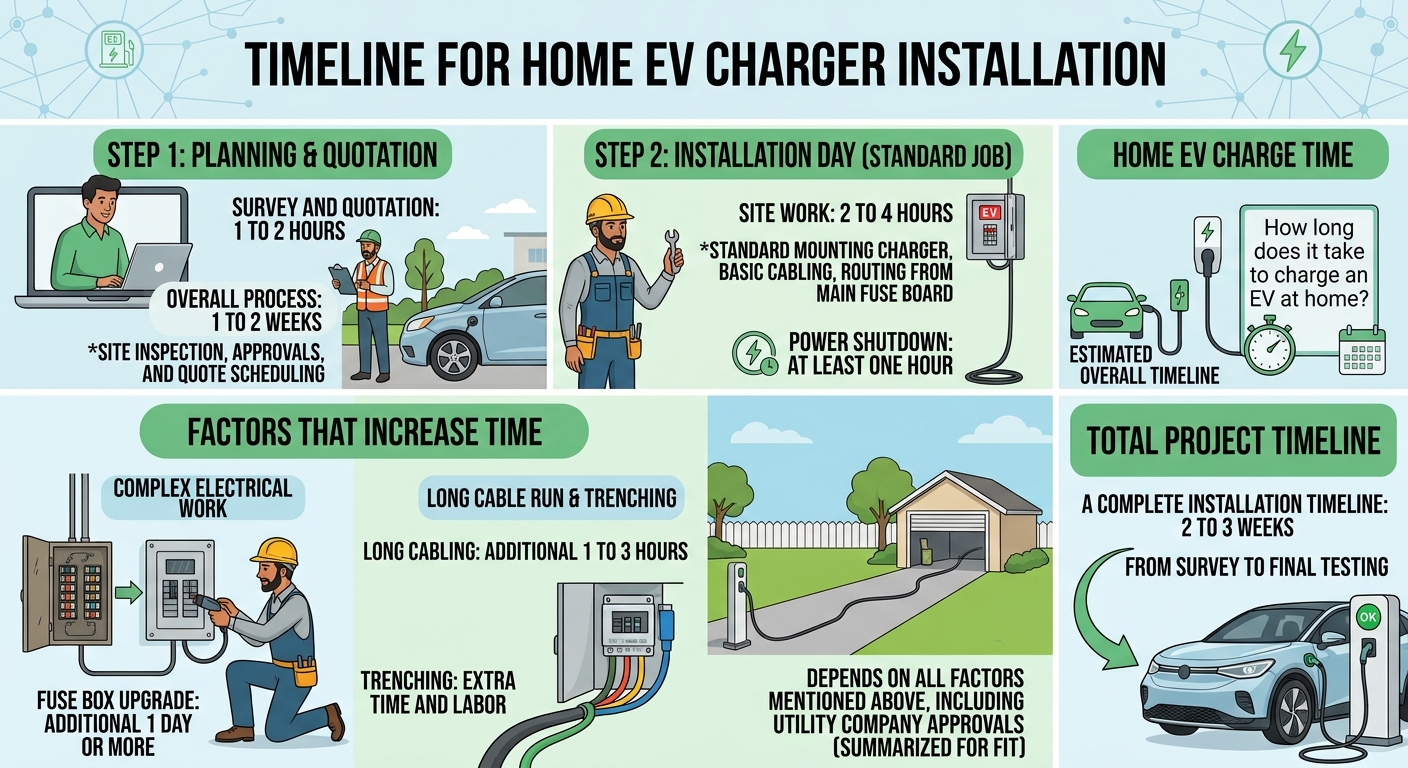
Installing a dedicated Level 2 home electric vehicle (EV) charger is the best way to ensure rapid, reliable overnight charging. Operating on a 240-volt single-phase branch circuit, a Level 2 wallbox adds 20 to 44 miles of driving range per hour—eliminating the long wait times of standard Level 1 trickle chargers. However, when scheduling an electrician, homeowners frequently ask: How long does it take to install an EV charger at your house?
The short answer is: installing a home EV charger typically takes 2 to 4 hours for a straightforward setup on-site, though complex installations or electrical upgrades can span 6 to 8 hours or require a multi-day timeline.
Understanding how electrical panel proximity, cable routing, panel service upgrades, and smart commissioning impact your schedule ensures you can prepare your home efficiently for installation day.
For complete load calculators, hardware reviews, and installation guides, visit EV Charger Advisor.
1. On-Site Installation Time: Standard vs. Complex Setups
The actual physical labor required to install a Level 2 wallbox varies depending on your home’s existing electrical infrastructure and layout:
A. Standard Installation (2 to 4 Hours)
A standard setup occurs when:
-
Your main electrical panel has sufficient continuous capacity (NEC Article 220 compliance).
-
There is an open slot for a double-pole circuit breaker.
-
The wallbox is mounted in the garage or on an exterior wall within 10 to 20 feet of the main panel.
-
Work Involved: Mounting the wallbox, installing a double-pole breaker, running short surface-mounted conduit with heavy-gauge copper wire (#6 AWG THHN or Romex), torquing terminal lugs, and commissioning smart app features.
B. Extended or Complex Installation (4 to 8 Hours)
An installation takes longer when:
-
Long Cable Runs (50+ Feet): Routing conduit through finished walls, ceilings, crawlspaces, or across the garage.
-
Trenching for Detached Garages: Digging a trench to bury underground direct-burial cable or conduit.
-
Panel Upgrades or Subpanels: Upgrading an outdated 100A panel to 200A or adding a subpanel, which adds 3 to 5 hours of electrical labor alone.
-
Installing EVEMS / Smart Splitters: Adding dynamic load balancing hardware (CT clamps) to monitor main line power in real time.
To learn more about how charger power levels and wire sizes compare, check out our guide on EV charging types.
Step-by-Step Mathematical Example: Project Lead Time vs. On-Site Time
It is important to distinguish between on-site electrician installation hours and the overall total project timeline (from buying the charger to first charge).
Project Lead Time Timeline Breakdown:
Phase 1: Pre-Installation Planning & Permitting (3 to 10 Days)
-
Site Survey & Quote Approval: 2 to 4 Days
-
Municipal Permit Issuance (If Required): 2 to 7 Days
Phase 2: On-Site Electrician Installation (2 to 4 Hours)
-
Standard Labor Time ($H$): $3 \text{ Hours}$
-
Electrician Hourly Rate ($R$): $125 / \text{hr}$
Phase 3: Utility / Municipal Inspection Sign-Off (1 to 5 Days Post-Install)
-
Formal inspection approval for rebate compliance and homeowners insurance validity.
Result Breakdown: While the actual on-site installation work takes only 3 hours ($375 labor), the total end-to-end timeline from requesting a quote to passing final inspection usually spans 1 to 2 weeks.
Comparison Table: EV Charger Installation Scenarios & Timelines
| Installation Scenario | On-Site Labor Time | Core Work Required | Typical Total Cost Range |
| Basic Plug-In Setup | 1 – 2 Hours | Plug mobile connector into existing 240V NEMA 14-50 outlet | $200 – $500 |
| Standard Hardwired Install | 2 – 4 Hours | New 50A/60A circuit, short conduit run (< 20 ft) | $800 – $1,800 |
| Long Cable Run / Trenching | 4 – 6 Hours | 50+ ft conduit run or underground trenching to carport | $1,800 – $3,000 |
| Panel Service Upgrade (200A) | 6 – 8+ Hours | Full panel replacement, utility disconnect & rewire | $3,500 – $7,000+ |
Summary & Key Takeaways
-
2 to 4 Hours On-Site: Most standard home Level 2 EV charger installations take 2 to 4 hours from arrival to testing.
-
Upgrades Add Time: Panel upgrades, 100A service load management, or long cable runs through finished walls can extend installation to 6 to 8 hours.
-
End-to-End Timeline Is 1–2 Weeks: Account for permit pulling, site surveys, and inspector scheduling when planning your EV delivery date.
-
Prepare the Garage Area: Clear space around your electrical panel and charger mounting location prior to the installer’s arrival to prevent setup delays.













Leave a Reply