
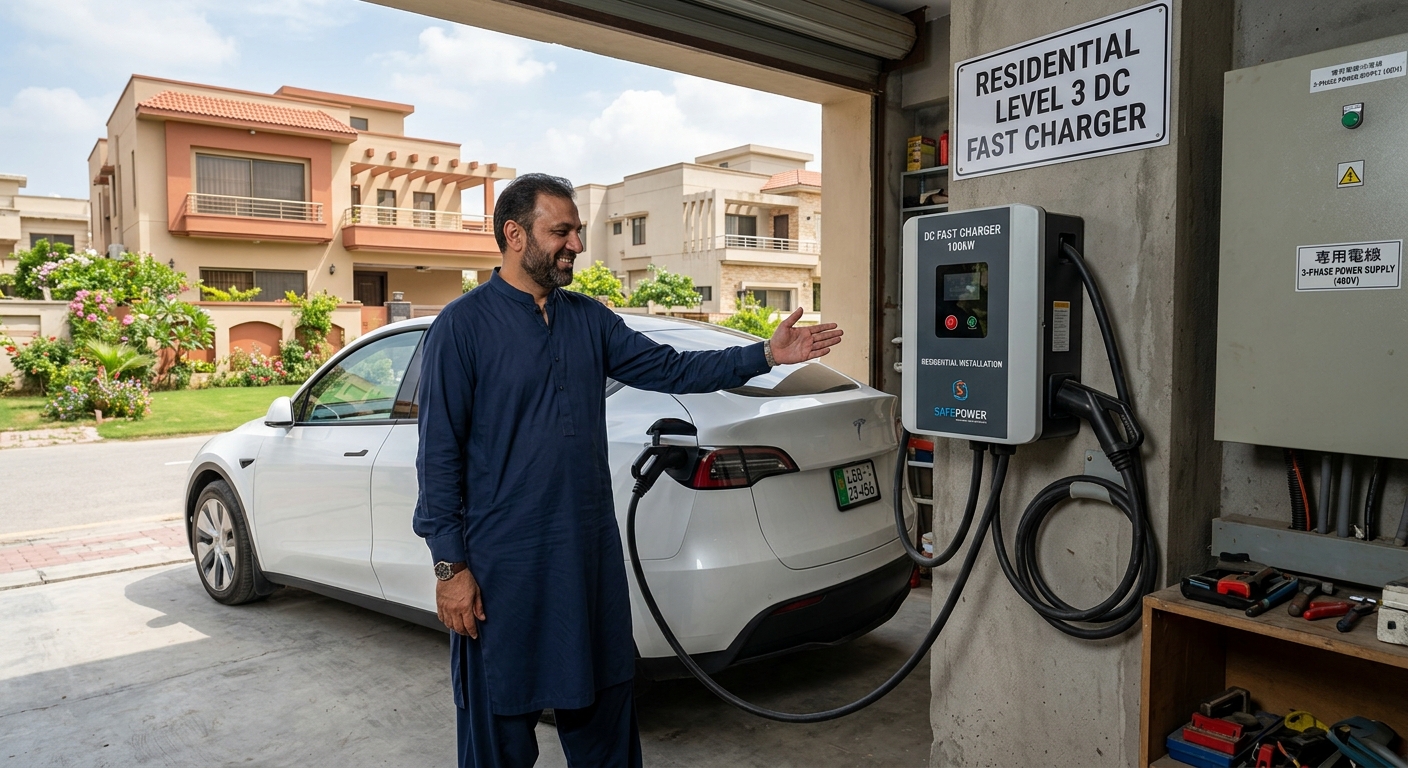
When making the switch to an electric vehicle, new EV owners are often amazed by the rapid charging speeds of commercial roadside stations. Known as Level 3 chargers (or DC Fast Chargers), these high-power commercial systems can replenish an electric car’s battery from 10% to 80% in as little as 15 to 30 minutes. Naturally, homeowners wanting maximum charging speed at home often ask: Can I install a Level 3 charger at my house?
The short answer is: no, you cannot realistically install a Level 3 (DC Fast) charger at a standard residential home.
While it is technically physically possible if someone possessed unlimited financial resources to rebuild local utility infrastructure, the overwhelming power requirements, three-phase commercial electrical grid needs, equipment costs ($50,000 to $150,000+), and severe utility service constraints make residential DC fast charging practically impossible.
Understanding why residential homes are restricted to Level 1 and Level 2 AC charging helps you optimize your home setup for maximum speed within residential code limits.
For complete hardware reviews, installer guides, and panel load calculators, visit EV Charger Advisor.
1. AC vs. DC: The Fundamental Power Supply Difference
To understand why Level 3 chargers cannot operate in residential neighborhoods, it helps to analyze how power flows into an electric vehicle:
Level 1 & Level 2 Home Charging (Alternating Current – AC)
Residential homes are supplied with single-phase Alternating Current (AC) electricity. When you plug a Level 1 ($120\text{V}$) or Level 2 ($240\text{V}$) charger into your car, the wallbox delivers raw AC power to the vehicle. The EV’s internal onboard AC-to-DC converter converts that AC electricity into Direct Current (DC) to store in the chemical battery pack.
Level 3 Commercial Charging (Direct Current – DC Fast Charging)
Level 3 chargers bypass the vehicle’s small onboard AC converter completely. Instead, a massive cabinet-sized external converter converts high-voltage AC electricity into high-voltage Direct Current (DC) inside the charger itself, pumping DC power directly into the battery terminals at extreme speeds ($50\text{ kW}$ to $350+\text{ kW}$).
To learn more about how charger power levels and wire sizes compare, check out our guide on EV charging types.
2. The Three Major Barriers to Residential Level 3 Installation
Why can’t standard residential homes support a Level 3 DC fast charger? The barriers fall into three distinct categories:
A. Single-Phase vs. Three-Phase Power Supply
Standard residential homes operate on single-phase $120\text{V} / 240\text{V}$ split-phase electrical service. Level 3 DC fast chargers require commercial three-phase $480\text{-Volt}$ AC power to convert massive amounts of energy efficiently. Electric utilities do not run 480V three-phase lines into residential residential zones.
B. Massive Amperage & Power Envelope Demands
A standard modern home has an electrical panel rated for $100\text{ Amps}$ to $200\text{ Amps}$ ($24\text{ kW}$ to $48\text{ kW}$ total potential power). Even the smallest entry-level commercial DC fast charger requires $50\text{ kW}$ to $60\text{ kW}$ ($200+\text{ Amps}$ at $480\text{V}$ three-phase). Operating a $150\text{ kW}$ DC fast charger would draw more electricity than three to four entire residential neighborhoods combined.
C. Prohibitive Capital & Utility Costs
Buying a commercial DC fast charger cabinet costs between $30,000 and $100,000+ for the hardware alone. Adding utility step-up transformers, commercial utility line extension work, trenching, and municipal permitting brings total installation costs to $80,000–$200,000+, alongside costly commercial demand charges from your local utility company.
To explore Wi-Fi-enabled smart wallboxes designed for high-speed residential charging, read our guide on smart chargers.
Step-by-Step Mathematical Example: Power Envelope Comparison
Let us compare the electrical power demand and amperage draw of a maximum-output Residential Hardwired Level 2 Wallbox ($11.52\text{ kW}$) versus an entry-level Commercial Level 3 DC Fast Charger ($50\text{ kW}$).
Given Parameters:
-
Residential Level 2 Voltage: $240 \text{ Volts (Single-Phase AC)}$
-
Commercial Level 3 Voltage: $480 \text{ Volts (Three-Phase AC)}$
Calculation 1: Residential Level 2 Power & Amperage (48A Continuous Output)
Calculation 2: Level 3 DC Fast Charger Amperage Demand (50 kW Output @ 480V Three-Phase)
Using the three-phase power formula ($\text{Power} = \sqrt{3} \times V \times I \times \text{Power Factor}$ assuming PF = 0.95):
Result Breakdown: Running even a small $50\text{ kW}$ DC fast charger on single-phase $240\text{V}$ power requires over $208\text{ Amps}$ of continuous current ($260\text{A}$ breaker)—consuming more than $100\%$ of a standard $200\text{-amp}$ home panel’s maximum continuous rating ($160\text{A}$) without running a single light bulb, refrigerator, or air conditioner.
Comparison Table: Residential Level 2 vs. Commercial Level 3 Charger
| Feature | Residential Level 2 Wallbox | Commercial Level 3 DC Fast Charger |
| Power Supply Required | Single-Phase $240\text{V AC}$ | Three-Phase $480\text{V AC}$ |
| Power Output Range | $3.8 \text{ kW} – 11.5 \text{ kW}$ | $50 \text{ kW} – 350+ \text{ kW}$ |
| Typical Charge Time (10-80%) | $6 – 10 \text{ Hours}$ | $15 – 30 \text{ Minutes}$ |
| Hardware & Install Cost | $800 – $2,000 Total | $80,000 – $200,000+ Total |
| Home Feasibility | 100% Feasible for standard homes | Unrealistic / Impractical for residential |
Summary & Key Takeaways
-
Unrealistic for Standard Homes: You cannot realistically install a Level 3 DC fast charger at a residential home due to severe grid, three-phase power, and financial constraints.
-
Requires Commercial Grid Service: Level 3 chargers require $480\text{V}$ three-phase commercial electricity, which is not supplied to residential residential neighborhoods.
-
Exceeds Residential Panel Margins: Even an entry-level $50\text{ kW}$ DC charger draws more continuous power ($208\text{A}$ at $240\text{V}$) than a full $200\text{-amp}$ main panel can safely deliver.
-
Level 2 Is the Ultimate Home Solution: Hardwiring a Level 2 wallbox ($48\text{A} / 11.52\text{ kW}$) delivers up to $44\text{ miles of range per hour}$, easily fully recharging any EV overnight for a fraction of the cost.













Leave a Reply