
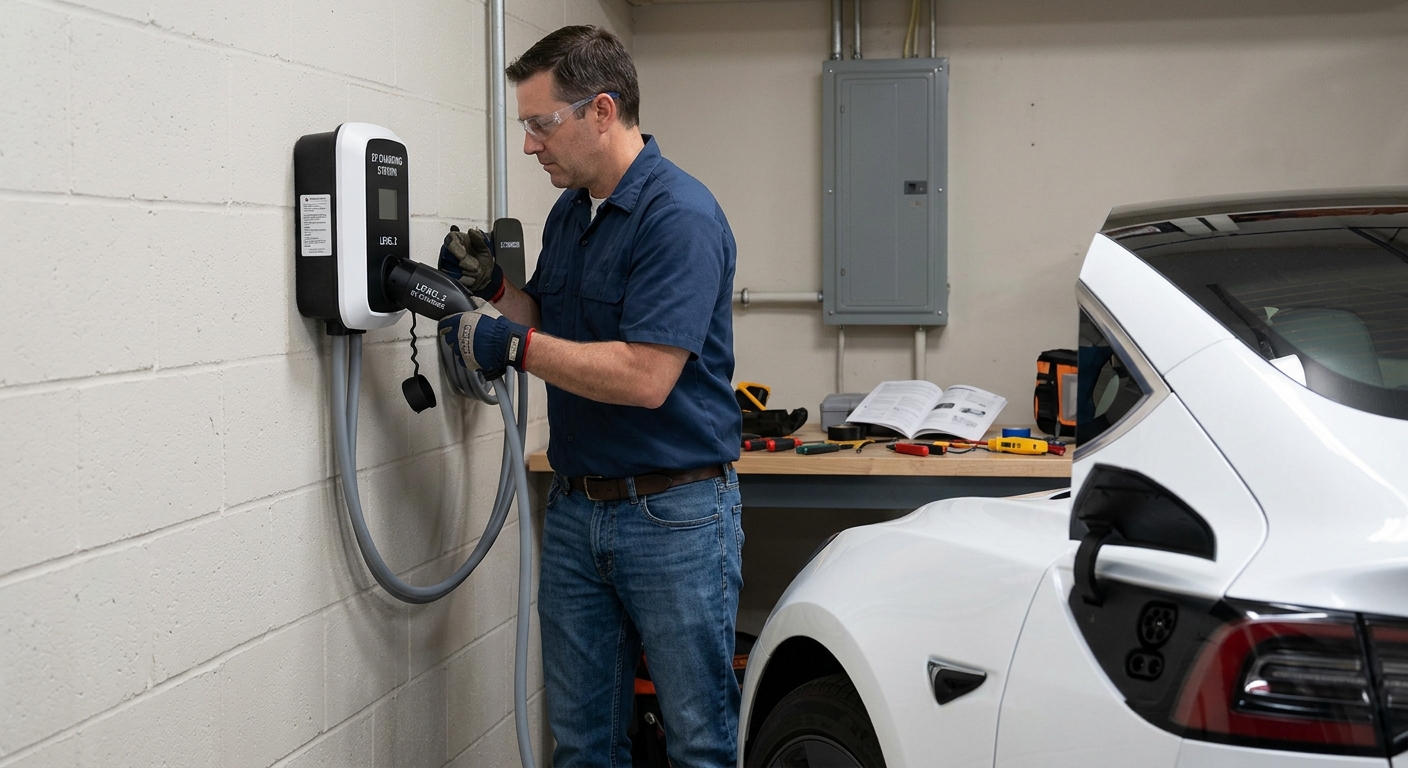
When purchasing a Level 2 electric vehicle (EV) charger for home use, many DIY enthusiasts and handy homeowners look at the wallbox unit and wonder if they can tackle the setup themselves to save on labor costs. Operating on a high-voltage 240-volt circuit, Level 2 chargers require dedicated branch lines and heavy-duty circuit breakers. Homeowners frequently ask: Can you install a Level 2 EV charger yourself?
The short answer is: yes, you can physically mount the charger enclosure and handle minor prep work yourself, but the 240-volt electrical connections and work inside your main breaker panel should be done by a licensed electrician.
While mounting a hardwired wallbox or plugging a mobile connector into a 240V outlet looks straightforward, navigating the National Electrical Code (NEC), pulling heavy-gauge copper wires, torquing terminal lugs correctly, and obtaining municipal permits require professional electrical expertise to prevent severe shock hazards and electrical fires.
For complete load calculators, wiring charts, and hardware reviews, visit EV Charger Advisor.
1. What You Can Safely Do Yourself (DIY Prep Work)
If you want to save money on your installation project, you can handle several non-electrical preparation tasks before the electrician arrives:
A. Wall Mounting & Enclosure Placement
You can easily use a level, drill, and wall anchors to mount your EV charger wallbox securely to a stud or masonry garage wall at the optimal height (typically 48 inches above the floor per ADA guidelines).
B. Conduit Routing & Cable Path Planning
If local codes permit homeowner labor, you can pre-run physical PVC or EMT metal conduit from your main electrical panel location along the garage ceiling or wall to where the charger is mounted, saving the electrician hours of manual labor.
C. Vehicle Compatibility & Hardware Selection
You can research and purchase the ideal Level 2 charging hardware (such as a Tesla Wall Connector, ChargePoint Home Flex, or Grizzl-E) matching your vehicle’s maximum acceptance rate.
To learn more about how charger power levels and wire sizes compare, check out our guide on EV charging types.
2. What Strictly Requires a Licensed Electrician
Working inside a residential electrical panel and terminating high-amperage 240V circuits carries extreme risks of electrocution, arc flashes, and catastrophic home fires. The following tasks must be performed by a licensed professional:
A. NEC Article 220 Load Calculations
Before installing any breaker, an electrician must calculate your home’s total electrical demand to ensure your main panel has enough continuous capacity headroom to handle an EV charger without overloading the service busbars.
B. Main Panel & Breaker Work
Installing a double-pole 40A, 50A, or 60A circuit breaker requires working inside a live or service-disconnected panel box containing exposed busbars carrying up to 240 Volts and 200+ Amps of available short-circuit current.
C. Professional Torque Calibrations ($I^2R$ Heat Prevention)
Loose electrical connections create high resistance, leading to severe $I^2R$ thermal heating ($P = I^2R$), melted lugs, and electrical fires. Licensed electricians use calibrated torque screwdrivers to tighten circuit breaker and charger terminal screws precisely to manufacturer-specified inch-pounds.
To explore Wi-Fi-enabled smart chargers that support dynamic energy management, read our guide on smart chargers.
Step-by-Step Mathematical Example: Project Cost & Risk Analysis
Let us analyze the financial and safety trade-offs of attempting a full DIY installation versus hiring a licensed electrician for a hardwired 48A Level 2 EV charging setup ($11.52\text{ kW}$ on a 60A breaker).
Given Project Parameters:
-
EV Wallbox Hardware Cost: $600
-
Materials (Wire, Conduit, Breaker, Fittings): $150
-
Professional Electrician Labor & Permit Fee: $500 – $900
-
Total Professional Turnkey Cost: $1,250 – $1,650
Calculation 1: Potential Costs of DIY Installation Errors
Calculation 2: Insurance & Warranty Implications
-
Homeowners Insurance Coverage: Most standard insurance policies contain exclusions denying claims for fire or property damage caused by unpermitted, DIY electrical work performed without a municipal inspection sign-off.
-
Manufacturer Warranty: Brands like Tesla, ChargePoint, and Emporia void their product warranties if the charging equipment is not installed by a licensed electrician or certified professional.
Result Breakdown: While a DIY installation saves roughly $500 in upfront labor costs, the risks of code non-compliance, voided warranties, insurance claim denials, and fatal electrical hazards vastly outweigh the short-term savings.
Comparison Table: DIY Prep vs. Professional Electrician Scope
| Installation Phase | Who Can Do It? | Safety & Code Requirements |
| Selecting & Buying Charger | Homeowner / DIY | Choose UL-listed hardware matching EV specs |
| Physical Wall Mounting | Homeowner / DIY | Ensure solid stud anchoring & correct height |
| NEC Load Calculations | Licensed Electrician Only | Mandated by NEC Article 220 |
| Main Panel Breaker Install | Licensed Electrician Only | Requires PPE, dead-front removal, & torque tools |
| Running 240V Branch Circuit | Electrician or Advanced DIY | Must comply with THHN/Romex ampacity & conduit rules |
| Permit & Inspection Sign-Off | Licensed Electrician | Mandatory for legal compliance and insurance validity |
Summary & Key Takeaways
-
Split the Work Safely: You can mount the charger and plan conduit runs yourself, but leave all electrical connections to the professionals.
-
240V Power Is Dangerous: Working inside a main panel carries severe electrocution and arc flash risks that require specialized training and tools.
-
Torque Specifications Matter: Professional electricians use calibrated torque tools to prevent loose terminal connections from causing electrical fires.
-
Protect Your Insurance & Warranty: Hiring a licensed electrician ensures your installation passes municipal inspection, keeping your homeowners insurance and equipment warranties fully valid.













Leave a Reply